

Campus News
Being fair: how to manage staff issues and behaviour
May 9th, 2016
The ‘Being fair: how to manage staff issues and behaviour’ workshop is open to all staff, and for anyone who manages people and wants to do so fairly and with consistency. You could, for example be leading a research team, managing an administrative team and line managing staff.
9.30am-4.30pm, Thursday 9 June
King’s Meadow Campus
This workshop covers a full range of issues including:
- types of problem people and motivations for their behaviours
- a leadership model for dealing with problem people
- managing difficult situation s where conflict or bullying are involved, including when to confront staff
- having difficult conversations around performance
- applying equal opportunities (including flexible working and sick leave) policies fairly
To reserve a place please visit the Central Short Courses website.
Tags: Central Short Courses, HR, human resources, Professional Development, training, workshop
Posted in News, People | Comments Off on Being fair: how to manage staff issues and behaviour
Update from the Vice-Chancellor (updated 9 May)
May 9th, 2016
A message from Professor Sir David Greenaway, Vice-Chancellor of The University of Nottingham.
Dear colleagues,
My annual round of All Staff Forums, which has always offered an opportunity for us to discuss change, is scheduled later than in the last few years. That being so, I thought I should write on our changing environment, issues we will no doubt pick up on again in upcoming Forums.
Significant changes are taking place in our University this year. These are in response to changes in the higher education environment more generally, and necessary to help sustain our University as a successful, broadly-based and modern institution; offering excellence in teaching and research.
Key changes in the wider environment include: changing student expectations (embracing how students learn as well as what they learn); ever more pressing competition (domestically and internationally) to recruit high quality students and staff; and increasingly fierce competition to secure funding to sustain our research activity at levels appropriate for a University of our standing.
I believe that accelerating changes in technology, increased internationalisation, and further regulatory intervention will only intensify these pressures.
As we embark on planning and budgeting for the next financial year and beyond, I thought it would be helpful to set out the context in which current planning decisions are being made. I would also like to update you on progress in key areas, major projects and new investment.
Responding to change
When developing Strategy 2020 we emphasized that, overall the University is in a strong position globally. Over the last two decades we have increased our student population, invested in priority areas of research, enhanced our estate and facilities in Nottingham, and established two international campuses in the continent which will be the world’s centre of gravity over the next century.
Strategy 2020 embodies real ambition. But we were very clear: to take our University to the next level will require investment in our future. In a world of shrinking public funding more resources will need to be generated from sustainable growth, income diversification, and of course ensuring we are doing what we do efficiently.
For these reasons we have reviewed how we are delivering on our Strategy 2020 objectives. Faculty-level evaluations led by Faculty Pro-Vice-Chancellors (PVCs) have been key to this process.
At a broad level, the outcomes of this review include plans to increase our international student numbers, whilst largely maintaining our UK student population. To remain competitive it is obviously vital we keep under review the courses we offer, to ensure they are fit for the future and meeting the needs of students. This is why, following carefully researched cases from the relevant Faculties, we are investing in new staff and facilities and offering new degrees in emerging areas such as aerospace engineering and food process engineering; and introducing an Arts Foundation course. At the same time certain areas are shrinking in response to the decline in numbers of A-level candidates – for example those wishing to study languages.
There have always been ebbs and flows in subject provision. However, tides change more rapidly now and we have to respond to changing patterns of student behaviour. This is one of the factors that led us to undertake a Portfolio Review in the Faculty of Arts, which began in February 2015 and is now at consultation stage. We have seen a trend of falling numbers nationally and this feeds through to applications. To maintain quality, and ensure sustainability, we have to make changes.
While some universities have closed entire language departments this is not a route we have chosen. A key outcome of the Arts Portfolio Review is to safeguard all existing disciplines in the Faculty. No Departments are closing.
I should also note that I asked our new PVC for Research and Knowledge Exchange, Dame Jessica Corner, to evaluate our Research Strategy with our Faculty PVCs to identify priorities for future investment. That work is now well underway.
Continuing to invest in core activity
The core principles stretching back to the foundation of our University – set out again last year in Strategy 2020 – include putting students at the heart of the institution, valuing our staff and supporting them to excel, focusing on quality and taking an international outlook across all activities.
Staying true to those principles means ongoing investment in the learning environment. And that means building a University which is flexible enough to adapt to a changing world; a University which is financially sustainable in an ever more challenging funding landscape.
So, we have continued to make significant investments in core academic activity, including promoting current staff and appointing new staff. Recent examples include: appointments in Social Sciences as part of the Q-Step Programme; new Chairs in Sustainable Chemistry; new promotions across all Faculties, and other appointments supporting new course developments and research initiatives.
We have also continued to invest in our infrastructure, for which there is comparatively little public funding. We have therefore to generate a surplus each year to help fund this. In truth though we cannot support investment on any scale unless we find others – partners, lenders, donors or sponsors – to share the cost of investment. And we have had success in doing that. For example, the £23 million Carbon Neutral Laboratories building on Jubilee Campus is almost entirely externally funded. For those who would like further detail, a breakdown of University finances can be found on our website.
A sustainable, successful future
We are also investing for the future through Project Transform. This will provide new technology, new infrastructure and a new staffing structure. Successful delivery will support the student experience at Nottingham. It will also mean we have much more joined up systems, much less manual intervention in processes, and more opportunities for career progression (dissatisfaction with all of which I have heard about in Staff Forums over the last few years).
I am aware there have been challenges in planning and implementation, as there always are with change programmes of this kind (and in all organisations). I am grateful for the effort and energy which so many colleagues have put into ensuring we deliver change to benefit all of us for many years to come. (You can read a more detailed update on Transform from Professor Karen Cox, our Deputy Vice-Chancellor).
Finally, there is much to be positive about. Undergraduate applications are up on last year, and up relative to our competitors and the sector as a whole. Moreover, we have more applicants with A*AA predicted grades than ever before, and we are all now working hard to convert these to ensure Nottingham is their first choice. Postgraduate applications are also up.
We also continue to be successful in attracting external funding for research. One recent example is the Energy Research Accelerator, which will bring £60m investment from Government to support world-leading work at Nottingham and our Midlands Innovation partners.
And our ambitious Impact Campaign, which set a target of £150 million, is now past £170 million; delivering new Chairs, new scholarships, new infrastructure. My statements to the University Council (which can be accessed online) give regular updates on these and other developments.
I look forward to working with all of you as we create a sustainable, successful future.
Responses to comments posted below (updated 9 May)
First of all, thank you all for reading my update and for taking the time to leave comments. Because of the range of issues mentioned, I thought it would be helpful to address some of the key points individually.
- ‘Building projects are being prioritised over staff.’
– Staff are our greatest resource, and quite properly we spend way more on people than anything else (£316mill, or 55% of total expenditure in 2014/15). But the truth is we have to invest in staff and facilities. Both are crucial. Our students deserve the best education in the best surroundings, and with the best facilities; likewise our staff deserve the best environment in which to work, whether that be office accommodation or laboratories.
It is worth noting that the funding streams for staffing and for capital investment are entirely separate: it is simply not the case that changes in staffing levels in one School or Faculty will release funding for new infrastructure. Finally, some infrastructure investment only takes place when we can secure external funding to support it.
- ‘Why should the language departments be cut to pay for Project Transform?
– Project Transform is an entirely separate process that was started in February 2014. This is a University-wide programme to update and improve student administration systems, processes and organisational structures. In any big organisation, it is not unusual to see a number of major projects running at the same time. Project Transform and the Portfolio Review in the Faculty of Arts are separate and distinct projects – it is not the case to say that the former is being funded by the latter.
- Why should the language departments be cut to pay for aerospace engineering or food process technology?’
– Each Faculty of the University has a large degree of autonomy over its own budget, and a responsibility to balance the books. It is not the case that changes in one Faculty are channelled into new courses in another. Proposals for new programmes come up through individual Faculties, and not in competition with other Faculties.
More broadly, our University does not exist in a vacuum. It is subject to external pressures – to changes in student preferences, in legislation, in funding, in admissions policy and numerous other factors – to a far greater degree than it was 20 or even 10 years ago. We have to adapt, to be flexible, to respond to what students want. Where there are fewer students wanting to study certain languages, for example, we have to be aware of that and plan accordingly. It would be irresponsible for the University to plan its course offering in any other way, or indeed to refuse to respond to those changes at all.
Essentially, we have to respond to the world as it is, rather than as we would wish it to be. No University today – no large organisation of any kind – can afford to stand still.
- ‘The proposed redundancies are short-sighted and do not ensure sustainability or safeguard disciplines within the department.’
– On the contrary, I believe changes are necessary to put Modern Languages on a sustainable footing for the future. We have worked hard to find a solution in which we could maintain all the current core languages – Russian, French, German, Spanish and Portuguese – rather than discontinuing some or all of these subjects, as other universities have done. The Review is intended to safeguard Modern Languages at Nottingham for the long term, and I believe it will do so.
- ‘The proposed cuts do not enhance the student experience.’
– The proposal to create a single Department of Modern Languages and Cultures will mean a more coordinated approach in related subject areas, and will mean we can capitalise on existing strengths in Cultural Theory and Linguistics which are currently spread among different Departments. A single Department will also mean teaching approaches can be harmonised to improve the student experience and make it more consistent across Languages. Levels of resource will also be spread more evenly across the Faculty.
- ‘The University has lost sight of the central foundations on which it was created – knowledge, understanding and education.’
– I completely disagree. Indeed, were that the case, I would not be working here. The founding principles of learning, excellence, discovery, longevity and partnership are as crucial to us today as they were when the first Nottingham degrees were awarded more than a century ago. Those core principles are reflected in our Strategy 2020, from the first word to the last. The challenge for the University’s leaders is to remain true to those principles while investing in and safeguarding our University for future generations. We are doing exactly that.
- Letters of concern from academics, students and alumni have not been answered.
– This is not the case. Responses are being sent to all letters, from the Faculty Pro-Vice-Chancellor. The large majority of correspondents have already received replies.
Thank you again for your comments, and for taking part in the ongoing conversation around the Portfolio Review in the Faculty of Arts. We are listening to students, staff and others, and we will continue to do so. I hope my responses have helped to address some of your concerns and to answer some of the questions that have been raised.
The Portfolio Review in the Faculty of Arts is still ongoing, and it has required us to make challenging decisions. But they are decisions that will help secure the long-term future of Modern Languages at our University.
Professor Sir David Greenaway, Vice-Chancellor
Tags: David Greenaway, Global Strategy 2020, Karen Cox, Project Transform, staff, Strategy 2020, Vice Chancellor
Posted in Announcements, News | 20 Comments »
Nottingham’s world-class health research on display in city-wide showcase
May 9th, 2016
Nottingham’s most exciting health research will be on display for the public in a series of events and exhibitions later this month.
The inaugural Nottingham Research & Innovation Showcase 2016 will bring together health and academic organisations from across the city, including Nottingham University Hospitals NHS Trust (NUH), The University of Nottingham and Nottingham Trent University for a week-long series of events, taking place from 13-21 May.
Members of the public will be able to visit numerous free events on a variety of health research related topics, including dementia, cancer and asthma. The Showcase will offer:
- open days highlighting Nottingham’s important research into areas such as cancer, asthma, hearing and independent healthy living
- hands-on interactive experiences relating to health research
- presentations and discussions on health research topics
- information stands promoting ways to get involved in research
- the opportunity to have your say on the future of research in Nottingham
Some of these events will be taking place at the University itself, such as:
- Innovative approaches to research for older people (Friday 13 May, 10-11:30am – Lecture Theatre 3, Medical School, QMC)
- Nottingham’s ground-breaking dementia research (Friday 13 May, 3-4pm – Room C1052, Medical School, QMC)
- Help us design the future of patient-based research in Nottingham (Tuesday 17 May, 5-7pm – Education & Conference Centre, QMC)
- Dementia: University Challenge (Thursday 19 May, 5-7pm – B63, Law & Social Sciences Building, University Park Campus)
- Breast Cancer Research Open Day (Saturday 21 May, 12-3pm – Medical School Foyer, QMC)
Further information about the Showcase, including a full schedule of events is available here.
Tags: asthma, Breast Cancer Research, Cancer, dementia, notitngham university hospitals NHS trust, nottingham research & innovation showcase 2016, Nottingham Trent University, NUH, The University of Nottingham
Posted in Announcements, News, Research | Comments Off on Nottingham’s world-class health research on display in city-wide showcase
Meet our world-changing researchers at the Breast Cancer Research Open Day
May 6th, 2016
A behind the scenes look at world leading research into breast cancer is set to give The University of Nottingham’s fundraising campaign – Life Cycle 6 – another boost.
This free open day at Queen’s Medical Centre will give students, staff and members of the public the unique chance to speak to expert researchers who are developing ground breaking techniques to detect breast cancer early, develop personalised treatments and prevent the disease from spreading.
The event, which takes place between 12 and 3pm on Saturday May 21 2016, is part of the build up towards Life Cycle 6 – the University’s annual fundraiser, led by the Vice-Chancellor – which this year is hoping to raise £1 million for breast cancer research at the University.
Alongside the chance to meet our experts, the day also includes a tour of the laboratories plus talks from women whose lives have been touched by the disease.
The public are welcome to turn up on the day but to secure a view of the laboratories, please register by Friday 20 May.
Life Cycle 6 includes a team of University staff undertaking a gruelling 1,400 mile endurance bike ride this August to the four corners of Britain to help raise funds for breast cancer research.
John Robertson, breast cancer specialist and Professor of Surgery in the Faculty of Medicine and Health Sciences, is taking part in the endurance bike ride this year. Professor Robertson is leading on developing the world’s first blood test to detect breast cancer early. His work to develop a similar blood test to detect lung cancer is already helping save lives in the US and currently undergoing a large scale clinical trial in Scotland.
He said: “Our innovative research is already making a difference and we hope that our work on early detection of this disease alongside developing personalised treatments will help save lives. The University has a long history of delivering outstanding breast cancer research and we look forward to giving an insight into our current work.
“You can support our vital research by joining our family-friendly community bike ride in September, or by raising funds in other ways – including by joining the Robin Hood walk this June led by my fellow researcher Professor Denise Kendrick. There are lots of great ideas on our Life Cycle website. Every penny raised will go straight to our laboratories in Nottingham and Derby and will make a real difference to our work.”
As well as sponsoring our team of Life Cycle 6 endurance cyclists and taking part in the community bike ride, the University is encouraging people to hold their own fundraising events such as bake sales, dress down days, sky dives and charity discos. A list of ideas and more information features on the Life Cycle website.
The Meet the Researchers event is part of the Research and Innovation Showcase 2016 – a series of events and exhibitions organised by Nottingham University Hospitals NHS Trust, The University of Nottingham and Nottingham Trent University, that showcase the life-changing world-class medical research taking place in Nottingham.
Tags: Breast Cancer Research, laboratory, Life Cycle, Life Cycle 6, Medical School, QMC, research
Posted in Main News Story, News, People | Comments Off on Meet our world-changing researchers at the Breast Cancer Research Open Day
Jubilee Campus’ very own swan lake
May 5th, 2016
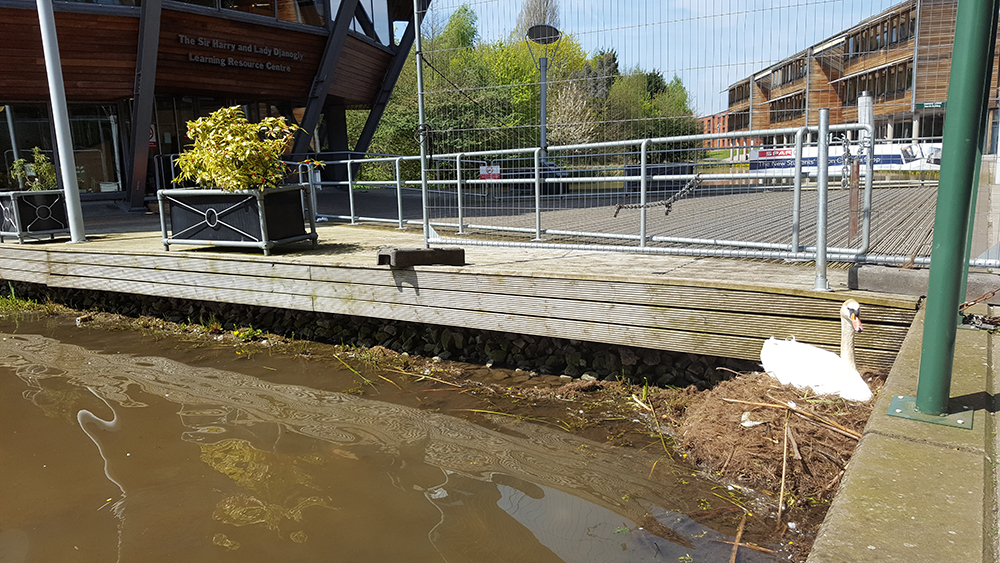
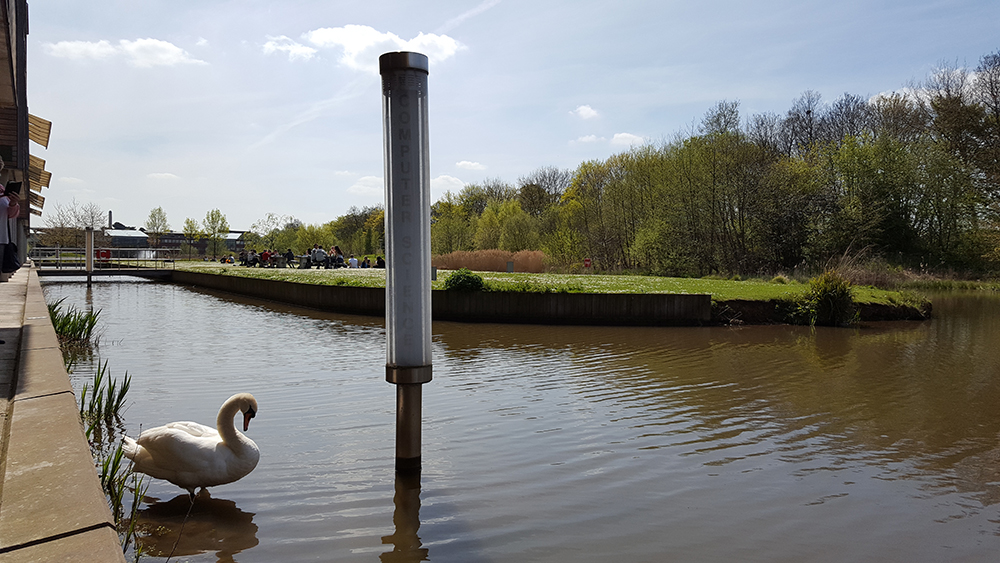
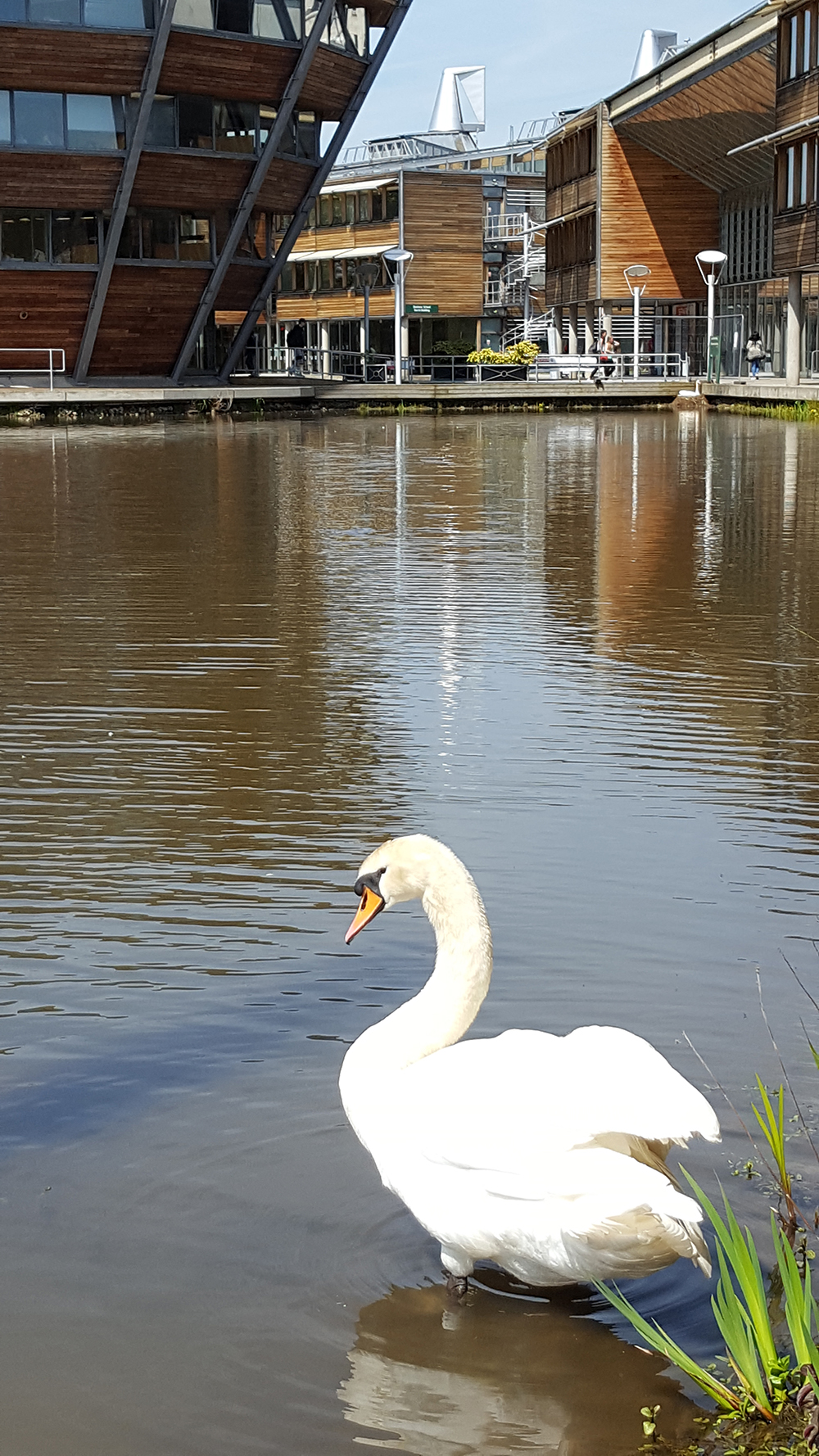
In a #BeastsofUoN first, a pair of swans have settled down to nest at the edge of the lake on Jubilee Campus.
You can see the marvellous sight just outside the Exchange Building on Jubilee Campus. Our grounds team have protected the nest with fencing and provided an information sign, and we ask you to please watch the birds from a safe distance and avoid disturbing them. The nest and eggs are protected under the Wildlife and Countryside Act 1981, and it is an offense subject to certain exceptions (such as the control of a species for permitted reasons under licence) to intentionally take, damage or destroy the nest of any wild bird while it is in use or being built.
Our campuses are home to many animals – make sure to share your own photos using #BeastsofUoN on Twitter and Instagram.

Tags: animals, Beasts of UoN, Djanogly Learning Resource Centre, Jubilee Campus, library, swan, wildlife
Posted in Environment, News | 1 Comment »
Student focus group – £10 Amazon voucher for your thoughts
May 5th, 2016
The University’s student recruitment team is holding a focus group to find out your thoughts on postgraduate study.
We would like to hear from any postgraduate students or final year undergraduates, especially if you have ever considered applying to study for a masters course or PhD in any subject.
When: Thursday 12 May 2016, 11am-12.30pm – it will last around one hour.
Where: C13, Trent Building, University Park Campus.
How to register: email amanda.cooke@nottingham.ac.uk – please state which course you are studying and at what level.
Please note if you attended the focus group on 21 April, you are unfortunately not eligible to attend this session.
Places will be allocated on a first come, first served basis.
Tags: focus group, masters, PhD, postgraduate study, student recruitment
Posted in News, Opportunities, Research | Comments Off on Student focus group – £10 Amazon voucher for your thoughts
Stunning student photos of natural world on display at exhibition
May 4th, 2016
A collection of stunning images of Mother Nature at her most beautiful, captured by students at the University, are due to go on display to the public as part of a new exhibition.
The photos from the natural world, taken by postgraduate students studying on the one-year MSc Biological Photography and Imaging course run by the School of Life Sciences, can be seen at the Wollaton Hall Courtyard Café from Friday 13 May to Friday 27 May and are free to view.
The nature photography includes images of sunlight glinting off the delicate petals of a tulip, the Aurora Borealis dancing in the sky above snowcapped Icelandic mountains and the extravagant purple hues of a passion flower in full bloom. Fittingly, it also features striking photos of Wollaton Hall’s most famous residents – the Red and Fallow deer which are synonymous with the Nottingham landmark. For a preview of some of the photos from the exhibition, visit the News Room blog.
The 7 Magpies exhibition has been organised by the students as part of a module for their course – the only one of its kind in the UK – which has challenged them to produce all the imagery and then organise every detail of the event, from finding a venue to organising the large format printing of their work.
Gilles Dubois, one of the students involved in organising the exhibition, said: “Our exhibition is an invitation to open your eyes and have a look at our environment and the infinite amount of wonders it is made of – we hope it will show our profound love for nature and for photography both as a documentation tool and as an art.”
Fellow student Emma Simpson-Wells added: “Our exhibition is such an exciting opportunity for us to show off all the hard work we put into our MSc course. What’s even better is that it’s an outdoor exhibition in a location we all love – Wollaton Deer Park. It really reflects our dedication to sharing our knowledge of the natural world and our ever increasing photography skills. I’m so proud of our small group’s achievements this past year.”
The exhibition will open on Friday 13 May with a launch event at 5.30pm which will feature two graduates as guest speakers.
Alex Hyde is now a professional natural history photographer based in the Peak District and winner of the Hidden Britain category in the 2015 British Wildlife Photography Awards for his incredible image of a female crane fly covered in morning dew. His work has been published in numerous newspapers, books and magazines including The Times, The Daily Telegraph, BBC Wildlife Magazine and New Scientist.
Alex Wilkinson is a professional photographer and videographer whose work has won national photography competitions and has included travel to Uganda to produce a book on chimpanzees titled Our Closest Relative – The Chimpanzee.
More information about the exhibition can be found on a dedicated Facebook page and via Twitter. You can also read the press release for more information.
Image: Tiger – Peter Simons. A Sumatran Tiger (Panthera tigris sumatrae) photographed at Anna’s Welsh Zoo in Pembrokeshire.
Tags: 7 Magpies, Biological Photography and Imaging, community, event, exhibition, family, photography, Wollaton Hall
Posted in Environment, News, Side news story | Comments Off on Stunning student photos of natural world on display at exhibition
Stay Safe – public information film
May 4th, 2016
An information film that provides advice on the steps to take to keep safe in the event of a firearms or weapons attack has been released to the public.
The University has taken the decision to highlight this guidance to staff and students in light of the national threat level – which remains at ‘severe’ in the UK. However, it must be stressed that this is not in response to any particular or specific threat to the city or the University. All UK police forces have been asked to share with partner agencies and large organisations.
The four-minute film, released by National Counter Terrorism Policing, sets out three key steps for keeping safe and is available at www.npcc.police.uk/staysafe. The film is accompanied by a transcript and an online information leaflet.
The film and leaflet advise that in the unlikely event you are caught up in an incident to ‘run, hide and tell’ – guidance which can be applied to many places and situations. RUN if you can. If you can’t run, HIDE. Then, when you can, TELL the police what’s happening so they can get there quickly to stop the threat. Also tell others of the threat so they don’t approach the danger.
Deputy Assistant Commissioner Neil Basu, speaking on behalf of National Counter-Terrorism Policing said: “The public should not be alarmed by this step. While the general level of threat to the UK is severe, the probability of being caught up in a firearms or weapons attack is very, very small. However, it is important the public know what to do in the event of getting caught up in such an incident.”
If you have any concerns please contact the University’s Security team on bw-security@exmail.nottingham.ac.uk
Dr Paul Greatrix
Registrar and Chair of the Incident Management Team
Tags: Incident Management Team, National Counter Terrorism Policing, Paul Greatrix, police, Registrar, safety, security
Posted in Announcements, News | Comments Off on Stay Safe – public information film