

Campus News
Coming soon: annual leave purchase scheme
August 1st, 2022
Enrolment for The Annual Leave Purchase Scheme is due to open, with a 6-week enrolment period, running from Monday 15 August to Friday 23 September 2022.
From Monday (15 Aug), eligible staff* will be able to purchase up to 1 week of additional holiday (pro-rata for part time staff) for the 22/23 holiday year.
Any annual leave purchased through the scheme needs to be booked in line with normal holiday booking processes and staff are encouraged to discuss plans with their manager prior to enrolling.
As many will have leave planned during August, alongside planning for the new academic year, advanced notice of the application window has been provided to increase time to discuss any plans with your line manager.
More guidance including a manager guide, FAQ’s and how to enrol can be found the annual leave web pages.
*Please note, staff on fractional term time only contracts are not eligible to apply to this scheme as the nature of their role requires them to be present during term-time and, therefore, it would not be possible to agree additional leave.
Tags: annual leave, Annual Leave Purchase Scheme, holidays, staff leave
Posted in Announcements, News | 4 Comments »
Green Flag awards for University of Nottingham
July 29th, 2022
The University of Nottingham is celebrating after receiving two Green Flag Awards for our Jubilee and University Park campuses.
The award is the international quality mark for parks and green spaces and the university joins 2,208 UK winners.
After two years that have seen our parks and green spaces play a vital role for people through lockdowns as a place to relax, exercise and meet friends and family safely, the news that the university has achieved two Green Flag Awards is testament to the hard work and dedication of the team that make the green space a great space that everyone can enjoy.
Keep Britain Tidy’s Accreditation Manager Paul Todd said: “I would like to congratulate everyone involved in making the University of Nottingham worthy of two Green Flag Awards.
“Both Jubilee Campus and University Park Campus are vital green spaces for the community in Nottingham.
This award is testament to all the hard work of staff and volunteers, who do so much to ensure that it maintains the high standards demanded by the Green Flag Award.”
University Park has had 18 consecutive Green Flags to its name over the years and attracts students and visitors to its large leafy campus. It boasts an impressive mix of landscape features, including a variety of tree species, wildflower meadows and contemporary gardens, including the Millennium Garden and Jekyll Garden.
Jubilee campus has also received the Green Flag award consistently since 2017. It was established in 1999 when a former industrial site was regenerated into a thriving environmentally friendly campus with a strong emphasis on sustainability. Four lakes provide diverse wildlife habitats as well as peaceful areas where people can pause and reflect.
A full list of Green Flag Award-winning parks and green spaces is available here.
Tags: green, Green Flag, Green Flag Award, green spaces, sustainability
Posted in Announcements, News | Comments Off on Green Flag awards for University of Nottingham
Digital Experience Insights survey – what we learned from your responses
July 29th, 2022
Earlier this year we asked our staff and students to complete our Digital Experience Insights survey. We received around 2,400 responses and your feedback has helped us to build a picture of the university’s digital landscape in 2022 and how it has evolved over the past few years.
The Digital Experience Insights project consisted of four separate surveys, one for each of the following cohorts: Professional Services staff, teaching staff, researchers and students. This has allowed us to assess the varying needs of the university population. Similarly, the feedback can be divided into four themes: You and your technology, Technology at your organisation, Technology in your role and Developing your digital skills.
The headlines and key findings – what’s going well and what could be improved – from the staff survey can be found below.
You and your technology
- There was a significant increase in the number of staff who reported receiving offers of support in using assistive technologies
Technology at your organisation
- 85% of Professional Services staff rated the quality of the online working environment as ‘good’ or better, which is an increase from 60% in 2020
- Only 62% of teaching staff rated the quality of the online working environment as ‘good’ or better, suggesting a disparity in experience
- Both Professional Services and teaching staff indicated a preference for investing in IT support when asked about investment preferences
Technology in your role
- The percentage of respondents saying that poor WiFi was problematic reduced across all cohorts – by 13% for teaching staff and 8% for Professional Services staff
- Despite improvements, WiFi was still seen as the biggest challenge to online teaching and working
- Teaching staff shared concerns about online learning, including a loss of community, students not making good progress, and assessment equitability
- Teaching staff reported that the most negative aspects of teaching online included a lack of interaction and disengaged students, both of which featured more prominently in responses than in 2021
- In comparison, teaching staff felt that workloads and technology were less of a limitation to online teaching and learning than in 2021
Developing your digital skills
- All cohorts reported an increase since 2021 in using online videos and resources when requiring help
- The proportion of both Professional Services and teaching staff who felt that the university’s support for online working and teaching was ‘good’ or better decreased by 14% and 4% respectively
- When asked what one thing the university should do to help learn/teach/work effectively online, the most popular response for all cohorts related to training and support
- Fewer than 50% of all cohorts felt that they had been offered training and support for the vast majority of digital skills
While the results have demonstrated broadly positive progress over the past three years, there are some common areas of improvement that can be identified – most notably increased support for digital technologies and the development of digital skills.
Similar themes can be found in the results of the student population, although there is some variation. The results for students are generally in line with, or slightly better than, the average for both the Russell Group and the broader sector:
You and your technology
- There was a significant increase in the number of students who reported receiving offers of support in using assistive technologies, although this was below the Russell Group average
Technology at your organisation
- 82% of students rated the quality of the online learning environment as ‘good’ or better, compared with 77% for the Russell Group average and 78% for the sector average
Technology in your role
- 83% of students agreed that online learning materials were accessible to them, compared to the Russell Group and sector averages of 78% and 77% respectively
- 52% of students said that flexibility was the most positive aspect of online learning – an 11% increase on 2021 – citing improved comprehension due to being able to re-watch materials, as well as the option to schedule part-time work around their studies
Developing your digital skills
- 69% of students thought that the support the university provides for online learning was ‘good’ or better – a 12% increase from 2021 and better than the national average of 65% for the Russell Group and 66% for the rest of the sector
As per the guidance of the Teaching and Learning Committee, recommendations based on the above findings are to be established at a school/department/Professional Services department level. These might feed into faculty plans, department plans, strategic delivery plans and Teaching Excellence and Student Outcomes Framework plans.
For more information, please consult the Digital Experience Insights 2022 Executive Summary. The detailed feedback can be found on Tableau (login required).
Posted in News | Comments Off on Digital Experience Insights survey – what we learned from your responses
Changes to parking – effective from Thursday 1 September 2022
July 29th, 2022
Virtual car parking permits will come into force from 1 September when the new permit year begins. These changes, which have been part of a review towards a more technology-based system, will also see a three percent rise in the cost of a permit. Virtual permits are available for annual permits only.
Applications will be made in the same way, but a permit will not need to be displayed. Management and enforcement of onsite parking will be managed through mobile ANPR hand-held devices.
Colleagues can apply for their 2022/23 permit from Monday 27 July 2022. Occasional use permits will remain paper based for this permit year, but plans are in place to transition to a fully-paperless virtual system for the 2023/24 permit year.
Car parking charges will increase by three percent in the new permit year, this increase is significantly lower than the increase in the cost of providing car parking meaning an average annual permit costs around £1.24 per day.
In order to keep costs to staff as low as possible the university has offset a large proportion of the workplace parking levy which has increased by 7.1 percent, (from £428 to £458 per liable space) in the last year, at a cost of £950,000.
The increase of three percent works out as an annual increase from £78 to £81 for cars in the lowest emission and salary bracket, and an annual increase from £871 to £898 in the highest emission and salary bracket. The average cost of an annual parking permit is £285.
Recognising changing travel patterns, parking demand and ensuring we improve the campus experience for all, the university will – over the coming year – be removing a small number of parking spaces across a number of locations.
We will also invest in additional electric charge points across the campuses to support the growth in electric vehicle (EV) ownership and use.
Tags: car parking, car parking charges, car parking permits, electric vehicles, parking, parking permits, permit
Posted in Announcements, News | Comments Off on Changes to parking – effective from Thursday 1 September 2022
New framework around all professorial roles supports a fairer pay structure
July 28th, 2022
Banding and pay for professors has been assessed as a part of the next step in creating a fairer more equitable pay structure at the university.
Bringing Nottingham in line with the majority of Russell Group universities, the review into senior pay was put in place to better support the university’s values around fairness and ambition and in doing so;
- Provides a fairer and more equitable system to reward and recognise contribution and performance to research, teaching and leadership to support the strategic direction of the university.
- Implements a Level 7 Academic Framework which clearly articulates the expectations within each of the different bands, based on core and indicative criteria.
- Introduces a system which supports the university to be competitive in recruiting and retaining leading academics from the UK and overseas.
- Helps to address some of the pay gaps experienced by women, minority ethnic staff and staff with disabilities.
This follows on from the improvements and increased transparency around the academic promotion pathway, including the frameworks for levels 4, 5 and 6 introduced in 2019.
It is part of a suite of activities to improve our reward and recognition structures and follows the recent pay and condition review for levels 1-3 and changes to the maximum pay spine at levels 4-6.
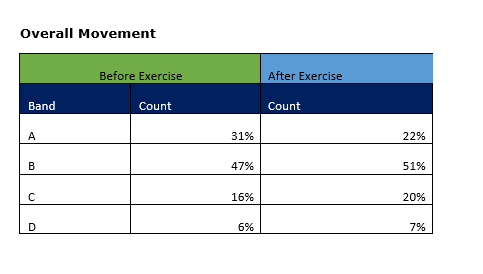
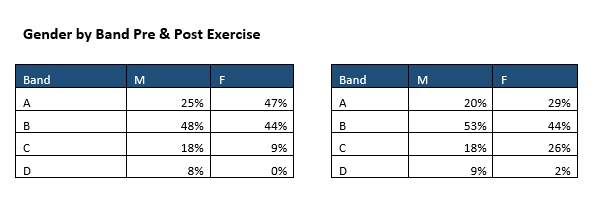
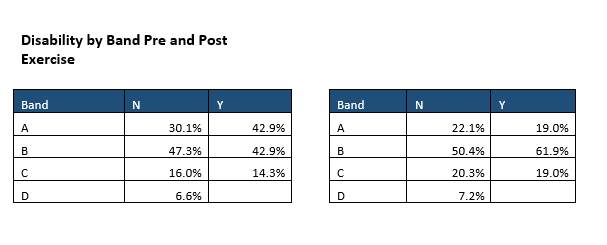
Under the review professorial staff at grade 7 had the opportunity to verify or challenge their indicative banding under the new framework. The results have had a positive impact on our staff profile, shown in the tables below, particularly from a gender, ethnicity and disability perspective.
The review has successfully addressed some of the historical systemic inequalities that previously existed in senior pay, such as long service being rewarded rather than performance, and has eliminated opportunities for individuals to benefit from social privilege.
This is evidenced by the increase in the number of those staff with protected characteristics at band C and D and the decrease in number of these individuals at band A. The new professorial reward system should see all academic staff fairly and equitably recognised for their talents and contribution to the work of the university in future.
Prior to the exercise there were no females in band D and only 9% working in band C. These have now grown to 2% and 26% respectively.
While just 4.4% of BAME staff were at band C before the exercise this has now grown to 11.1%. At the same time the number of BAME staff at band A has shrunk from 31.1% to 26.7%, moving more in line with white staff.
The number of staff with disabilities have grown substantially in bands B and C, from 42.9% to 61.9% and 14.35% to 19% respectively.
The professorial pay review is the final step in creating a transparent and criteria led reward structure for all academic grades. However, there is still more to be done across the university to make sure we are proactive in addressing the leaky pipeline and ensure all talented individuals have equal opportunity to progress their careers.
Work is planned over the next academic year to increase support for disabled staff, encourage disclosure and to provide career progression support for women and BAME staff to prevent any widening of the career progression gap as a result of the Covid pandemic.
Work is also underway to apply the banding to APM 7 Directors.
Results in full

Posted in Announcements, News | Comments Off on New framework around all professorial roles supports a fairer pay structure
Dame Jessica: reflecting on my time at the University of Nottingham
July 27th, 2022
Professor Dame Jessica Corner, Pro-Vice-Chancellor for Research and Knowledge Exchange, is joining Research England in October as Executive Chair, responsible for its critical role in providing more than £2 billion annually in grant funding to English universities for research. Here she reflects on her time at the University of Nottingham.
I appeared before the House of Commons Science and Technology Select Committee last week for my pre-appointment scrutiny for the role of Executive Chair of Research England. The event was certainly a point for reflection. Alongside the challenges of getting to London in 40C via a not fully functioning transport system, our hospitals were struggling with huge increases in people needing care.
I was posed questions as to how to set priorities and funding for research. How to balance providing immediate solutions to the massive challenges facing society in a world that is no longer functioning as we need it to, with the need for long-term, fundamental research. Thankfully they agreed that I am on the right track and endorsed my appointment, though the committee’s approval ended my denial about leaving the university at the end of September.
Setting direction and strategy for research
At Nottingham, we continually face these questions as we set direction and strategy. We must work out how to use our resources to deliver our core business of providing an excellent and life-changing education for our wonderful and talented students and delivering high-quality research across a broad disciplinary base. At the same time we must put energy and resources into those areas where we can make a real difference in tackling societal challenges.
Over the last five years we have found a way to do this through the Beacons of Excellence programme, which committed to focus our areas of transdisciplinary strength on UN Sustainable Development Goals. The Beacons provide platforms for the next era and over next five years, as an integral part of our renewed research strategy, we plan to develop research and innovation clusters.
The Propulsion Futures Beacon is helping drive progress towards a zero carbon cluster, which will help establish Nottingham and the East Midlands as an international hub for the translation of net zero technologies.
Precision Imaging is establishing a national ultra-high field imaging facility, following the award of funding to secure the UK’s most powerful MRI scanner and the creation of a health research cluster will accelerate the translation of our discoveries into patient care across the East Midlands and beyond.
Digital Nottingham meanwhile is a new programme in partnership with local stakeholders that uses our research expertise in data science, technology and artificial intelligence to provide further tremendous potential to drive regional innovation, investment and growth.
Growing out of Future Food, a new Food Systems Institute is proposed, and our Rights Lab continues to build its extraordinary work supporting human rights and ending human exploitation through enforced labour.
Strengthening our research culture
At the same time, much has been done to strengthen the environment of support for research. A research culture survey, workshops and our first research culture conference underline our commitment to building and maintaining a healthy, positive, supportive and enabling working environment.
A warm welcome for a ‘research tourist’
When I arrived at the university in January 2016, I received such a warm welcome. I remember thinking of myself as a research tourist and visited as many areas of the university as I could to meet research groups and see facilities. It was inspiring and a way to connect and build relationships and surface issues and problems. It became the foundation for the 2017- 2022 research strategy.
Preparing for REF2021 success
There was remedial work to be done. We were in no way on track for a strong performance for REF2021. Many parts of the university were unable to give confidence that research outputs would be in place or that we would be able to produce the required impact case studies. Together we set off a big programme of work led by REF coordinators, heads of schools, FPVCs and APVCs and research support leads.
Providing our individual academics with meaningful support and time to achieve our goals was crucial. We made enormous progress, well-rewarded in the final REF outcome. But now we need to move on from an approach that involved so much heavy lifting, to embedding all this into business as usual for all. At the foundation of this is producing highly impactful and world-leading outputs.
A real privilege
There are so many things I could reflect on from my time at the university. First and foremost, the many, many friends I have made over the last six years. The brilliance of colleagues and the extraordinary work I have encountered almost daily. Behind every door in the university, something remarkable is going on. We have superb facilities and enjoy a very collegiate environment that even the pandemic does not seem to have dampened. While there is plenty to do, our culture is becoming more inclusive. We are less focused on a few principal investigators; there is fuller recognition of women and others from diverse backgrounds; there is greater insight into the ways we inadvertently hold back careers.
I have learnt so much. It has been a real privilege to serve as Pro-Vice Chancellor for Research and Knowledge Exchange.
Looking forward to thanking you in person
For anyone wishing to reflect with me in friendship, please join me at a gathering in September, when I look forward to thanking you in person for your extraordinary contributions and celebrating our wonderful research environment and community. Look out for further details after the summer break.
I sign off, not with a goodbye but with heartfelt and huge thanks to all my friends and colleagues at the University of Nottingham who made my time here so wonderfully rewarding.
My sincere best wishes
Jessica
Professor Dame Jessica Corner
Pro-Vice-Chancellor for Research and Knowledge Exchange.
Read more research news in Dame Jessica’s final update
Tags: professor dame jessica corner, Professor Dame Jessica Corner update, REF
Posted in Announcements, News | Comments Off on Dame Jessica: reflecting on my time at the University of Nottingham
Life-changing technical leadership programme celebrates successes
July 26th, 2022
More than 170 women technicians have completed a pioneering national leadership programme designed and delivered by the university to tackle the workforce imbalance and equality gap within the UK’s technical community.
The Herschel Programme for Women in Technical Leadership, named after Caroline Herschel – a pioneer in the discovery of comets and an early ‘technician’ – concluded its six-month pilot with a celebration event in London.
53 higher education and research institutions from across the UK were represented on the unique programme delivered by the University of Nottingham and the Research England funded Midlands Innovation TALENT programme.
Co-created with technical and organisational development experts to address topics specifically relevant to women in technical roles, the programme set out to elevate and advance career opportunities for current and aspiring leaders who identify as women.
Technicians reflected on the changes they had experienced as a result of completing the programme, with many having successfully applied for new jobs and development opportunities.
In an inspiring keynote talk from Professor Carole Mundell, President of the Science Council and Head of Astrophysics at the University of Bath said: “Diversity is critical within teams and experienced leaders help scientists answer fundamental questions. Technicians enrich and influence teams, open new ways of working and drive new discoveries, developments and impact.”
She shared personal career highlights and encouraged the group of leaders to be curious, say yes to new opportunities and experiences and be confident as visible leaders at the frontiers of knowledge.
Claire Cawthorne, Herschel Programme Director, University of Nottingham said: “When we launched this brand new leadership pilot programme we were overwhelmed by the response and number of applications. This shows the value of tailored leadership and management training for the technical community.
“The leadership course has been inspired by Caroline Herschel’s incredible story of endurance and adaptability, two themes central to the programme. Caroline Herschel was the first woman in England to earn a salary for her scientific work. She was a tenacious and ambitious woman who never gave up and her story has been an inspiration for our facilitators and participants.”
All delegates were gifted their own edition of Double the Stars which tells her story on course completion. Kelley Swain, author of Double the Stars, commented: “I hope those on the programme continue in your work as technicians and that you’re inspired by her incredible journey.”
Helen McNamara, Director of Organisational and People Development for the University of Nottingham chaired a panel discussion with course facilitators Sandy Sparks, Denise McLean, Michelle Jackson, Emma Colley and Lindsay Davies.
Kelly Vere MBE, Director of Technical Skills and Strategy for the university and TALENT Programme Lead added: “Thank you to all our participants for engaging in the programme, I am incredibly proud of this vibrant network of technical leaders who are already seeing the benefits personally and professionally.
“These achievements are testament to the hard work of the delivery team including colleagues from MI TALENT, the University of Nottingham, University of Leicester and Keele University.
“I hope our Herschel Leaders continue to share their new knowledge, experiences and skills within their institutions and with peers.”
The celebration event took place at Church House Westminster on Thursday 14 July.
Tags: Female technicians, Herschel Programme, Herschel Programme for Women in Technical Leadership, Kelly Vere MBE, TALENT
Posted in Announcements, News | Comments Off on Life-changing technical leadership programme celebrates successes
Small Business Engagement Award and briefing with Q&A
July 26th, 2022
Would you like to apply your research to help solve problems within small to medium-sized businesses, develop business engagement skills to establish new contacts, or create research impact by helping businesses grow?
If yes, then applying for a Small-Business Engagement Award (SBEA) is for you.
Awards of up to £4,000 are available to cover your/a researcher’s time and the project delivery costs (e.g., marketing materials, toolkits, consultancy etc). If successful, you will be expected to:
- Develop and deliver a 30-minute presentation on your research to an audience of various small to medium enterprises in different sectors (from healthcare to construction)
- Implement and embed your research into company policies and procedures through additional events and/or bespoke projects
You will have full access to the University of Nottingham’s business network (over 1500 external small-medium enterprises) and be supported by research and innovation to:
- Develop the business skills required to engage with business
- Create your first in person presentation to the business network at a business facing event
- Plan, market and manage the business facing event
- Implement and embed your research into companies’ policies and practices through additional events and/or bespoke projects
To apply, please complete this short Expression of Interest form.
There is also a briefing and Q&A session on Wednesday 14 September 2022, please click here to register.
If you have any questions, please contact Gemma Morgan-Jones.
Tags: SME, UoN business, UoN business network
Posted in Announcements, News | Comments Off on Small Business Engagement Award and briefing with Q&A
Diversity Festival recap: Social & economic challenges: into, in and out of higher education
July 26th, 2022
For the next few weeks, we will be highlighting one keynote event a week for those who missed out on the live sessions. This week, we’re recapping the Social and economic challenges: into, in and out of higher education event.
This keynote session brought us together as a community to explore the social and economic challenges encountered when moving into, being in and moving beyond higher education and the support and services available to overcome these.
Our UoN SU Liberation Officer set the scene by sharing our students’ union’s research into the under-representation of students from various socio-economic backgrounds.
We heard about the immense challenges which come with ‘breaking the mould’ and being the first in the family to go to university. Our student panellists shared their personal stories, and highlighted their challenges; for example, whether to attend a lecture or go to work to put food on the table, whether to pay the rent or fix the washing machine. And those difficult choices often also impacted on the choices of others around them, such as their siblings; for example, who goes to university and who doesn’t.
We learned about the importance of belonging, and that the focus for an institution shouldn’t be solely on the provision of support services but also on the demographic of those who engage with that support. Successful people ask for support and never do it alone – it doesn’t matter how difficult it can be to access that support, the key thing is to just keep trying.
Alumnus Zach Jones encouraged us to remember the phrase ‘seeing, being, doing’ – how you see influences who you become and therefore what you do. You can choose what defines you – is it your past, or the choices you make along the way? Your biggest taboo might just be your biggest asset! And this insightful analogy – the degree a student gets is the car but they need the fuel to make it go – it is the student who is the fuel for the car.
There were many powerful and inspiring moments. We hope everyone walked away with a greater understanding of how someone’s socio-economic background impacts on every aspect of their life and the choices they make.
Find out more about the support available for staff and students experiencing social and economic challenges and watch the full recording below.
Tags: Diversity Festival, Diversity Festival 2022, edi, equality, Equality Diversity and Inclusion
Posted in Announcements, News | Comments Off on Diversity Festival recap: Social & economic challenges: into, in and out of higher education
New Gold Open Access funding form
July 25th, 2022
Following major funders’ recent policy changes, University of Nottingham Libraries have launched a brand new Gold Open Access Funding Form to better meet the funding needs of our researchers.
The new Office 365 form is now quicker to complete and provides an overall improved user experience.
The new form should only be used to:
- apply to the block grants held by the University of Nottingham from UKRI, Wellcome Trust and British Heart Foundation for individual Article Processing Charges (APCs)
- benefit from partial APC discounts offered by certain publishers
- enable Research and Innovation to facilitate an invoice payment to a publisher using a university project code or school code
If your publication is covered by a Transformative Agreement (TA) you may not need to fill in a gold open access funding form.
How do I know if I need to use the form?
Before submitting the form, Libraries recommend:
- checking the list of Transformative Agreements(TAs) and APC Discounts
- contacting the Research Support Team via their dedicated Gold Open Access enquiry form for a more tailored enquiry. The team will be able to advise on next steps depending on your funding situation and/or the venue of publication.
University of Nottingham researchers can find out more information about open access funding, policies and the support available on the Libraries website.
Tags: open access, open access funding
Posted in Announcements, News | Comments Off on New Gold Open Access funding form