

Campus News
Midwifery in the District
February 14th, 2012
Julia Allison
Date: Wednesday 14 March
Time: 1pm to 2pm
Venue: Djanogly Theatre, Lakeside Arts Centre, University Park
Admission: Free
Posted in Public Lectures, What's On | Comments Off on Midwifery in the District
The Dance of Death: Edward Burra’s Macabre and Surreal Images
February 14th, 2012
Simon Martin (curator)
Date: Tuesday 13 March
Time: 6.30pm to 7.30pm
Venue: Djanogly Art Gallery lecture theatre, Lakeside Arts Centre, University Park
Admission: Free
Posted in Public Lectures, What's On | Comments Off on The Dance of Death: Edward Burra’s Macabre and Surreal Images
The Ragged Trousered Philanthropists: Post-show discussion
February 14th, 2012
Stephen Lowe
Date: Thursday 8 March
Time: 10.15pm
Venue: Djanogly Theatre, Lakeside Arts Centre, University Park
Admission: Free
Posted in Public Lectures, What's On | Comments Off on The Ragged Trousered Philanthropists: Post-show discussion
An introduction to the exhibition and the work of Edward Burra
February 14th, 2012
Simon Martin (curator)
Date: Friday 2 March
Time: 6.30pm to 7.30pm
Venue: Djanogly Art Gallery lecture theatre, Lakeside Arts Centre, University Park
Admission: Free
Posted in Public Lectures, What's On | Comments Off on An introduction to the exhibition and the work of Edward Burra
Mothers and Midwives: A history of maternity in the East Midlands
February 14th, 2012
Friday 13 January to Sunday 15 April 2012 at Weston Gallery, Lakeside Arts Centre, University Park. The gallery is open 11am-4pm, Monday to Saturday, and noon-4pm, Sundays and bank holidays. Admission is free.
The experience of having a baby has changed dramatically in the past century. This exhibition explores this development through historical and contemporary sources, including interviews, photographs and equipment. It looks at reasons behind the change and the impact this has had on women, families, midwives and communities. Historic material from the University’s Manuscripts and Special Collections provides examples from published sources and archives of medical understanding and practice from the past. A series of lunch-time talks accompanies the exhibition.
Tags: Mothers and Midwives
Posted in Uncategorized | Comments Off on Mothers and Midwives: A history of maternity in the East Midlands
Craft Showcase with Suet Yi Yip
February 14th, 2012
Wednesday 1 February to Monday 30 April at Djanogly Art Gallery, Lakeside Arts Centre, University Park. The gallery is open 11am-5pm, Monday to Saturday, and noon-4pm, Sundays and bank holidays. Admission is free.
Suet Yi Yip featured in Young Meteors at Lustre 2011 at Lakeside. The Hong Kong-born artist dreamt of living in a quiet place surrounded by hills and lakes. This love of the countryside inspires her art.
Tags: Lustre, Young Meteors
Posted in events | Comments Off on Craft Showcase with Suet Yi Yip
Scientists leading £1.3m project
February 14th, 2012

Scientists at The University of Nottingham are leading a £1.3 million research project to develop new treatments to replace brain cells lost during dementia.
Lead investigator Dr Virginie Sottile, of the School of Clinical Sciences, is heading up the Alzheimer’s Society-funded study to ‘flick a genetic switch’ to turn bone marrow stem cells into brain cells.
Dr Sottile said, “This project will be a step towards stem cell therapies, altering human bone marrow stem cells to resemble brain stem cells by ‘switching on’ specific genes.
“Bone marrow contains a fraction of stem cells that are promising in terms of new therapies. These stem cells are already used to repair bone and cartilage. The research is a fundamental project to understand whether and how we can manipulate bone marrow cells to use as a source to replace lost brain cells.”
Stem cells have the potential to turn into many different cell types that the body needs, offering an opportunity to treat diseases where tissue has been damaged.
Alzheimer’s disease causes nerve cells to die, interrupting complex inter-connections in the cortex, the outer layer of the brain. It is this network of cells that gives us our memories, personalities and behaviour patterns.
Alzheimer’s Society Research Manager Dr Anne Corbett said: “Understanding how brain stem cells are produced is a further step towards knowing more about how the brain works and could, potentially, be repaired.
“We are still a long way off from a stem cell treatment for dementia but research like this is vital if we are to move forwards. Dementia research is drastically underfunded. We must invest now to develop new treatments and search for a cure.”
Find out more about the University’s Impact Campaign and how you can support dementia/Alzheimer’s research at: http://tiny.cc/UoNImpactdementia.
Tags: Alzheimer’s Society, dementia, Dr Virginie Sottile, Impact: The Nottingham Campaign
Posted in Research | Comments Off on Scientists leading £1.3m project
Lowry breaks all records
February 14th, 2012

A staggering 46,800 people visited the University’s Lowry exhibition in just 10 weeks.
A rarely-seen collection of works – loaned from private collectors – made Lowry the most successful exhibition ever held at Lakeside Arts Centre, drawing thousands of visitors from across the UK.
The exhibition’s popularity led Lakeside to extend its opening hours in the final weeks and peak periods saw visitors queuing to get in to the Djanogly Art Gallery.
The free exhibition focused Lowry’s work from the 1920s to the mid 1950s, and featured a large number of drawings, many of which had never been exhibited as a collection before, plus a substantial number of works loaned by The Lowry Collection in Salford.
Shona Powell, Lakeside director, said: “We have been utterly delighted by the response to this fantastic exhibition. From the very first day the exhibition opened, it attracted large numbers, from art enthusiasts to novices from Nottingham and beyond.
“The gallery has been brimming full of visitors since day one with many queuing to see this amazing collection of works together.”
The exhibition was held in association with the Crane Kalman Gallery, London, and generously supported by Sir Harry and Lady Djanogly and The Lowry Collection in Salford.
University Vice-Chancellor, Professor David Greenaway, said: “The number of visitors to Lakeside is a demonstration of the national importance of this unique retrospective of Lowry’s work.”
Neil Walker, curator of the exhibition, said: “Over the course of its ten-week opening, the Lowry exhibition was an overwhelming success and we’re thrilled with the number of visitors we had. We’ve had some incredible exhibitions at Lakeside Arts Centre and with the Edward Burra exhibition due to open next month, we’re sure that there will be plenty more to come.”
Next month, Djanogly Art Gallery is to host the first major exhibition in 25 years of works by artist Edward Burra. The free exhibition will run from Saturday 3 March to Sunday 27 May.
Lakeside: Cultural Impact is a key project within the University’s new appeal, Impact: The Nottingham Campaign, which is delivering the University’s vision to change lives, tackle global issues and shape the future. Find out more about Lakeside and how you can support us at: http://tiny.cc/UoNImpact.
Tags: Impact: The Nottingham Campaign, Lowry, Sir Harry and Lady Djanogly
Posted in News | Comments Off on Lowry breaks all records
Good enough to eat?
February 14th, 2012
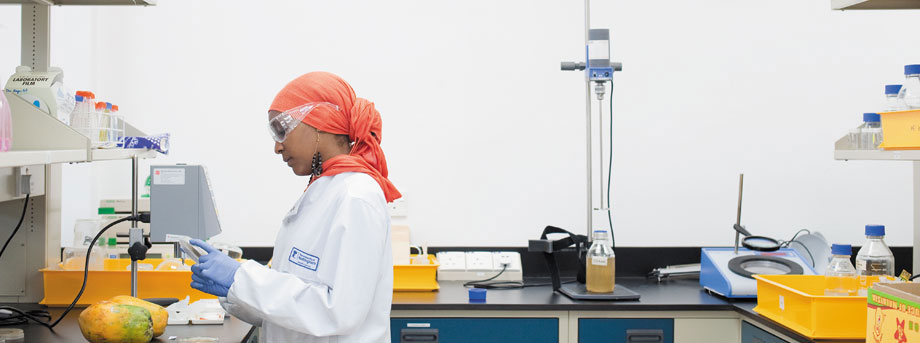
Producing enough food to feed the world’s growing population is becoming a major concern. But making sure the food we grow is safe, nutritious and good enough to eat is also fraught with difficulty.
In developing countries disease and decay can inflict losses of up to 100% on crops that left the field in perfect condition. These losses occur during harvesting, handling, shipment and after purchase by the consumer.
A new Centre of Excellence for Post-harvest Biotechnology (CEPB) has opened in the School of Biosciences at The University of Nottingham Malaysia Campus (UNMC). Led by Dr Asgar Ali — an expert in postharvest biology and technology — the centre is developing new technologies aimed at reducing food losses, improving overall quality and food safety. The aim is to increase profits for growers and marketers and make quality and nutritious food available to consumers.
Dr Ali said: “In developing countries losses of between 10 to 100% have been recorded. Tropical countries like Malaysia have a particular problem because of the number of micro-organisms that exist due to humidity. Cutting post-harvest losses could add a sizable quantity to the global food supply.”
With funding from the Biotechnology and Biological Sciences Research Council (BBSRC) UK, the Ministry of Agriculture (MOA), the Ministry of Science, Technology and Innovation, Malaysia (MOSTI) and private sector organisations in Malaysia, the CEPB is working with other universities across the world to find solutions to the problem of post-harvest waste. It is also running an accompanying MSc and PhD programme.
In the first research of its kind Mehdi Maqbool, a Phd student from Pakistan, is looking at ways of developing edible coatings from natural Gum Arabic powder to extend the shelf life of fruit. His research is focused on the banana and papaya. These are two of Malaysia’s most common crops but they are susceptible to diseases which occur in cold storage and they also have a short shelf-life.
Mehdi said: “Natural Gum Arabic is already used as an emulsifier in cold drinks and sweets. It is green, biodegradable and safe for human consumption. In liquid form Gum Arabic can create a thin edible film around the fruit which creates a modified atmosphere protecting it from disease and decay.”
Dr Ali said: “Farmers are using pesticides to reduce these diseases. But we are trying to develop technologies that are free from synthetic chemicals and fungicides. We are using natural-based products and bio-fungicides, or physical treatments such as ozone and negative ions, to enhance the storage and shelf life of tropical fruits such papaya, banana and tomatoes. Our research findings have already been published in major international journals in the area of food science and technology.”
The team have already proved the concept of their technology and are now negotiating with industry to trial their product.
The new centre is a joint venture with the School of Biosciences in Nottingham. It is one of 13 Malaysia Research Priority Groups which complement and overlap the global research priorities at The University of Nottingham UK.
Professor Jerry Roberts, Academic Champion of the University’s Global Food Security Priority Group, said: “The opening of this new Centre of Excellence is a good example of the work that is being undertaken across the University’s campuses in the area of Global Food Security. The centre will act as a focal point for our research to reduce post-harvest losses of fruits and vegetables and will provide the opportunity for staff in industry to receive the training necessary to limit waste in the food chain.”
Global Food Security is a key project within the University’s new appeal, Impact: The Nottingham Campaign, which is delivering the University’s vision to change lives, tackle global issues and shape the future. The University is ideally positioned — scientifically, geographically and politically — to make a significant contribution to global food security. More information is available at: http://tiny.cc/UoNImpact.
The University has been awarded a Queen’s Anniversary Prize for Higher and Further Education, for its research on Global Food Security — which includes everything from growing more crops with less fertiliser, to improving the nutrition, safety and taste of food on the plate.
Tags: Biotechnology and Biological Sciences Research Council (BBSRC) UK, Centre of Excellence for Post-harvest Biotechnology (CEPB), Dr Asgar Ali, global food security, Global Food Security Priority Group, Impact: The Nottingham Campaign, Malaysia (MOSTI), Technology and Innovation, the Ministry of Agriculture (MOA), the Ministry of Science
Posted in Research | Comments Off on Good enough to eat?
Nottingham top choice for students
February 14th, 2012

The University of Nottingham is the UK’s most popular university among applicants, according to new official figures.
The University received the highest number of applications in the UK. It has also seen its overall applications rise by 0.3% — from 49,278 in 2011 to 49, 441 — despite a national downward trend, which has seen the number of UK university applicants drop by 8.7% overall.
Registrar Dr Paul Greatrix said: “We are absolutely delighted by this news and that Nottingham is bucking the national trend, which appears to be affecting the recruitment figures of so many of our competitors.
“These are uncertain times within higher education, with universities continuing to feel the impact of reduced government funding and having to adapt to a very different environment for student recruitment and a new set of student fee arrangements.
“Nottingham has a great deal to offer — we have award-winning UK campuses, excellent course choices, first-class facilities and fabulous city nightlife, sports opportunities and student societies. In addition, our campuses in China and Malaysia offer unparalleled international study opportunities and this global outlook makes our graduates particularly sought after by leading employers — at 5.6%, our graduate unemployment rate is below the national average.
“However, there is no doubt that the overriding factor affecting student choice in this changing landscape is quality — something which The University of Nottingham is able to demonstrate in every aspect of the student experience it offers. We believe this is what makes the difference.”
Nottingham was followed by the universities of Manchester and Leeds as the UK’s most popular universities, in second and third positions, according to the figures released by UCAS, the Universities and Colleges Admissions Service.
The increase in applications at Nottingham is also set against the backdrop of a decline in applications from applicants living in the East Midlands, which at -10.3% is one of the biggest drops by region in the UK.
Dr Greatrix added: “It is disappointing that UCAS applications from the East Midlands have dropped. We’re not entirely sure why this should be the case, although it could be that previous mixed messages about the new fees regime has not helped.
“However, Nottingham is working extremely hard within the city, across the county and the region to promote access to university and will continue to do so. We recently launched a major new campaign, Nottingham Potential, to support wider access to university in the city and beyond. And with the levels of bursaries and loans available, no-one should be put off applying because of financial fears.”
The latest UCAS figures reflect all the applications considered on time for the January 15 equal consideration deadline. UCAS will continue to send applications to UK universities and colleges up until 30 June, with those received later going into clearing.
Tags: Registrar Dr Paul Greatrix, student experience, the Universities and Colleges Admissions Service, UCAS
Posted in News | Comments Off on Nottingham top choice for students