

Campus News
Are you Nu2 Sport?
February 14th, 2012

If you want to try your hand at a new sport, beat a bulging waist line or find yourself fondly reminiscing about by-gone days of sporting triumph, Nu2 Sport is for you.
The initiative, funded by Sport England, aims to get more people involved in sport and physical activity by removing the barriers that so often get in the way: time commitment, cost and the need for membership.
Instead, students and staff are encouraged to turn up to the sessions that suit them. During the spring term ten sports are available, including traditional games, like football, cricket and badminton, as well as touch rugby, Korfball, and AQUA Zumba.
Nu2 Sport Project Activator, Chris Campbell, explained: “We are looking to fit into the gap which currently sits just below competitive sport, offering people the opportunity to come and have a go in a no-pressure, relaxed and sociable environment.
“We know that there are lots of staff out there that want to get active or re-engage with sport, but find time or cost prohibitive. Nu2 Sport activities cost just £1 each and the vast majority take place outside of normal working hours, so you can come to the sessions that suit you without the usual commitment of membership. Just drop in and out as you please.”
More than 300 people attended sessions last term, many of whom became regular participants. In that time the initiative has had a number of success stories from a staff member trying handball for the first time and being inspired to join a local club to a volunteer being chosen to run the University’s No Strings badminton programme.
To get involved, have a look at the timetable at: www.nottingham.ac.uk/sport, www.nu2sport.com or www.facebook.com/nu2sport and choose the sessions you want to attend. If you need to book instructions will be given, if not simply turn up at the venue at the time indicated.
Tags: Nu2 Sport
Posted in News | Comments Off on Are you Nu2 Sport?
New humanities centre opens
February 14th, 2012

Humanities at the University has joined the digital age, with the launch of a new centre that will transform the way the subject is taught, studied and researched at Nottingham.
The Digital Humanities Centre (DHC), based in the new £8m Humanities building on University Park, features an impressive array of state-of-the-art technology for the creation, manipulation and presentation of digital imagery.
Among the potential uses of the new visualisation resources will be the creation of detailed 3-D reconstructions of ancient monuments and relics, virtual galleries and a multi-screen ‘smart’ classroom for the teaching of humanities subjects.
However, the new kit will also be a multidisciplinary resource — seven of its workstations, all complete with Humanities-themed names, are bookable through the university’s central booking system accessed through Outlook and available to staff and students across the university.
Among the bookable technologies are Daidalos and Leonardo – high performance PCs with A3 scanners, graphics tablets and various software including PhotoshopCS5 and AutoCAD 2011; Frida (as in Kahlo) — a PC with 50” plasma screen, A4 scanner, Nikon Coolscan 35mm slide scanner and various software; and Annie (named after photographer Leibovitz) — a camera copy-stand with lighting units for digitising large pictures, maps etc
The centre also features a hi-tech 3-D scanner, which can be used to capture and digitally render animate and inanimate objects — anything from ancient Roman statues to the human hand.
The DHC is the new home to Art History’s 80,000 strong 35mm slide collection featuring fine art, architecture (ancient and modern), sculpture/installation, manuscripts and applied art, with plans to digitally archive the most useful and precious of these images.
Dr Matt Davies, Head of Visual Resources, is available during opening hours at the centre (9am to 4pm during term-time only) to provide access, help and support, and advise on the use of digital images and copyright issues.
He said: “This is a fantastic facility featuring resources which in many cases simply aren’t available in other departments of the university. The equipment here which is centrally bookable could be extremely useful to staff and students whatever discipline they are working in and we are really keen to let people know that the doors of the DHC are open to them.”
The centre also offers a range of equipment including laptops, digital projectors, HD flip cameras, Dictaphones, 35mm slide viewing and projecting equipment, video and DVD recording and playback equipment which can be used at the centre or booked out on request.
Information is available from: www.nottingham.ac.uk/humanities/digital or by emailing: digitalhumanities@nottingham.ac.uk.
Alternatively, follow the centre on Facebook or Twitter (@NottinghamDigi).
Tags: Digital Humanities Centre (DHC), Dr Matt Davies, Head of Visual Resources
Posted in Features | Comments Off on New humanities centre opens
Knight of Norway
February 14th, 2012

A University of Nottingham scientist has received a New Year’s Honour with a difference…a Knight of the First Class from the King of Norway.
Professor Stephen Harding is Director of the University’s National Centre for Macromolecular Hydrodynamics (NCMH) and Scientific Adviser of the Centre for the Study of the Viking Age.
The Norwegian Royal Palace said His Majesty King Harald V has appointed Prof Harding a Knight of the 1st Class of the Royal Norwegian Order of Merit. This is the highest honour for a foreign national who is not a Head of State for “outstanding service in the interests of Norway”.
In his role at the National Centre for Macromolecular Hydrodynamics, Prof Harding collaborates extensively with Norwegian scientists. But over the past 15 years he has also been a dynamic force in the scientific and historical investigation of the Vikings in North West England, and it is mainly in recognition of these activities he has received the award.
He has actively involved the public in his research, built around the highly successful Genetic Survey of Wirral and West Lancashire, done jointly with the University of Leicester and funded by a prestigious Watson-Crick DNA award from the Biotechnology and Biological Sciences Research Council (BBSRC). That work led to a more extensive survey of the rest of northern England. This has involved lectures, school visits, heritage trails and the establishment of a website working in conjunction with Mike McCartney, brother of Sir Paul. More recently he instigated the establishment of a St Olav’s heritage walk between Wirral and Chester – last year it was joined by BBC’s Michael Wood who will be featuring it in a new TV series to be broadcast this year.
Prof Harding said: “I was shell-shocked when I received the news, but I would like to thank all the support I’ve had from many people especially Professor Judith Jesch and Dr Paul Cavill at the CSVA and Professor Mark Jobling and Dr Turi King at the University of Leicester. This award in all honesty represents a team effort”.
Peter Copland, Consul from the Royal Norwegian Consulate of Liverpool, said: “Norway has every reason to be grateful to Professor Harding for his enormous contribution towards unearthing the facts surrounding the country’s early colonial expansion and I would like to offer him my sincere thanks and congratulations for all that he has done to increase our awareness of the common heritage of the two countries.”
Tags: Centre for the Study of the Viking Age, National Centre for Macromolecular Hydrodynamics (NCMH), Professor Stephen Harding
Posted in News | 1 Comment »
Spotlight
February 14th, 2012
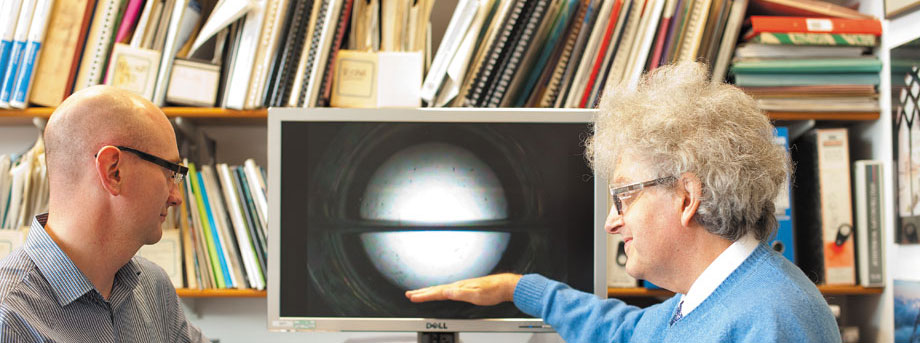
New accolades for Professor Poliakoff
A Nottingham professor is to receive two accolades from the world of science for his work to raise the profile of chemistry.
Professor Martyn Poliakoff is a familiar face to millions of YouTube followers around the world, after he was featured in the Periodic Table of Videos, a series of videos dedicated to each and every one of the 118 chemical elements, which became an overnight internet sensation.
Prof Poliakoff has been awarded the Royal Society of Chemistry’s Nyholm Prize for Education for his work on the videos, and has also been elected as a Foreign Member of the Russian Academy of Sciences. These honours come soon after Prof Poliakoff took up his role as the Foreign Secretary for the Royal Society, the UK’s national academy for sciences.
Read more at: http://tiny.cc/UoNPoliakoff
Tributes are paid to Don Varley
Tributes have been paid to the life and work of former University of Nottingham lecturer Don Varley, who has died at the age of 87.
Mr Varley played a significant part in the development of the University in a career spanning more than 40 years, as a senior lecturer, hall warden, student mentor and a key member of the academic community both in Nottingham and further afield.
Professor David Greenaway, Vice-Chancellor, said: “Don gave wonderful service to our University. He helped shape the lives of so many graduates in his academic role, but had an even more memorable impact as Warden of Rutland Hall. He will be warmly remembered as educator and mentor.”
Read more at: http://tiny.cc/UoNVarley
World leaders gather for two-day summit
World-leading business schools and major global corporations gathered at Nottingham University Business School for a major summit on corporate social responsibility and sustainable business last month.
The Academy of Business in Society (EABIS), was established 10 years ago, partly prompted by the global financial crisis. It now has more than 100 members worldwide made up of major players in business higher education including Harvard and ISEAD as well as global companies like IBM, Microsoft, Unilever and Shell. The two-day conference will see delegates review the development of sustainability and corporate social responsibility (CSR) in management education and to develop a roadmap for the future of business schools in both teaching and research.
Read more at: http://tiny.cc/UoNCSR
President honour for professor
Professor John Holmwood from The University of Nottingham has been appointed President of the British Sociological Association (BSA). Professor Holmwood has pledged to make sociology a necessary part of public life and debate during what he called a very testing time for universities.
John Holmwood, a Professor of Sociology in the School of Sociology and Social Policy, was elected by the trustees of the BSA late last year and will begin his three-year period in office in June. The BSA is the representative body in British sociology and has 2,500 members, most of them social scientists in UK universities.
Professor Holmwood said: “The next few years will be a very testing time for universities and for different disciplines as they adjust to the new market in higher education. A period of austerity will also test many other social institutions.”
Read more at: http://tiny.cc/UoNLong
Tags: British Sociological Association (BSA), corporate social responsibility, Don Varley, Nyholm Prize for Education, Periodic Table of Videos, Professor John Holmwood, Professor Martyn Poliakoff, Royal Society, Royal Society of Chemistry, Russian Academy of Sciences, Rutland Hall
Posted in media | Comments Off on Spotlight
Vet ‘first port of call for advice’
February 14th, 2012

Horse owners are most likely to use their vet to guide the choice of nutritional supplements they feed their animal, but also rely heavily on recommendations from other riders, a unique study has revealed.
Early findings from the research, being led by the University’s School of Veterinary Sciences, also found that joint and mobility and behaviour problems topped the list of owners’ concerns when seeking supplements.
Dr Sarah Freeman, Associate Professor and European Specialist in Large Animal Surgery, and study supervisor, said: “This collaborative study by vets and nutritionists is the first of its kind. It has given horse owners a voice on important issues, and the results will help vets, nutritionists and horse owners to work together to match needs for different horses.”
The study is being undertaken by two third-year veterinary students, Charlotte Agar and Rachael Gemmill, in collaboration with Dr Teresa Hollands at Dodson & Horrell Limited, a leading manufacturer of horse feeds, including nutritional supplements.
More than 800 horse owners took part in an online questionnaire for the survey, which was launched in September last year. The study was primarily aimed at dressage and eventing riders to look at which issues were of most concern to competition horse owners, what supplements they’d like to see available and the best ways of passing on information to them.
Initial results found that almost half of all owners (49.8%) rely on their vet for advice on supplements, followed by internet articles or reviews (39.4%). However, when asked specifically about their latest purchase of supplements, word of mouth and advice from other horse owners was identified as the most important source most frequently (18.5%).
Joint and mobility supplements were considered to be the most important, however, there were differences between the competitive disciplines, which is likely to be explained by the different demands of the individual sports.
Further research is needed. The next stage will involve interviewing individual owners.
Tags: Associate Professor and European Specialist in Large Animal Surgery, Dr Sarah Freeman, School of Veterinary Sciences
Posted in Research | Comments Off on Vet ‘first port of call for advice’
Project is a virtual winner
February 14th, 2012

A virtual reality maternity unit, which allows student midwives to practise their communication and clinical skills, has won a prestigious national award from the Royal College of Midwives.
The maternity unit built on The University of Nottingham’s ‘island’ in Second Life — an online 3D virtual world — has been developed by Jenny Bailey, a midwife teacher in the University’s Academic Division of Midwifery, as a teaching tool for her students.
The work has been done in collaboration with colleagues Colleen McCants and Fay Cross in the University’s Information Services department who helped bring Jenny’s idea to virtual life and with support from Dr Bob Hallawell in the Division of Nursing.
The RCM awarded the project the Philips Avent Award for Innovation in Midwifery at the annual awards ceremony of the College in London. The judges were impressed with the unit’s delivery of a range of scenarios and environments which student midwives can access, some of which they may not commonly encounter during real-life clinical practice in training. Facilities in the unit include all the equipment available in the modern labour suite including birthing pools, gym balls and inhalation analgesia (gas and air).
Jenny Bailey, midwife teacher in the Academic Division of Midwifery, said: “I am absolutely thrilled to be a winner, especially considering the excellent calibre of the other candidates. Hopefully, the virtual maternity project will continue to go from strength to strength.”
The University of Nottingham Maternity Unit in Second Life is designed to represent a range of similarities found within birthing units, with a birthing room that can be set up according to the type of birth that a mother has requested.
The computer simulation allows students to use avatars to role play through a range of scenarios, many of which they may not otherwise encounter during real-life clinical practice. With the midwife teacher taking on the part of the expectant mother, students can be put through their paces to assess how they react to every aspect of the experience, such as the clinical decisions they make or how well they communicate.
Jenny added: “Part of a midwife’s role is to be able to provide unbiased information to women so they can make informed choices for their journey through pregnancy and childbirth, and that means sometimes students need to alter or adapt their language depending on the situation to get the information across.
“Childbirth is a life-changing experience and some women can feel very vulnerable when they are in hospital so much so that it can affect their labour. Students need to learn very quickly how to put women at ease and gain their trust. Using avatars removes some of the embarrassment which can be experienced in real role play and is intended to enhance clinical practice rather than replace it.”
The Second Life simulation is so realistic that students can virtually practise clinical skills such as administering pain relief, checking the mother’s contractions and taking her pulse and blood pressure, with the results of tests being displayed in the midwife’s control panel on screen. They can also offer other support and reassurance, even sitting beside the mother on the floor and rubbing her back.
The tutor, as the expectant mother, plays a leading role in the labour including deciding the results of various tests and when the baby or placenta is delivered.
After the virtual birth, the students learn the procedures used during the first minutes and hour of a baby’s life to carry out the Apgar score to assess baby’s wellbeing or to record the weight or to establish feeding.
Chief Executive of the Royal College of Midwives, Cathy Warwick, said: “This project demonstrates that there is wonderful and ground-breaking work being done by midwives and I congratulate Jenny on her award. Midwifery practice is always moving forward and innovating. This shows that if we give midwives the resources and freedom to do this, the result is better services for women, babies and their families.”
See the video: http://youtu.be/BjBhcgclOeM.
Tags: Academic Division of Midwifery, Division of Nursing, Jenny Bailey, Maternity Unit in Second Life, Royal College of Midwives, virtual reality
Posted in News | Comments Off on Project is a virtual winner
Welcoming in the Year of the Dragon
February 14th, 2012


Lakeside Arts Centre and Highfields was packed with people welcoming in the Year of the Dragon. An evening of music, song, theatre and dance was rounded off with the traditional spectacular fireworks finale that Lakeside’s celebrations have become known for.
Tags: Chinese New Year, Year of the Dragon
Posted in Features | Comments Off on Welcoming in the Year of the Dragon
May
February 3rd, 2012
Presented by Probe (16+. Contains content that some could find disturbing)
Date: Tuesday 28 February
Time: 8pm
Venue: Djanogly Theatre,
Lakeside Arts Centre, University Park
Admission: £15, £12 concessions,
£9 restricted view
Posted in Theatre and Dance, What's On | Comments Off on May
DNA
February 3rd, 2012
Presented by Hull Truck (13+)
Date: Monday 20/Tuesday 21 February
Time: 7.30pm Monday, 1.30pm and
7.30pm Tuesday
Venue: Djanogly Theatre,
Lakeside Arts Centre, University Park
Admission: £6 all tickets
Posted in Theatre and Dance, What's On | Comments Off on DNA
Goldilocks
February 3rd, 2012
Presented by Little Angel
Date: Saturday 18 February and Sunday
19 February
Time: 1.30pm and 3.30pm
Venue: Djanogly Theatre,
Lakeside Arts Centre, University Park
Admission: £6 all tickets
Posted in Theatre and Dance, What's On | Comments Off on Goldilocks