

Campus News
The Dance of Death: Edward Burra’s Macabre and Surreal Images
April 16th, 2012
Simon Martin (curator)
Date: Tuesday 20 March
Time: 6.30pm to 7.30pm
Venue: Djanogly Art Gallery lecture theatre, Lakeside Arts Centre, University Park
Admission: Free
Posted in Issue 56, Public Lectures, What's On | Comments Off on The Dance of Death: Edward Burra’s Macabre and Surreal Images
Midwifery in the District
April 16th, 2012
Julia Allison
Date: Wednesday 14 March
Time: 1pm to 2pm
Venue: Djanogly Theatre, Lakeside Arts Centre, University Park
Admission: Free
Posted in Issue 56, Public Lectures, What's On | Comments Off on Midwifery in the District
Mothers and Midwives: A history of maternity in the East Midlands
April 16th, 2012
Friday 13 January to Sunday 15 April 2012 at Weston Gallery, Lakeside Arts Centre, University Park. The gallery is open 11am-4pm, Monday to Saturday, and noon-4pm, Sundays and bank holidays. Admission is free.
The experience of having a baby has changed dramatically in the past century. This exhibition explores this development through historical and contemporary sources, including interviews, photographs and equipment. It looks at reasons behind the change and the impact this has had on women, families, midwives and communities. Historic material from the University’s Manuscripts and Special Collections provides examples from published sources and archives of medical understanding and practice from the past. A series of lunch-time talks accompanies the exhibition.
Posted in events, Issue 56 | Comments Off on Mothers and Midwives: A history of maternity in the East Midlands
Craft Showcase at the Djanogly Art Gallery with Suet Yi Yip
April 16th, 2012
Wednesday 1 February to Monday 30 April at Djanogly Art Gallery, Lakeside Arts Centre, University Park. The gallery is open 11am-5pm, Monday to Saturday, and noon-4pm, Sundays and bank holidays. Admission is free.
Suet Yi Yip featured in Young Meteors at Lustre 2011 at Lakeside. The Hong Kong-born artist dreamt of living in a quiet place surrounded by hills and lakes. This love of the countryside inspires her art.
Posted in events, Issue 56 | Comments Off on Craft Showcase at the Djanogly Art Gallery with Suet Yi Yip
Small change, big impact
April 16th, 2012

Hundreds of University staff have opted to round their net pay down to the nearest pound each month – and donate the pennies to HeartLight: a unique sensor for newborn resuscitation.
The Small Change: Big Impact scheme automatically collects the pennies from net pay each month and places them in a fund to support vital research into HeartLight.
In a collaboration between engineers and clinicians, the HeartLight device is being developed here to save the lives of newborn babies in the UK and across the world.
Melissa and Simon’s son Joel was born 14 weeks early, weighing less than 1lb.
“Joel required resuscitation immediately at birth and was put on a ventilator,” said Melissa. “He had done really well, which is in part due to the expert care he received in the first few minutes of his life. New technology such as the HeartLight sensor could improve the care given at this crucial time, potentially helping to save lives and make a big impact on the outcomes of children like our son. We’ve been fortunate with Joel, and would urge people to support HeartLight at this exciting stage and help more parents to feel the same way in future”
The University’s student community is also supporting HeartLight through a series of events.
“Last year’s Karnival committee was invited to raise funds for a project from Impact: The Nottingham Campaign and came back with overwhelming support for HeartLight,” said Simon Buttenshaw, from the Campaign Office. “Given Karni’s outstanding track record in fundraising, I’m really looking forward to seeing how they do over the course of the year’.
Clinical Associate Professor of Neonatal Medicine Dr Don Sharkey, a project lead, said: “It’s really encouraging to have the backing of the University community for this project. Research into HeartLight is at a critical stage and support through Impact: the Nottingham Campaign will make a real difference and hopefully allow us to improve newborn resuscitation.”
To support this cause, staff need to log into the portal and follow the instructions on the ‘Me’ tab.
Impact: The Nottingham Campaign is delivering the University’s vision to change lives, tackle global issues and shape the future. More information on the Campaign is available at http://tiny.cc/UoNImpact.
Tags: Clinical Associate Professor of Neonatal Medicine Dr Don Sharkey, HeartLight, Impact: The Nottingham Campaign, Karni
Posted in Issue 56, News | Comments Off on Small change, big impact
After Lowry, there’s Burra
April 16th, 2012
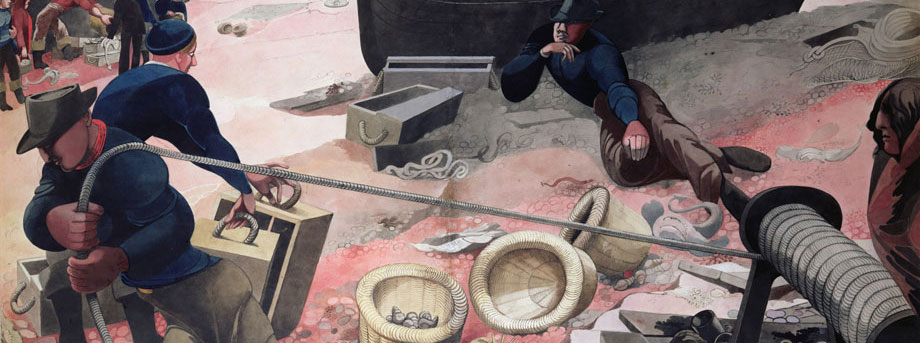
After the success of the record-breaking Lowry exhibition, Lakeside Arts Centre has just unveiled the first major exhibition of Edward Burra in over 25 years.
Burra (1905-1976) is one of the most individual British artists of the 20th century, creating a large body of memorable paintings during his lifetime.
Although he lived most of his life in Rye, Sussex, Burra travelled widely, and it is these trips that inspired much of his art. He was an observer, and spent a lot of time browsing flea-markets, cafes and pubs, where he met the hustlers, prostitutes and sailors that feature in his powerful and distinctive watercolours.
His affectionate depictions of 1930s’ Harlem and Boston nightlife led to him being described as “the best painter of the American Scene.”
He once described painting as “a sort of drug” and made it clear that he painted for himself. Other people liking his work was just a bonus.
A 1973 documentary on Burra, made by Carole and Peter Smith for the Arts Council of Great Britain, shows the eccentric Burra — crippled with arthritis — which makes his achievements even greater.
Burra is reluctant to talk about himself, asking the interviewer: “what is all this about personality?”
When asked does he like some of his pictures more than others, Burra answers: “I suppose so.”
“Which?”
“I don’t know.”
“I enjoy painting,” Burra said simply. “And then, I get tired of it after that. I don’t particularly want to keep the painting. I never hang any paintings up, hardly ever. They’re all kept in piles.”
“Nobody bought them years ago… and then they were discovered and people bought them.”
He conceded that his later commercial success was “useful” as it allowed him to buy things.
Burra remained distinct from most mainstream art movements though he was a member of the British art group Unit One and the English Surrealist Group in the 1930s and a close friend of the artist Paul Nash.
Like Lowry, this exhibition draws on private collections, with some pieces having not been shown in public for many years.
Edward Burra, which opened on March 3, is a Pallant House Gallery touring exhibition, curated by Simon Martin. It has been sponsored by Lefevre Fine Art Ltd and is supported by the Pallant House Gallery Edward Burra Supporters’ Circle. It runs until Sunday 27 May at the Djanogly Art Gallery. Admission is free.
A new documentary: I Never Tell Anybody Anything: The Life and Work of Edward Burra, featuring Andrew Graham Dixon, will be screened on Wednesday 18 April at 7pm. The film visits Burra’s old haunts and features haunting footage of Burra in conversation.
A series of guided tours are available to complement the exhibition. Tours are free but places are limited. To book, please call the Box Office on (0115) 846 7777.
Main image: Edward Burra Harbour (detail). Smaller image: The Straw Man (detail) © Estate of Edward Burra c/o Lefevre Fine Art Ltd.
Tags: Edward Burra, Lefevre Fine Art Ltd, Lowry, Pallant House Gallery Edward Burra Supporters’ Circle
Posted in Features, Issue 56 | Comments Off on After Lowry, there’s Burra
Raleigh call to city youngsters
April 16th, 2012

Youngsters at a Nottingham primary school had a lesson in road safety… 1950s style.
The pupils at Southwold Primary School in Radford were put through their paces in a reconstruction of the original cycling proficiency test.
The event launched a project led by the University and local community theatre group Hanby and Barrett to celebrate the 125th anniversary of Nottingham-based Raleigh, the world’s oldest bicycle company.
Professor Christine Hall, Head of the School of Education and one of the academics leading the project, said: “This year marks 125 years since Raleigh began trading in Nottingham and its name has since become synonymous with the city.
“We were delighted when Raleigh agreed to collaborate with us on a community history project to commemorate this very special occasion. The site of one of the company’s most important factories on Triumph Road is now home to our own Jubilee Campus and, as such, we feel that we have a very special relationship with the company and its roots in the city.”
Pupils had a go at the original cycling proficiency test — which resulted from a report from a working party set up in 1958 by the Ministry of Transport and Civil Aviation — under the direction of actors from Hanby and Barrett in the guise of 1950s’ cycle inspectors.
Headteacher Kate Clifford said: “We are very excited at being chosen as the partnership primary school in this project. It will be great for the children to learn more about the history of the area while at the same time taking part in some fun and enriching activities. We are hoping it will also encourage more children to bring their bikes to school in the future.”
The Raleigh project, which involves staff from the University’s Schools of Education, History, English and Computer Sciences, aims to engage with the local community to celebrate Raleigh’s history and heritage.
A Raleigh-based lecture series — organised by the University’s Centre for Advanced Studies — kicked off on February 21 with Andrew Ritchie, the creator of the Brompton folding bike. Cycling historian Roger Lovell spoke about the origins of the cycle industry on February 28. On March 6, former Raleigh employees gathered to speak about their experiences, while John MacNaughtan and Tim Buxton, of Raleigh, will round off the series on March 20 with a talk on the company’s international reach and future plans.
Hanby and Barrett will also be creating a performance looking at Raleigh’s history and the experiences of the thousands of Nottingham men and women who worked there. The performance will tour venues across the city in May and June. Producer Julian Hanby said: “This is a great opportunity to work with members of the community and The University of Nottingham on an event that will celebrate the Jubilee Campus and its former use. It was once the most modern bicycle factory in the world and we hope that members of the public — including many former Raleigh employees — will visit the site for these events, and relive memories of past activity there.”
The events will culminate in a community open day at Jubilee Campus on Saturday 16 June.
Raleigh’s story began in 1887 when Sir Frank Bowden bought an interest in a small bicycle shop based on Raleigh Street. During its 125-year history, the company has become famous for its innovative bicycle designs, particularly the iconic children’s bikes the Burner, Grifter and Chopper. Despite moving from its Triumph Road factory in the early 2000s — now home to the University’s Jubilee Campus — the company has retained its strong links with Nottingham and the company’s HQ is now in nearby Eastwood.
John MacNaughtan, from Raleigh, said “As the leading UK bike brand for 125 years, Raleigh shaped many of the engineering and processing practices seen in today’s cycling industry. In the 1960s, 70s and 80s these practices were refined through studies carried out by a number of Nottingham University departments, narrowing the gap between ‘theory’ and ‘practice’, resulting in many new innovations and revolutionised working practices. Raleigh is proud of its long association with The University of Nottingham and we’re pleased to be collaborating again in our landmark anniversary year.”
Posted in Features, Issue 56 | Comments Off on Raleigh call to city youngsters
Memorial fund to help continue Sue’s work
April 16th, 2012
A fund has been set up in memory of a leading scientist who has died of breast cancer.
The Sue Watson Cancer Fund will support young researchers, particularly non-clinical scientists, working to discover new cancer treatments, something Professor Sue Watson believed in passionately.
Friends and colleagues from the University and from the wider scientific community have paid tribute to Sue, a greatly respected and warmly admired scientist and a leader in the School of Clinical Sciences.
Sue studied and worked at the University for almost 30 years as PhD student, Research Fellow, Senior Lecturer, Reader and, from 2002, Professor of Pre-Clinical Oncology. She published more than 135 scientific articles on cutting-edge research and developed several new treatments in the field of cancer.
In 2010, she established the Ex Vivo Pharmacology Centre of Excellence within the Division of Pre-Clinical Oncology. She also established a company, PRECOS Ltd, which specialises in bridging the gap between research and industry, recognising that without industry involvement discoveries were unlikely to reach patients.
John Atherton, Head of the School of Clinical Sciences, said: “Brilliant and radical initiatives such as this were typical of her, and will ensure that she leaves a rich legacy in cancer research.”
Sue’s achievements are reflected in the tributes from colleagues around the world after her death, and in the awards made to her during her career. Most notable were two prizes for best young UK researcher in different fields: the Moynihan Prize (1999) for the best UK research in the area of general surgery and the Sir Francis Avery Jones Research Medal (2002) for the best UK research in the area of gastroenterology.
Sue also served on several committees, including the Cancer Research UK Discovery Committee and the Council of the European Association for Cancer Research.
One of her greatest legacies was in enthusing staff and helping them create a stimulating, useful and successful career in medical scientific research.
Prof Atherton said: “Many of us owe Sue a great debt of gratitude for supporting the development of our careers and enthusing us for science and research. Sue was enormously proud of her family. She leaves a husband Chris and two daughters, Gabby and Maddy. They are enormously proud of Sue and her achievements. Sue will be missed on so many levels – as a brilliant and talented colleague, as an inspiring mentor, but most especially as a caring friend, wife and mother.”
Colleague Anna Grabowska added: “Sue always approached new challenges with enthusiasm, leading by example, and, by expecting the same commitment from her staff, encouraged us to achieve beyond our own expectations.”
To make a gift to The Sue Watson Cancer Fund, please contact Ashley Flint on 0115 951 3627, or send a cheque to Campaign Office, The University of Nottingham, King’s Meadow Campus, Lenton Lane, Nottingham, NG7 2NR.
Tags: Ex Vivo Pharmacology Centre of Excellence, Head of the School of Clinical Sciences, John Atherton, PRECOS Ltd, Professor of Pre-Clinical Oncology, School of Clinical Sciences, The Sue Watson Cancer Fund
Posted in Issue 56, News | Comments Off on Memorial fund to help continue Sue’s work
Aiming high…
April 16th, 2012

University of Nottingham student and international high-jumper Isobel Pooley has her sights set on a place at London 2012 after taking gold at the BUCS Indoor Athletics Championships in Sheffield.
Success at her first university championships comes just weeks after the Biosciences student set a new personal best of 1.88 metres – a mark just 4cm short of the British Olympic team’s provisional qualification mark.
Isobel said: “I’m over the moon to have won the Championships. There were some great contenders for the title so I am delighted to have been able to pull out a good performance when it really mattered and to have done the University proud!
“With the Olympic qualification standards as they are I could earn a place on the team with only a 4cm improvement on my personal best, and I have four months to achieve this. Selection takes place in early July, with the Olympic Trials in late June, so for me it’s just a case of training hard and hoping that the rewards will come in time for London.”
The University’s sports department, which is aiming to be The Academic University of Choice for talented sports-people, provided Isobel with a bursary to help her balance her academic and sporting commitments.
Nigel Mayglothling, Assistant Director of Sport, said: “Our University has a proud tradition of supporting academic students in pursuit of Olympic glory and we will continue to support Isobel in every way possible towards London 2012 and the Road to Rio for 2016.
“Isobel is still very young in high-jumping terms so the future is clearly bright and we’re looking forward to her competing for us again in the BUCS Outdoors event in the Olympic Stadium this June — hopefully only a warm-up event for her to compete there again later in the year.”
Isobel added: “Without sounding boastful or cocky I am confident that I will break the British Record (1.95m) one day. My success so far has been remarkable and I’m still very young in high-jump terms — jumpers are at their prime in their late 20s so I have plenty of years left in the game!
“Obviously my height is an advantage, something I inherited from my Dad — he’s 6ft 10in and I’m 6ft 3in, and I know that I have the drive and the commitment to go all the way.”
Tags: BUCS Indoor Athletics Championships, Isobel Pooley, Nigel Mayglothling, The Academic University of Choice
Posted in Issue 56, News | 2 Comments »
‘Café culture’ is to blame
April 16th, 2012

England should look to Scotland to solve its drinking culture, which has seen having a pint of lager become as cheap and freely accessible as downing a pint of milk, says a Nottingham academic.
Dr Jane McGregor, a specialist in drug and alcohol addiction treatment in the School of Nursing, Midwifery and Physiotherapy, said that with prices for a four-pack of lager as cheap as a pint of milk in some cases, people are drinking too freely and often way in excess of sensible limits.
And, she said that with initiatives such as minimum pricing, Scotland is leading the way in fighting back against its traditional hard-drinking image, placing it way ahead of its more liberal neighbours.
Dr McGregor said: “It is treating alcohol as a health risk, rather than an issue of disorder — England is only now waking up to this.
“Because of the huge impacts of alcohol misuse on health, the Scottish Parliament has been quicker to act than the rest of the UK and now is way ahead of the curve in this area.”
Dr McGregor has just launched a book about alcohol problems in urban Britain, Drink and the City, which tracks drinking trends and the many factors which have led the UK to its current situation.
The book comes just weeks after the Prime Minister David Cameron called on the drinks industry to do more to tackle the ‘scandal’ of drunkenness and binge drinking and hinted that the Government’s alcohol strategy — due to be published later this year — could contain proposals for minimum pricing for drink and the potential use of US-style ‘drunk tanks’ to detain people while they sober up.
Dr McGregor said that Government liberalisation of alcohol laws had led to more deaths and an increase in health problems. She blamed a bid by politicians to create a ‘café culture’ and to rejuvenate city centres through the relaxation of licensing laws for fuelling binge drinking. Alcohol-related deaths are on the increase — the Office for National Statistics reported 8,790 fatalities in 2010, up 126 on the previous year.
The English Government favours ‘nudging’, a non-coercive approach to behaviour change.
She added: “It expects people to follow the unit system of measure which was set in the l980s. This sets sensible drinking limits of 21 units a week for men, and no more than 14 for women. While there is no evidence to raise the limits, there is evidence that this approach on its own is not enough. This is why the Government must look at other means — minimum pricing being just one of a number of levers — to encourage everyone to change their drink behaviour.”
Dr McGregor said that Scottish policymakers had been quicker to emphasise public health concerns because the full impact of increasing levels of alcohol consumption has recently become all too apparent. Alcohol-related mortality in Scotland is twice that of the rest of the UK, with one Scot dying every six hours as a direct result of alcohol misuse, according to recent studies.
Scottish Parliament passed the Alcohol etc. (Scotland) Act 2010, which came into force on October 1 2011 and introduced a ban on promotions that encourage binge drinking, such as ‘3 for 2’ and ‘3 bottles for £10’.
A recent report by Alcohol Focus Scotland calls for the Scottish Government to take further action to regulate off-sales and return licensing to its fundamental purpose of controlling the availability to prevent harm. This includes calls for separate alcohol checkouts and reduced trading hours.
Dr McGregor added: “Now the Scottish Parliament proposes to set minimum prices for alcohol, and is utilising the abundant evidence that the most effective way of reducing consumption and harm is increasing the price of alcohol relative to disposable income. Policymakers in England are looking to Scotland to lead the way.”
Drink and the City — Alcohol and Alcohol Problems in Urban UK Since the 1950s is published by Nottingham University Press.
Tags: Alcohol Focus Scotland, chool of Nursing, Dr Jane McGregor, Drink and the City, Midwifery and Physiotherapy
Posted in Issue 56, Research | Comments Off on ‘Café culture’ is to blame