

Campus News
NSS: sharing the student experience
January 14th, 2014
It may have enjoyed its fair share of controversy since launching in 2005 but for better or worse the National Student Survey (NSS) is here to stay. With increases to tuition fees and the introduction of Key Information Sets (KIS), students are becoming ever more discerning about their choice of university and increasingly reliant on data to inform that decision.
In recognition of this, the University continues to target an overall satisfaction score of 90% in the NSS and a top 20 place by 2015.
While results have steadily improved, overall satisfaction in the 2013 survey was almost the same as the previous year, at 88%. But improvements by other institutions meant the University saw a relative decline, dropping from 41st in the rankings in 2012 to 64th in 2013.
“It is frustrating and challenging but we know that this is a fantastic university,” said Dr Paul Greatrix, University Registrar, adding that the results highlighted the need for a shift in focus.
“We’ve got fantastic resources, we’ve got very able students, excellent staff, great courses, and we’ve got amazing opportunities for learning. All of those elements are the right ingredients to enable every student to have the best possible education experience.”
“Part of what we’re trying to communicate about this is a sense of ambition about the student experience. [It is] about putting it front and centre in terms of the University’s mission and being absolutely clear that we are utterly, totally committed to providing the best student experience and the best possible teaching and learning.”
Although a top 20 place in the NSS remains a target for the University, Dr Greatrix stressed that providing a first-class experience for University of Nottingham students remains the bottom line.
“Everyone needs to be under no illusion that we have to do better in this, but fundamentally what we’re about is focusing on students and ensuring that they have the best possible learning experiences,” he said.
“Ultimately one would hope that is reflected in the NSS and if it isn’t we’d be a bit disappointed, but if our students are telling us they’re having a better experience and they’re feeling more comfortable about their teaching and learning then that’s fantastic.”
The University Executive Board and representatives of the Students’ Union will visit Schools in the New Year to discuss how to engage with students and find out what support is needed to improve results.
NSS 2014 campaign launches on 3 February. Schools will be kept up to date with response rates ,and examples of best practice will be shared to help them promote the survey. For details, email: studentcommsoffice@nottingham.ac.uk
Tags: Dr Paul Greatrix, Executive Board, National Student Survey, NSS, Students' Union, University Registrar
Posted in News | Comments Off on NSS: sharing the student experience
Bulletin board
January 14th, 2014
Accolade for University’s banking MSc programme
A postgraduate degree course at Nottingham University Business School aimed at producing the next generation of financial business leaders has attracted a prestigious endorsement.
The Chartered Banker Institute has confirmed its accreditation of Nottingham’s MSc Banking and Finance programme, making it the only MSc of its kind in Europe to be accredited by the Institute.
Professor James Devlin, Associate Dean and Director of the Centre for Risk, Banking and Financial Services said: “The formalisation of our relationship with the Chartered Banker Institute via full accreditation of our MSc Programme is an exciting development and one which endorses the School’s excellence and heritage in the areas of banking, risk and financial services.”
Chartered Banker status is the gold standard for banking professionals.
Mark Roberts, Head of Learning Partnerships at the Institute, said: “The MSc is an excellent programme that will prepare its graduates for work in the sector or further study and are pleased to recognise the quality of the programme with the recognition of Chartered status.”
New School of Medicine underlines excellence
The Chief Executive of Health Education England, Professor Ian Cumming OBE, has officially open the new School of Medicine.
The School includes a new library and student hub, an admin department, meeting rooms and a café for students and staff.
Professor John Atherton, Dean of the School of Medicine said: “We are really proud to launch our new, greatly-expanded School of Medicine. Our size means that we can be truly innovative in training tomorrow’s doctors — building a caring professional ethos and concentrating more on debilitating long term illnesses. We will now be able to perform even more research that really matters.
“Recently we have renewed our UK Centre for tobacco control to include alcohol and further grown our national centres for hearing research and for bowel and liver research… among many other areas where we lead in the UK. Medicine in Nottingham will be bigger and better — locally, nationally and internationally.”
The School of Medicine makes up part of the new Faculty of Medicine and Health Sciences at the University.
PhD student lands gender research award
A PhD student at Nottingham University Business School has won the Michael Christie award for Best New Research Paper in Gender at the 2013 Institute of Small Business and Entrepreneurship (ISBE) Conference.
Angela Martinez Dy, MSc Entrepreneurship 2010, is in the third year of her PhD which focuses on women’s online entrepreneurship. She is supported by her supervisors Dr Lee Martin and Professor Susan Marlow, experts in creativity and gender, respectively, at the University’s Haydn Green Institute for Innovation and Entrepreneurship.
Angela said: “It feels really encouraging to be recognised as a new researcher in gender, especially by an audience of people outside of my immediate university circle. It was also good to see an award for gender research specifically and the positive focus on this area.”
Professor Marlow said: “I am delighted that Angela has won this prestigious award. This conference is the largest European event for UK entrepreneurship researchers and to be recognised as a leading young researcher here is a real achievement. It is so gratifying to see Angela’s hard work and excellent research acknowledged.”
Tags: Angela Martinez Dy, Banking and Financial Services, Centre for Risk, Chartered Banker Institute, Dean of the School of Medicine, Dr Lee Martin, Dr Lee Martin and Professor Susan Marlow, Health Education England, Institute of Small Business and Entrepreneurship (ISBE) Conference, Mark Roberts, Michael Christie award for Best New Research Paper in Gender, Nottingham University Business School, Professor Ian Cumming, Professor James Devlin, Professor John Atherton, Professor Susan Marlow
Posted in Bulletin board | Comments Off on Bulletin board
Impact: Our achievement
January 14th, 2014
The University’s biggest ever fundraising campaign has raised £100m in just two years and is now more than two thirds of the way towards its target.
Impact: The Nottingham Campaign was launched in October 2011. It is supporting a vibrant range of projects which are already changing people’s lives, shaping the future and having a global impact.
Generous gifts from all over the world are being regularly contributed, adding to major gifts including our largest ever corporate gift and our largest ever single gift from an alumnus.
The £100m announcement was made at the launch of the Pop Art to Britart exhibition at Lakeside. The exhibition is from the private collection of alumnus David Ross, who is Co-Chair of the fundraising campaign.
Vice-Chancellor Professor David Greenaway said: “It is a remarkable achievement to have come so far, so soon in the Campaign’s life and it gives me immense pride to see tangible evidence of its impact on communities locally, nationally and internationally.
“Impact is funding our world-leading research on critical global issues; enabling students to fulfil their potential in the broadest sense by supporting the arts, sport and community projects; and continually widening access to a Nottingham education.
“Our supporters should feel pride in what they have helped us to achieve and I thank everyone whose contributions, whether through donations or support, have got us to this point.
“Although this means we are well on course to reach our £150m target I am well aware that we still have a third of the way to go and raising the last £50m will be a big challenge. I hope even more people will be inspired by Impact and will join with us to reach our ambitious goal.”
The Campaign has already had a visible impact:
• Crucial advances into childhood brain tumours, reducing the time it takes to diagnose tumours from 9.1 to 6.9 weeks
• 2,000 of Nottingham’s most disadvantaged children to enjoy a programme of educational support
• More support for palliative care research, stroke rehabilitation research and wider educational aspiration and attainment in the City, thanks to the three UK-wide Life Cycles
• More than 500 new student scholarships, bursaries and prizes rewarding excellence and including an extra £100,000 to help students from lower income backgrounds
• Two gold, two silver and a bronze medal won at the 2012 London Olympics, won by student and alumni sports bursary recipients
• Five new professorial chairs
• 600 staff regularly donating loose change from their wages. Many donations from University alumni and friends support Cascade, a fund which has already supported more than 150 student projects enhancing the lives both of the students themselves and many people around the world.
Recent grants helped some of the poorest communities in Ghana and South Africa, and supported a farmers’ market at Sutton Bonington. Meanwhile on the University’s Innovation Park, construction has begun on one of the Campaign’s landmark projects, the £20m GlaxoSmithKline Carbon Neutral Laboratory for Sustainable Chemistry, which is set to become a global centre of excellence shaping the future of drug discovery.
Tags: Children’s Brain Tumour Research, David Ross, GlaxoSmithKline Carbon Neutral Laboratory for Sustainable Chemistry, Impact: The Nottingham Campaign, Life Cycle, Pop Art to Britart, Vice-Chancellor Professor David Greenaway
Posted in News | Comments Off on Impact: Our achievement
Mandela: a giant
January 14th, 2014
The Vice-Chancellor of The University of Nottingham, Professor David Greenaway, has added his tribute to the global accolades for the extraordinary life and work of Nelson Mandela.
Mr Mandela died at his home in Johannesburg on 5 December, aged 95.
Mr Mandela was awarded an honorary degree by The University of Nottingham in 1996 in recognition of his leadership in fighting apartheid.
Nottingham joined seven other universities — Oxford, Cambridge, London, Bristol, Warwick, De Montfort and Glasgow Caledonian — in awarding Mr Mandela a degree on 10 July 1996.
There were so many universities that wished to confer an honorary degree on Mr Mandela at the time that it was decided to incorporate them into one ceremony. That ceremony took place at Buckingham Palace during a state visit from 9 to 12 July, with Nottingham’s then Vice-Chancellor Sir Colin Campbell.
At the ceremony, Professor Lawrie Challis, Pro-Vice-Chancellor, described Mr Mandela as “the Mahatma Gandhi and the Abraham Lincoln of our time.”
On hearing the news of Mr Mandela’s death, Vice-Chancellor, Professor David Greenaway, said: “I had the honour of meeting Mr Mandela when I spoke at the Edinburgh Commonwealth Summit in 1997, an unforgettable experience. He was one of the giants of the 20th century. He did much more than just change South Africa, he helped redefine an entire continent’s role in world politics and, in doing so, he inspired a generation in how to achieve change.”
Tags: honorary degree, Nelson Mandela, South Africa, Vice-Chancellor Professor David Greenaway
Posted in News | Comments Off on Mandela: a giant
Pop Art to Britart a smash
January 14th, 2014
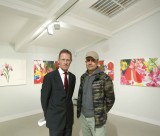
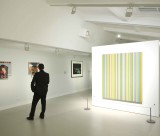
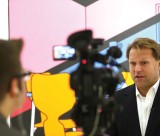
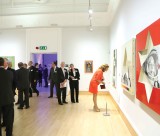
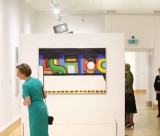
More than 3,000 people have enjoyed the Pop Art to Britart exhibition since it opened at Lakeside Arts Centre at the end of November.
The show, from the private collection of Carphone Warehouse boss David Ross, includes works by Pop Art figures such as David Hockney and Peter Blake, through to pieces by Marc Quinn and Damien Hirst.
Following the success of the record-breaking LS Lowry exhibition at Lakeside in 2011, Pop Art to Britart is also on course to attract thousands of visitors, again drawn to a remarkable opportunity to see a unique collection.
Sir Nicholas Serota, Director, Tate, who opened the exhibition, said: “The collection of David Ross is one of the most important collections of modern British art in the UK. Chosen with real discrimination, each of the works is a fine example, and several of the artists are represented by outstanding paintings. The exhibition fills the galleries with vibrant colour and presents a compelling account of British art over a 50-year period.”
Mr Ross is a member of the University Council and his funding of Nottingham Potential is helping transform lives by helping less advantaged young people reach university. He is co-chair of the Impact: The Nottingham Campaign, and news of its £100m fundraising milestone was announced at the exhibition’s launch.
Vice Chancellor Professor David Greenaway said: “It is wonderful to see art of this quality at Lakeside for our staff and students to enjoy, as well as the tens of thousands of visitors it will attract to Nottingham.”
Lakeside Director Shona Powell said: “I’d like to thank David Ross for his extraordinary generosity in sharing his treasured possessions in this very public way, so that Lakeside’s audiences have this unique experience to enjoy such an exceptional collection.”
Pop Art to Britart, Modern Masters from the David Ross Collection, is at Djanogly Art Gallery, Lakeside Arts Centre, until Sunday 9 February.
Tags: Carphone Warehouse, Damien Hirst, David Hockney, David Ross, Djanogly Art Gallery, Impact: The Nottingham Campaign, Lakeside Arts Centre, LS Lowry, Marc Quinn, Nottingham Potential, Peter Blake, Pop Art to Britart, Sir Nicholas Serota
Posted in News | Comments Off on Pop Art to Britart a smash
January 10th, 2014
Landscapes of Space
Paintings and Prints by Tess Jaray
Richard Davey, Co-ordinating Chaplain, Nottingham Trent University and Visiting Fellow in the School of Art and Design, introduces the work of Tess Jaray in conversation with the artist
Date: Thursday 20 February
Time: 1pm to 2pm
Venue: Djanogly Art Gallery Lecture Theatre, Lakeside Arts Centre,
University Park
Admission: Free
Origins of the Afro comb Project
Archaeology NOW
Sally-Ann Ashton, curator of an exhibition at the Fitzwilliam Museum and Museum of Archaelogy in Cambridge
Date: Wednesday 22 January
Time: 1pm to 2pm
Venue: Djanogly Theatre, Lakeside Arts Centre, University Park
Admission: Free
Yangshi Lei: An Architectural Story of China’s Last Empire
Dr Wang Qi
Date: Wednesday 26 February
Time: 1pm to 2pm
Venue: Djanogly Theatre, Lakeside Arts Centre, University Park
Admission: Free
Posted in Public Lectures | Comments Off on
Profile: Dr Rita Tewari
January 10th, 2014
Tell me a bit about yourself?
I was born and grew up in Delhi. I was always fascinated by biology. After school I wanted to do medicine but my father – who was a professor in Social Sciences — moved to northeastern India, a backwater, to establish a university. There were no medical colleges so I went for Zoology. I started my PhD at the University of Delhi, studying genetics and sex chromosomes. I became hungry for research, wanted to see more and the only way to do that was to go abroad in good labs. My life is such a mixture now with languages, culture, with friends — I have friends all over in Europe — and it becomes your life.
Do you have a typical day?
In the lab, talking, planning. And then there are the students. So it’s part research, part teaching, a bit of fun and conversation. My modules include pathogens, mainly about malaria parasites, bacteria, fungi — you get students that can really inspire you.
What drew you to this area of research?
Imperial College wanted me to work on transgenic mice. The panmalarial parasite first attacks the host’s liver cells. So can I express certain proteins in the mice’s liver so the parasite cannot invade? That’s how I got into malarial research. The basic processes, whether it’s a human cell or a mouse cell or a parasite cell are more or less the same. For me, that is the beauty of biology: there are no boundaries if you want to ask simple questions — how does the cell divide, how can I make the cell stop?
What does it involve?
Now we are very much interested in how a parasite cell divides, that’s our major grant now. Can we stop these protein, stop the cell division? Can we target them?
In parasites, particular proteins direct them. Some of these like kinases are very important — if you block them the cell cannot grow. At Imperial College I started this ambitious project to knock out [replace one gene with another] each of the 72 kinase genes in the genome one by one and understand the function. That was a big gamble, a very, very ambitious project. I was quite close to finishing when this job at Nottingham came up. I finished that work [the world’s first comprehensive study of the molecular switches in the malaria parasite’s life cycle] and that made me.
Now we are doing the other side of the coin, the phosphatase, which returns the protein to its silent state. Nobody has studied these phosphatases at this scale.
The malaria lifecycle has two parts — one is the host, for which we do everything in mice, and the other side is mosquitoes, and to maintain the colony was the biggest challenge. Now we have both the mosquito and host stages here at Nottingham so we can study the protein or any gene function in the parasite through the life cycle and that gives me the advantage because many labs either do one or the other.
What do you like most or least about your work?
I love sitting at the microscope! I love the lab. I can sit at the microscope for hours. Every time you see a cell it looks different, it has something else to show you. Least: Too many student answer sheets! I like creativity or a challenge.
What are the highs and lows of your career?
Getting a PhD was a big thing for my family and for myself. A big high was working for Frank Grosveld [head of the Department of Cell Biology at the Erasmus University Medical Centre, Rotterdam] in Holland. I think Imperial exposed me to lots of challenges, and here [Nottingham] when I got this work published. I think every paper is a high and now it’s not just for me, it’s a group effort.
Lows? [Dr Tewari encountered racism from one foreign individual at her lab in Norway but has nothing but praise for the country as she has made some lasting friends there.]
For me the biggest part of a scientific career is learning about people, their culture, the language and that I would have never learned if I had not taken this journey.
What do hope your research will achieve in your lifetime?
I’m hoping there will be drugs and a better quality of life for people who suffer from malaria, at least in Africa. The Indian sub-continent has improved a lot but the parasite is also mutating so you have drug resistance. Malaria will not be eradicated: I think it can be controlled. Education is important.
What advice would you give your younger self?
Have a passion for your work. For me to come on a Saturday or at four in the morning because I want to see a result is not a hardship. What drives me is that I want to know the unknown. For me, it’s not work: I love every bit of it.
What living person do you most admire?
I really admire my old boss in Holland, Professor Grosveld, and Dr Tony Holder, who’s in London [at the National Institute for Medical Research]. They are both famous scientists but the thing I admire in them is that they are both very good human beings, and they understand people.
Who would you invite to your dream dinner party?
My neighbours — they’re great — my students and group and my mentors. My parents, my family.
If you weren’t doing this, what else might you be doing?
I don’t know! Maybe I should open a restaurant — I love cooking. There would be food from every part of the world that I’ve lived. My cooking in not ‘Indian’ anymore, it’s a mixture. I’m a vegetarian, I mix things, it’s the same I do in research, if you’re exposed to so many different things you can think, create.
Where do you call home?
It’s where I live because I have been a nomad. India is still a big part of me — my father and sister and most of my family are there — but I call myself now ‘part of this world’. Home would be where I’m living now.
Where would you go back in time?
I’m a person of the here and now.
How do you relax?
I love cooking, going to concerts. I love live music: jazz, world music — I don’t always understand the language but I love listening to it — or meeting people. Lakeside is a favourite of mine.
Tags: Centre for Genetics and Genomics, Dr Rita Tewari, School of Biology
Posted in People profiles, Profile | Comments Off on Profile: Dr Rita Tewari
Reacting to death toll on Malaysia’s roads
January 10th, 2014
Malaysia has one of the world’s highest death rates from road accidents, according to the International Transport Forum.
The UK, however, has a much lower rate and is experiencing a downward trend.
A cross-cultural study of drivers carried out by the School of Psychology’s Driving Research Group at The University of Nottingham Malaysia Campus (UNMC) and The University of Nottingham in the UK showed that Malaysian drivers have much slower reaction times and required a higher threshold of danger before taking action. The study also found that the better we know a road, the more likely we are to identify hazards.
This could have consequences for hazard perception tests for drivers in developing countries where road safety is a primary concern.
The International Transport Forum’s Annual report for 2013 showed that in 2011 there were 1,960 fatalities on UK roads — a fall of nearly 64% since 1990. In Malaysia the figure was 6,877 — a rise of 70% since 1990.
Phui Cheng Lim, a postgraduate student who led the research, said: “The fact that Malaysian drivers were slower to respond to danger possibly reflects the more hazardous road environment they are used to.
“Although hazard perception tests are used in several developed countries as part of the driver licensing curriculum, little research has been done in developing countries where road safety is a primary concern. Our results suggest that hazard perception testing, particularly in developing countries, would benefit from a paradigm where performance cannot be confused with differing thresholds of what is regarded as a potential hazard.”
The research — “Cross-cultural effects on drivers’ hazard perception” — was carried out in Malaysia and the UK. It was instigated by Dr Elizabeth Sheppard shortly after she arrived at UNMC. Funded by an Early Career Research and Knowledge Transfer grant from The University of Nottingham, the research has been published in the academic journal Transportation Research Part F: Traffic Psychology and Behaviour.
Dr Sheppard said: “I thought getting a car would make life easier but I soon realised that driving in Malaysia was very different from back home in Britain. I had to completely rethink my driving strategy.”
Dr Sheppard now heads the Driving Research Group, which is among the first groups to do experimental research on driving in Malaysia. Until now most studies have been based on surveys or observational analysis looking at the social aspects of driving.
Volunteers from the UK and Malaysia were shown videos of driving scenarios in both countries and tested on their reactions. The difference was statistically significant, with British drivers taking an average of 1.68 seconds to register the emerging threat while Malaysian drivers took 2.25 seconds to respond.
Eye-tracking data showed the Malaysians saw the hazards at the same time as the British drivers but took longer to respond, suggesting they considered the hazards less dangerous.
Dr Sheppard said: “Although Malaysian drivers reacted more slowly, having a slightly attenuated view of what constitutes a hazard doesn’t mean you’re not noticing what’s going on around you. The kind of test we used works very well in the UK, but for countries where people seem more desensitised to hazards, it may not be as appropriate.”
Her team is investigating alternative ways to examine hazard perception.
Tags: Dr Elizabeth Sheppard, Driving Research Group, Early Career Research and Knowledge Transfer, International Transport Forum, Phui Cheng Lim, School of Psychology, The University of Nottingham Malaysia Campus, Transportation Research Part F: Traffic Psychology and Behaviour, UNMC
Posted in Research | Comments Off on Reacting to death toll on Malaysia’s roads
Festival of carols
January 10th, 2014

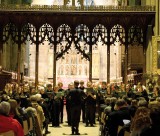

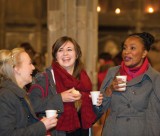
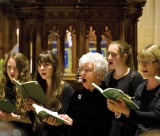
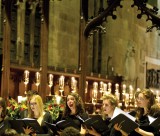
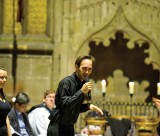

The Christmas season was launched with the University’s Festival of Lessons and Carols at the Church of St Mary the Virgin in Nottingham’s Lace Market.
The traditional carol service featured Viva Voce Chamber Choir, The Revival Gospel Choir and The University Choir. After the service, students, staff and the wider community enjoyed seasonal refreshments.
The Revd Canon John Bentham, the University’s Co-ordinating Chaplain, said: “The Festival of Lessons and Carols was once again a great success, bringing students, staff and friends of the University together in the magnificent beautiful candlelit surroundings of St Mary’s to enjoy some inspirational Christmas music from three University Choirs and hear once again the timeless Christmas Story read from the scriptures by staff and students.”
Tags: Festival of Lessons and Carols, Revd Canon John Bentham, The Revival Gospel Choir, The University Choir, Viva Voce Chamber Choir
Posted in News | Comments Off on Festival of carols
Milestone for video stars
January 10th, 2014
The University of Nottingham’s chemistry-themed Periodic Table of Videos is firmly established as an internet heavyweight — attracting more than 350,000 YouTube subscribers in the last five years — and is celebrating this success in style with its 500th video.
The brainchild of video journalist Brady Haran and fronted by unlikely internet sensation Nottingham’s Professor Martyn Poliakoff, the team has travelled the globe — including Everest basecamp and Sydney’s Bondai beach — to fulfil its initial aim of making a video about each element in the periodic table. And, having established a loyal fan base, they couldn’t stop there and have now hit the 500 mark.
The celebratory 500th video is a round-up some of the series’ very best moments since its launch in 2008. It features impressive explosions, some of Professor Poliakoff’s classic lines, and lots and lots of bars of gold.
One of the big reasons for the videos’ success is the Professor Poliakoff — as celebrated in the 500th video. But Brady had no idea how popular the professor would prove.
Brady said: “Off camera the professor is very humble and almost shy. He doesn’t strike you as a clichéd ‘internet star.’ But in hindsight it is that humility, combined with great knowledge, that makes him so popular. People can spot a fake — and they know Professor Poliakoff is the genuine article.”
In addition to the Poliakoff-effect, Brady believes that it’s chemistry itself which is key to the videos’ popularity. He said: “I think that even after 500 videos, the scientists are still excited to be sharing their love of chemistry. I also think the videos try to be very honest and show what life’s like in a real lab. You don’t see that unvarnished depiction of science too often on TV or in videos.
“We’ve also been lucky — with so many people making so many videos, you need a little bit of luck on YouTube.”
But reaching the 500th video doesn’t signal the end — there’s lots more in the pipeline.
Brady said: “For starters we’d like to update our element videos. Some of them could be much better. There are countless molecules we’re yet to discuss. And every day there are new stories and things happening around the world with a chemistry angle. We’ve also got our hands on some new equipment and cameras which will help us show things we’ve not tried to capture before.”
Professor Poliakoff is equally delighted at the videos’ success. He said: “Once a journalist — not Brady — said their favourite story is the one they’re working on at the moment, and once it’s done, it fades into the background. And it’s a bit like this for me — I hope that every video when we make it is going to be the best.
“I think the single video that I think is funniest, which amused me most at the time and I still like, is our original video about Hassium where at the beginning I say ‘Hassium — I know nothing about Hassium, should we make something up?’”
Watch Q&A videos with Professor Poliakoff on the Periodic Videos blog:
And watch that very first video, Hassium, at:
Tags: Brady Haran, Periodic Table of Videos, Professor Martyn Poliakoff, YouTube
Posted in Features | Comments Off on Milestone for video stars