

Campus News
Campus planning groups
May 7th, 2021
Our campuses are hugely important to the attraction and recruitment of the very best staff and students and they’re known for their green spaces, hidden corners, diversity of landscape, planting and architecture and are home to over 4000 students and staff.
We are fortunate to have these fantastic resources and, as we plan for the future needs of our university, we know, through consultation on the University Strategy, that maintaining high quality, sustainable campuses are incredibly important to us all. For these reasons, the Estates & Facilities directorate have created the University Estate Development Framework (EDF) to ensure the future needs of the university are understood and planned for.
Over the past two years we have been building a framework for our future estate that will meet the needs of the university. Many of you reading this will have directly, and indirectly, input to this process already. If you provided feedback to the University Strategy green paper in 2018/19 or have come to one of our EDF consultation events in 2020 your thoughts, ideas and opinions will all have been incorporated into the EDF when it was published in June 2020.
Its adoption by University Council in June 2020 came six months after the publication of the University Strategy and set out 8 guiding principles to build on the characteristics of our teaching and research campuses and to achieve three main outcomes: to be sustainable, connected and adaptable.
Since the EDF was published, we’ve been working on detailed and integrated plans for each of our four campuses in the UK. This is no small task – it encompasses almost every element of our campuses – over 600,000m2 of floor space across over 400 buildings – and includes teaching spaces, research facilities, libraries, sport, our farm, theatres, shops, halls of residence, transport, ecology and environment.
When the EDF was adopted we committed to 8 Guiding Principles against which all future development of the university campuses will be judged against:
- Digitally enabled
- Innovative approach
- Sustainable, healthy and promotes well-being and EDI for staff, students and visitors
- Cost effective and financially achievable
- Continuously improving student and staff experience
- Maintaining a campus to be proud of
- Flexible and adaptable to future requirements for the University’s core business of teaching and research
- Welcoming and accessible to all
Alongside the 8 guiding principles we established 11 Themes which are getting special attention as we develop our campus plans:
- Size, Shape and Space
- Well-being and EDI – people
- Teaching & learning Space
- Environment, Ecology and Sustainability
- Research & Knowledge Exchange
- Branding & marketing
- Transport, Accessibility and Way Finding
- Digital Interface
- Amenities – Accommodation, Catering, Commercialisation
- Heritage, Civic presence & Engagement
- Sport and Recreation
In January this year we began to translate the priorities and themes of the EDF into more detailed campus plans to deliver a balance of prioritised investments across all campuses. Engagement with the wider university community is one of the defining characteristics of this programme and is central to the process for ensuring that the guiding principles of the EDF remain uppermost.
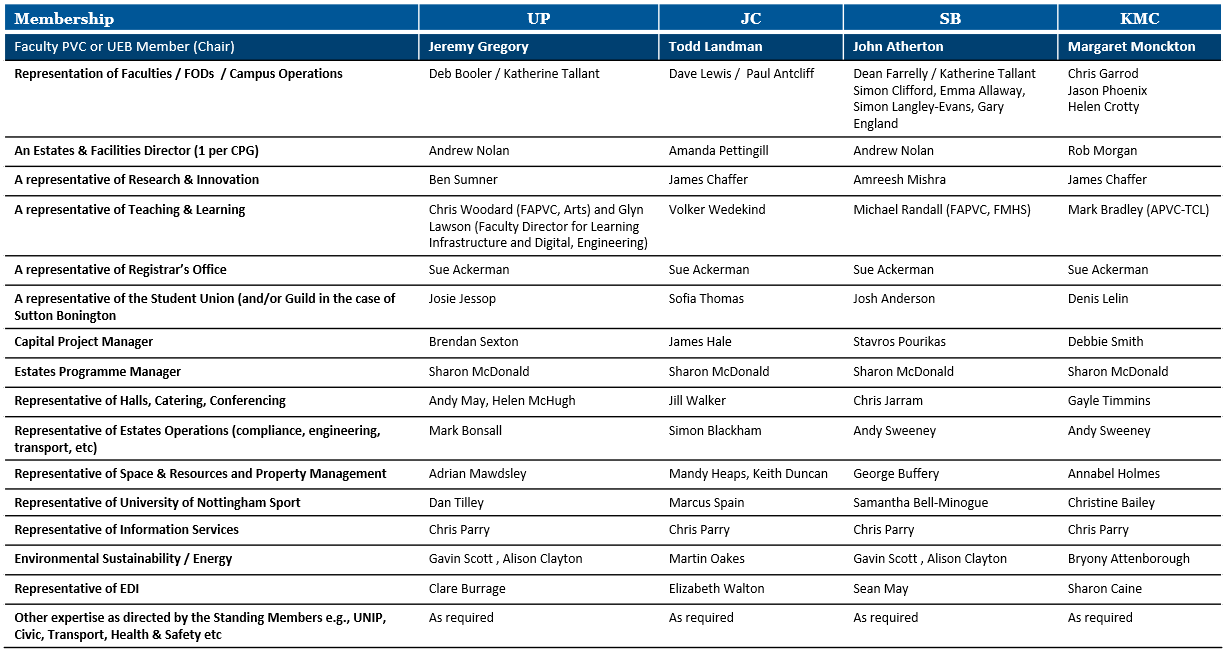
Each UK Campus has its own Campus Planning Group Chaired by a Member of the University Executive Board. Professor John Atherton is leading the development of the Sutton Bonington Campus, Professor Todd Landman is heading up the Jubilee Campus plan, whilst Margaret Monckton Chairs the King’s Meadow planning group and Professor Jeremy Gregory is overseeing the plans for University Park and the portfolio associated with the Medical School, Derby Royal and City Hospitals. We have also put in place an EDF Programme Board to provide strategic oversight and manage inter-dependencies between the four groups. That programme board reports in directly to the Estates and Infrastructure Committee.
The 12-month programme comprises 6 Chapters with the following descriptive titles; Conceive, Craft, Consolidate, Create, Confirm, Complete. Since January we’ve been actively listening to the needs of our key stakeholders and, as we go into mid-May, we’re beginning to consolidate our thinking from chapters 1 and 2 before starting the process of shaping each plan in more detail. To help those 60+ representatives, we have put in place a series of presentations with expert speakers for every individual EDF Theme.
By early 2022 we aim to have a strategic Campus Plan for each of the 4 UK campuses covering short (0-5 years), medium (5-10years) and longer-term (10-20 years) timescales. The plans will outline the future look and feel, with broad timescales for delivery, subject to University financial planning and governance procedures. Of course, it will include refurbishments to existing buildings and infrastructure, enhancements to our external spaces and new buildings too. The outputs from this planning process will be made available to the wider university community and will be integrated with the university’s strategic delivery plans to ensure the estate is able to support the needs of our community.
We’ve been really pleased with the level of engagement from academic and professional services staff together with officers of the Students Union/Guild across the university in all 4 Campus Planning Groups with some creative and exciting proposals coming forward. These are now starting to be prioritised in alignment with the University Strategy and the Themes of the EDF. We’ll be sharing our progress with you in more blogs like these in the coming months.
How can you get involved?
If you have a great idea for our campuses we’d encourage you to either share your idea via this form which you can submit directly or talk to one of the campus planning group representatives if you have ideas you’d like to share. We have representatives for a wide range of areas across each of the 4 campuses and we have a dedicated estates project manager for each of them too. You can contact them directly (membership of the groups is set out below) or you can contact me, direct: andrew.nolan@nottingham.ac.uk .
Brendan Sexton – University Park and Hospital sites – brendan.sexton@nottingham.ac.uk
James Hale – Jubilee – james.hale@nottingham.ac.uk
Stavros Pourikas – Sutton Bonington – stavros.pourikas@nottingham.ac.uk
Debbie Smith – King’s Meadow – debbie.smith@nottingham.ac.uk
Membership of the Campus Planning Groups is shown in the table below (click to expand).
Tags: campus planning, campus planning group, EDF, Estate Development Framework
Posted in Announcements, News | Comments Off on Campus planning groups
Disability Recognition Month Alumni Blog Series: Agata Cienciala
May 6th, 2021
This month, we’re delighted to share a series of blogs from alumni reflecting on this year’s theme of ‘Disability: Finding our way’.
Our alumni have been kind enough to share their experiences of living with a disability whilst studying at Nottingham, how they found transitioning to and from university life and their career journeys to-date, along with their advice to inspire and support for current students and staff.
This week, we’re delighted to introduce alumna, Agata Cienciala, who graduated from Nottingham in 2018 with a degree in History.

In this blog, Agata shares her experiences of studying at the university as a visually impaired student and how her time at Nottingham was shaped by her involvement with sport.
Students and staff alike will benefit from learning about Agata’s story – whether they have a similar disability themselves or are supporting those who’s university experience is a little less straightforward than most. We’d like to thank Agata once again for sharing so openly and honestly.
“My name is Agata and I studied history at Nottingham between 2015 and 2018. I’m blind and have been since I was 14. I use a screen reader to access the computer which means that text is converted to speech.
“It feels strange to say that I ‘chose’ to study at Nottingham, because it wasn’t my first choice, but after I had made the decision to accept my place and started hearing about all the amazing sports opportunities that there were available for disabled students, not to mention that my course did look great, I was excited to have ended up at the university.
“The first term at uni was hard. Having taken a gap year, most of my friends from school had already started their uni experiences and I interpreted the amazing time they were having as pressure for me to do the same. It took me a while to realise how I would like to shape my time at uni. Sport, it became increasingly clear, would play a huge part in that.
“I arrived on campus a week before most students and met Hannah Webber during that week. From then on it became clear that the easiest way for me to get involved in uni life was to join all the disability sport related activities that were available.

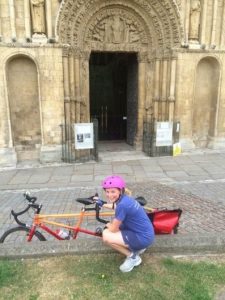
“Being a blind student isn’t easy, despite all the support which is available. I got lost, a lot, on campus, particularly in the first term, but also over my three years at uni. I learnt what a panic attack was – finally linking my breathlessness when I became stressed or frustrated at a situation to a mental health trigger. But I could generally find a place of safety and security in the sports facilities and I did everything that was available. I swam, climbed, cycled, took part in horse riding, kayaked, did a session of scuba diving. I also began to run on campus because Hannah introduced me to the idea of guide running. I took part in supported fitness sessions and developed a love of lifting heavy weights and yoga. I had never had the opportunity to try so much sport in a low pressure, relatively easily accessible environment. I couldn’t believe my luck.”
My journey since graduating
“I left Nottingham three years ago – first for a job in Bradford and then back home to London to do a masters in history and to train as a sports massage therapist. The pandemic has currently put my massage career on hold, but I’ve started another job at a local council.
“I’ve been able to carry on a lot of the sports I first found at uni – running is a huge part of my life, and I climb, swim, cycle, lift, when I can. The biggest difference is the increased difficulty in getting to activities now that they’re not all an ‘easy’ walk away on campus.
“The extra travel and lack of education about how to do disability sport well beyond the university setting has meant it’s been harder for me to enjoy the activities I love. That being said, the grounding I had in accessible sport whilst at university has given me a great understanding of what inclusion in a sports setting can look like, so I’m able to be an advocate for myself and others. I speak on diversity and inclusion issues in my running club, for example.
“As for the world of work I will mention briefly that, as much as I love study, and as much as I have enjoyed my masters, the workplace is also pretty rewarding. I found studying so absorbing, and didn’t want to leave it behind, for the fear that my mind would rot, and I would lose all the ‘mental fitness’ I had gained. Work is not the same, but it leaves you more financially viable and introduces you to a great bunch of colleagues.”
My words of wisdom
“Students: figure out how you can make the most of your time at uni. If that’s loving your academic work, dig in. If that’s spending too much time in the gym, on the pitch, or climbing, do it. It’s likely you’ll never have so much time to invest in yourself or your interests again. So make the most of it.
“But also, try to balance that with looking after yourself, as well you can. And know that if your uni experience isn’t what you hoped it would be, or isn’t the same as those you see around you, that’s ok as well. There’s so much life beyond campus.”
Useful resources
- Whilst at university, Agata also featured in a video for UoN Sport talking about accessing the David Ross Sports Village as a visually impaired student which is available here.
- Further information about inclusive sport at Nottingham can be found online here.
- Information about the university’s Disability Support Services Team, our specialist service providing student-led support to enable disabled students to flourish as independent learners, is available here.
Many thanks to Agata for sharing her story. If you or someone you know would like to write a piece for the series, please email: Emily.Bateman@nottingham.ac.uk
Tags: disability recognition month, Disability recognition month 2021
Posted in Announcements, News | Comments Off on Disability Recognition Month Alumni Blog Series: Agata Cienciala
Town halls: all staff invited to help shape research strategy
May 5th, 2021
All staff are invited to a series of town halls to hear about and contribute to the development of our five-year research strategy.
We encourage our whole community – colleagues from all job families as well as researchers and staff who support research – to join us and help shape our vision for the future of research.
Professor Dame Jessica Corner, Pro-Vice-Chancellor for Research and Knowledge Exchange, will update you on the consultation so far, how to get further involved and plans including workshops that will help shape and achieve our ambitions for research. There will also be an opportunity to ask questions.
The virtual town halls follow the first steps of our university-wide consultation, which received 1,426 responses to questions on the future of research at Nottingham.
There are five town halls, each geared towards one of our faculties. If you are unable to attend your faculty’s event, please feel free to express an interest in attending one that best suits you.
The town halls take place on:
Monday, 17 May 11am-noon – Faculty of Social Sciences
Tuesday, 18 May 10.30-11.30am – Medicine and Health Sciences
Tuesday, 25 May 11am-noon – Arts
Wednesday, 26 May 4-5pm – Science
Thursday, 27 May 3.30-4.30pm – Engineering
Please register your interest (before 5pm, Friday 7 May 2021).
A Teams link will be sent to you during week commencing 10 May
Tags: research, Research Strategy, research town halls, town halls
Posted in Announcements, News, Research | Comments Off on Town halls: all staff invited to help shape research strategy
Equality, Diversity and Inclusion Q&A events: May 2021
May 4th, 2021
Professor Sarah Sharples, Pro-Vice Chancellor for Equality, Diversity and Inclusion and People will be hosting a series of Q&A events.
These will comprise a short presentation which provides an overview and update of progress on the EDI strategic delivery plan to date but will dedicate most of the time to answering questions.
These events are open to all and are particularly targeted at people who are not currently working closely with our Equality, Diversity, and Inclusion programmes, but who are interested in finding out more about how this impacts them and their work, and how they can get more involved.
| Date | Time | Faculty / Department |
| Monday 17 May | 14:00 – 14:45 | Registrar’s / HR |
| Monday 24 May | 14:00 – 14:45 | Estates / HR |
| Wednesday 26 May | 10:00 – 10:45 | Finance & Infrastructure / HR |
The events will be held online, and a Teams link will be sent out with further information by the EDI Office to all staff in each department.
Tags: edi, EDI Q&A, Professor Sarah Sharples, PVC EDI
Posted in Announcements, News | 2 Comments »
Nottingham to play its part in government-supported pilot to improve testing participation
May 4th, 2021
The university is set to take part in a pilot to test how participation in asymptomatic Covid-19 testing might be improved.
Students in Cripps and Lincoln Halls of Residence have agreed to take part in the pilot, aiming to achieve 90% participation in twice weekly testing, which is incentivised by allowing greater social interaction and mixing within the hall.
The Testing Participation Pilot has been given approval by Nottingham and Nottinghamshire Local Public Health and is supported by Government.
It will begin on Thursday 6 May for an initial four weeks. Students are required to test twice weekly, via the university’s in-house Asymptomatic Testing Service. This will give a clear indication of the prevalence of Covid-19 within halls, with any positive cases quickly identified and isolated.
Within each of the pilot halls, students will be allowed to mix with all residents, while still wearing masks and adhering to 2-metre social distancing in communal spaces and when interacting with staff.
The focus of this pilot is on more ‘traditional’ Halls of Residence such as Cripps and Lincoln. These Halls have large corridors, shared facilities, communal dining and socialising models which makes a ‘household’ an arbitrary concept.
It is hoped that the pilot will help to increase safety on campus and provide insights that will inform better policy and best practice at how to increase testing participation in university settings.
All other university students, as well as staff, continue to be encouraged to take part in asymptomatic Covid-19 test at least weekly. Students in other halls will be encouraged to increase the levels of testing participation, to be considered for inclusion in the pilot should it be extended by Government.
To find out more information about the Testing Participation Pilot, including FAQs for students and staff, visit the dedicated Testing Participation Pilot webpages.
Tags: COVID-19, COVID-19 testing, testing, testing participation pilot
Posted in Announcements, News | Comments Off on Nottingham to play its part in government-supported pilot to improve testing participation
Professional Development workshops for staff
May 4th, 2021
Professional Development would like to draw your attention to two online workshops that will be running in May and June.
The “Surviving the Mental Health Impact of COVID” workshop will give participants the opportunity to understand the mental health challenges of Covid, how to manage difficult emotions, and how to build positive emotions for improved resilience.
The “Introduction to Emotional Resilience” workshop will give participants the opportunity to develop your awareness of the signs and symptoms of stress, gain a greater understanding of the skills and strategies needed to build and maintain personal resilience, as well as some key tips for managing stress more effectively and growing emotional resilience.
These are staff only sessions and will be hosted by fully qualified, and experienced Clinical Psychologists, with over 40 years NHS experience between them.
Spaces are available to book via the direct links above.
Tags: online workshops, Professional Development, staff workshop, workshop for staff
Posted in Announcements, News | Comments Off on Professional Development workshops for staff
PVC EDI Blog: Celebrating Disability Recognition Month
May 4th, 2021
In her latest blog, Pro Vice-Chancellor for Equality, Diversity and Inclusion and People Professor Sarah Sharples writes about Disability Recognition Month and discusses the events, workshops and talks taking place throughout May.
Read the blog here.
Tags: disability, Disability recognition month 2021, edi, equality, Equality Diversity and Inclusion, Professor Sarah Sharples, PVC EDI
Posted in Announcements, News | Comments Off on PVC EDI Blog: Celebrating Disability Recognition Month
New Provost appointed for UoN Malaysia
April 30th, 2021
Professor Sarah Metcalfe has been appointed as the new Provost for the University of Nottingham in Malaysia, taking up role from 1 August 2021 for an initial period of one year.
Professor Metcalfe has worked at the University of Nottingham since 2003, with roles including Head of School, APVC for Research and Knowledge Exchange for the Faculty of Social Sciences and lead of the Developing Sustainable Societies Global Research Theme.
Sarah has worked at higher education institutions across the UK and overseas, as well as at what is now the Research Complex at Harwell. Her research and teaching spans climate change and human-environment interactions across a range of timescales, with a particular focus on tropical and sub-tropical environments. She continues to work on air pollution issues, based on her time at Harwell.
Vice-Chancellor Professor Shearer West said:
“I am delighted to appoint Sarah as the next Provost for the University of Nottingham in Malaysia. I am confident that she will continue the work to chart our next 20 years in Malaysia with the same passion for education in the country as we have since the start of the century, while managing the current phase of the coronavirus pandemic and any local restrictions affecting UNM.
“I am also grateful to Professor Sam Kingman, Pro Vice-Chancellor for Engineering, who will continue to oversee campus operations as interim Provost and provide University Executive Board support for UNM until Sarah’s appointment commences.”
Professor Sarah Metcalfe said:
“I am really looking forward to joining UNM to help lead it into its next decade. The last year has been difficult for everyone and we are still dealing with the effects of the Covid-19 pandemic, but it is time to start looking to the future and the opportunities it can bring. I hope to help staff and students alike to build on UNM’s existing strengths in education and research to make a real difference in Malaysia and the wider region.
“Our university is unique in having campuses in Malaysia, China and the UK and I will relish the opportunity to lead UNM’s contribution to our truly global institution. As a regular visitor to the UNM campus as part of my university work, I have an enormous respect for my colleagues and the student community there and look forward to returning as soon as is practicable.”
Tags: Professor Sarah Metcalfe, Provost, University of Nottingham Malaysia, UNM
Posted in Announcements, Main News Story, News | Comments Off on New Provost appointed for UoN Malaysia
Extended library opening hours for Ramadan
April 28th, 2021
From today (Wednesday 28 April) until Wednesday 12 May, the following three libraries will be open until 4am (Sunday to Thursday):
- George Green Library, University Park Campus
- Djanogly Learning Resource Centre, Jubilee Campus
- James Cameron-Gifford Library, Sutton Bonington Campus
The libraries will be open to all during this time. All other libraries, except Music, will continue to stay open until 2am (Sunday – Thursday).
Individual silent study space in these libraries will be available without advance booking from 9pm – 4am. At all other times, study space must be booked online via Click and Study. Students will also be able to access books on the shelves and printing services.
Keeping our libraries safe
Students must always show their University Card for entry to the libraries and follow the Covid-19 safety measures in place.
Anyone failing to follow the safety measures will be asked to leave the library and will be unable to book study space for seven days.
If you have any questions about our library services or accessing resources, please contact the Library Helpline by email, phone or Live Chat
Posted in News | Comments Off on Extended library opening hours for Ramadan
Lean Problem Solving: Bite size learning opportunity
April 27th, 2021
The Leadership and Management team are delighted to launch the latest series of webinars in their Bite Size Learning offering.
The Lean Problem Solving series has been created to support a proactive problem solving culture across our University though the wider understanding and practical applications of problem solving tools and techniques.
Led by the Getting in Shape team, the series comprises a mix of theory and interactive exercises. Each of the three webinars cover self-contained topics so you can join any, or all, of the webinars.
These webinars are suitable for all university staff. Places are now available and you can book your place and find out more information here.
Tags: Leadership and Management Academy, Lean Problem Solving, LMA, Problem solving
Posted in Announcements, News | Comments Off on Lean Problem Solving: Bite size learning opportunity