

Campus News
Sadistic, remote or God-like?
September 29th, 2010

Head teachers are sadistic and evil. They are child-hating, remote and occasionally ineffectual. Only rarely are any positive qualities to be found in them, although in these few instances they can be wise, moral and even god-like.
Before the National Association of Head Teachers becomes too irate, it should be pointed out that the above descriptions relate to fictional school leaders, as depicted in a host of modern children’s books, analysed by a University researcher.
The characteristics of some 19 head teachers — in works by JK Rowling, Roald Dahl and 17 other authors published in the last 35 years — have been dissected by Professor of Education Pat Thomson.
And while the stylised and highly coloured depictions of these heads may seem fanciful to some, Prof Thomson argues that there is more than a grain of truth to the novels’ presentation of the head teacher as the embodiment of power, which can be used for good or ill.
Heads are frequently portrayed negatively in literature for the young, found the research, which cites examples including an evil and messianic vampire-like figure known only as ‘headmaster’ in Gillian Cross’s The Demon Headmaster, and the sadistic, child-hating Miss Trunchbull of Roald Dahl’s Matilda.
Of the 19 texts featuring a head teacher as a major character, nine are described as either evil, sadistic, messianic, authoritarian, child-hating or some gruesome combination of these adjectives.
A further six are remote figures of power. Three are described in more neutral terms. But only one — the most well-known, Prof Dumbledore of Harry Potter — emerges to be categorised as having positive characteristics. He is, says Prof Thomson: “Wise, God-like, remote and moral.”
‘Power’ is often regarded by real head teachers as a dirty word not to be discussed, argues Prof Thomson, while serious texts on school management often avoid characterising the central task of the head as the exercise of power. Children’s books, then, could be used as part of school leadership courses to address this deficit, she says.
Prof Thomson concludes: “Children’s stories come clean about head teachers’ work in ways that mainstream educational leadership texts often do not.”
Tags: children's books, headteachers, JK Rowling, literature, Roald Dahl, school leadership, School of Education
Posted in Research | Comments Off on Sadistic, remote or God-like?
New centre for sustainable energy research
September 29th, 2010

A new £6.5m research centre will bring together world-class experts in energy research at the University.
The Energy Technologies Building (ETB) underlines Nottingham’s leading role in global energy research, and its commitment to developing low-carbon technologies with the potential to touch every aspect of 21st century life.
It also highlights the strength of the University’s links with industry, and its commitment to further regeneration of the former Raleigh site on which the centre will be built. The building itself will have excellent environmental credentials, with designers aiming to make it one of the lowest-carbon buildings in the country.
The ETB will be constructed on the University’s Innovation Park, adjacent to the Jubilee Campus and alongside the recently-opened Nottingham Geospatial Building, a focus for research into global positioning systems.
Prof Alan Dodson, Pro-Vice-Chancellor for Infrastructure, said: “The Energy Technologies Building will reinforce Nottingham’s place in the vanguard of global energy research.
“This exciting initiative on our Innovation Park will further our strategic objective for the old Raleigh site to become an exemplar of sustainable development. This is particularly fitting for a building which will accommodate world-leading research into energy technologies, and we’ll be working hard with the architects and contractors to produce the University’s, and one of the country’s, lowest-carbon buildings — not an easy task with the laboratory facilities demanded by such a research centre.”
It is being funded by the University, the European Regional Development Fund (ERDF), which is administered by the East Midlands Development Agency (emda), and a donation of £1m from the Wolfson Foundation.
The new building will comprise specialist laboratories, a prototype hall, an exhibition area, a rooftop laboratory zone, offices and external technology area for use as an energy testing facility.
The 2,500 m² facility will provide the University with a centre that is specifically designed for continuing and developing its world-leading energy research. It should also attract increased attention from industry, academia, funding agencies, researchers, students and stimulate public interest in new developments in sustainable energy.
Construction is scheduled to start on site early in 2011, with completion due in January 2012.
Tags: Energy Technologies Building, global energy research, Innovation Park, Jubilee Campus, low-carbon technology, sustainable energy
Posted in News | Comments Off on New centre for sustainable energy research
Getting UK trains on track
September 29th, 2010

A £3.1million research grant will underpin a radical overhaul of the performance of the UK’s railway track system.
The research programme, Track21, brings together academics from The University of Nottingham, the University of Southampton, and The University of Birmingham with key industrial partners.
With funding from the Engineering and Physical Sciences Research Council (EPSRC) the aim is to develop a comprehensive understanding of the engineering, economic and environmental performance of railway track that will provide the science needed to bring about a step-change improvement in techniques for track design, construction and maintenance.
The Nottingham research will be led by Prof Glenn McDowell in the Faculty of Engineering’s Centre for Geomechanics.
Prof McDowell said: “At Nottingham we have a lot of experience and expertise in research of the micro mechanics of particulate materials, and we are at the forefront of numerical modelling of aggregates of irregular-shaped particles.
“Our fundamental scientific approach to looking at ballast behaviour will enable us to produce a step-change in the design of railway track. This is a unique and exciting collaborative opportunity which will allow us to make a real impact in railway engineering.”
This team of experts will be studying the ground beneath the track; ballast, sleepers and alternative methods of rail support; noise and vibration and economic and energy costs. The programme has been developed in consultation with industry partners.
Prof William Powrie, of the University of Southampton, said: “This is a unique and exciting opportunity to make a real difference to the railway system.
“The railway industry is constantly making gradual improvements, but what we’re doing is something different. We’re interested in high-quality science. Working with our industry partners, we want to create the new knowledge that will inform not just incremental advances but a fundamental shift in the way the existing network is maintained and new lines are designed and built.
“The implications will be far-reaching; reduced costs, increased capacity and improved reliability would make an appreciable difference to all rail users.”
Tags: Centre for Geomechanics, EPSRC, Faculty of Engineering, railways, trains
Posted in Research | Comments Off on Getting UK trains on track
Let’s talk about dying
September 29th, 2010

Lack of openness about death has negative consequences for the quality of care provided to the dying and bereaved.
Jane Seymour, Sue Ryder Care Professor of Palliative and End of Life Studies at the University, says to change attitudes to dying we have to eradicate ignorance about what can be achieved with modern palliative care and encourage discussion about end of life care issues.
Attitudes must change if we are to achieve a good death for all, say the experts. By 2030 the annual number of deaths around the world is expected to rise from 58 million to 74 million, but too many people still die alone, in pain, without dignity, or feeling alienated.
Prof Seymour and colleagues discussed the consequences of not talking about and planning for death in a series of articles for the British Medical Journal website. Topics included public attitudes to euthanasia, physician-assisted suicide and how to raise awareness and public involvement.
Prof Seymour said: “While in some ways our society is obsessed with death — with reports of violent, sudden, and unexpected death paraded across our media every day — it is still very difficult to talk about this one shared certainly in terms that relate to our own deaths or those of people close to us.
“When death is managed badly it leaves a scar that runs deep in our collective psyche and reinforces the tendency to turn away from any reminder of it. Shifting attitudinal barriers to the provision of excellent end of life care means eradicating ignorance among clinicians, patients and the public about what can be achieved with modern palliative care and with careful proactive planning.
“Raising public knowledge of issues surrounding death, dying and bereavement risks raising expectations we cannot yet meet or sending an unrealistic message that death can always be managed well. But such activity is a vital part of generating a sense of wider responsibility for the dying and promoting social justice for all those living towards the end of their life.”
The authors drew on research commissioned by the National Council for Palliative Care and the National End of Life Care Programme and a survey of UK public attitudes commissioned by the National Coalition Dying Matters: Let’s Talk About It.
‘Palliative care beyond cancer’ also topped a recent BMJ poll of topics respondents wanted to read more about, suggesting that doctors are keen to be more open about death and deliver better end of life care for their patients.
Tags: death, end of life studies, Nottingham University Medical School, palliative care
Posted in Research | Comments Off on Let’s talk about dying
Spotlight
September 29th, 2010

Coconuts, submerged cities and microbiology are some of the highlights of University media coverage over the past month.
Blood clot risk investigated
Commonly prescribed drugs to treat nausea and vomiting increase the risk of potentially deadly blood clots by a third, the Daily Telegraph reports. Hundreds of thousands of people in England take atypical antipsychotics, mainly for schizophrenia, but they are also used to treat common complaints such as nausea, vomiting and vertigo. A team from The University of Nottingham investigated around 25,000 people who had suffered a blood clot, either in the legs or the lung, and compared them with non-sufferers. Risks were higher for new users, the researchers found, as patients who had started a new drug in the previous three months had about twice the risk.
Canned phrases learned early
Ritualised moments of everyday communication — greeting someone, answering a telephone call, wishing someone a happy birthday — are full of canned phrases that we learn to perform with rote precision at an early age, the New York Times reports. As University of Nottingham linguist Prof Norbert Schmitt explained, it is much less taxing cognitively to have a set of ready-made lexical ‘chunks’ at our disposal, than to have to work through all the possibilities of word selection and sequencing every time we open our mouths.
Protecting livelihoods
Nottingham scientists have joined forces with African researchers to tackle a disease which kills coconut palms, the Nottingham Post reports. The coconut is an important part of the livelihood of many in the developing world. But a disease called ‘lethal decline’, caused by bacteria, has wiped out whole coconut plantations in some areas. Researchers from the University’s Division of Plant and Crop Sciences have been working in Ghana to find new ways of diagnosing the disease.
Film threatened
A record of British life on film could be threatened from an emerging ‘disease’ which eats away at film, BBC News Online reports. Home movies on cine film, videos and even TV and film archive can end up covered in fungal mould if they are not stored correctly. The research was presented at a meeting of the Society for General Microbiology at The University of Nottingham.
Submerged city to reveal secrets
Discovered over 40 years ago just off the coast of Greece, Pavlopetri is the oldest submerged city in the world. Now BBC2 is to follow the first team of experts to have been given permission to excavate the site, eager to discover exactly what lies beneath the waves. The team, led by underwater archaeologist Dr Jon Henderson of The University of Nottingham, will use the latest cutting-edge science and technology to prise age-old secrets from the complex of streets and stone buildings that lie less than five metres below the surface.
Posted in media | Comments Off on Spotlight
Starting them young
September 29th, 2010
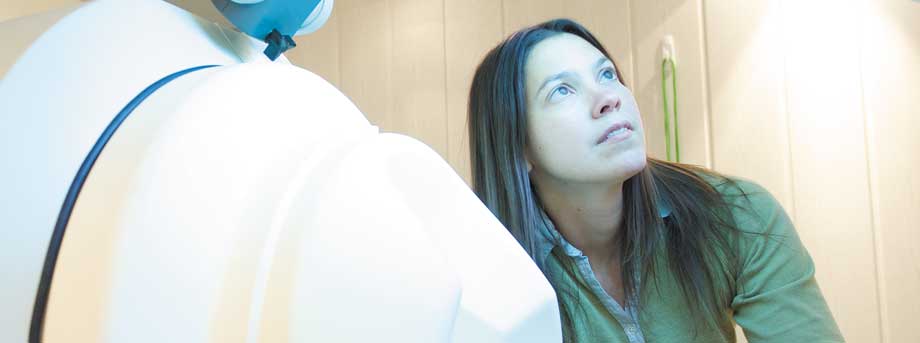
The School of Physics and Astronomy has been highlighted for its work in promoting the career progression of female academics and researchers.
The School has been awarded a silver Athena SWAN Charter award, which rewards excellent practice in female career progression within science, engineering and technology (SET) departments. The Athena SWAN Charter, funded by the Equality Challenge Unit and the UK Research Council, aims to encourage institutions to recruit, retain and promote women in SET in higher education and research.
The School starts at an early stage when it comes to promoting academic careers to women in its field, investing heavily in outreach programmes encouraging teenage girls to take science subjects at GCSE and A Level. Physics and Astronomy has also recruited more fellows to the University’s Anne McLaren Fellowship scheme than any other school. These Fellowships are targeted at excellent female postdoctoral researchers in science and engineering.
The School is also working to increase the number of female undergraduate students it recruits. A significant increase in the proportion of female students accepting places has been recorded following changes made to UCAS recruitment open days.
Prof Richard Bowtell, Head of School, said: “We are very proud to receive this award, which recognises the School’s commitment to ensuring that women and men can achieve success in physics-related careers.”
Tags: Athena SWAN, Prof Richard Bowtell, School of Physics and Astronomy
Posted in Features | Comments Off on Starting them young
DNA – the Nottingham strand
September 29th, 2010
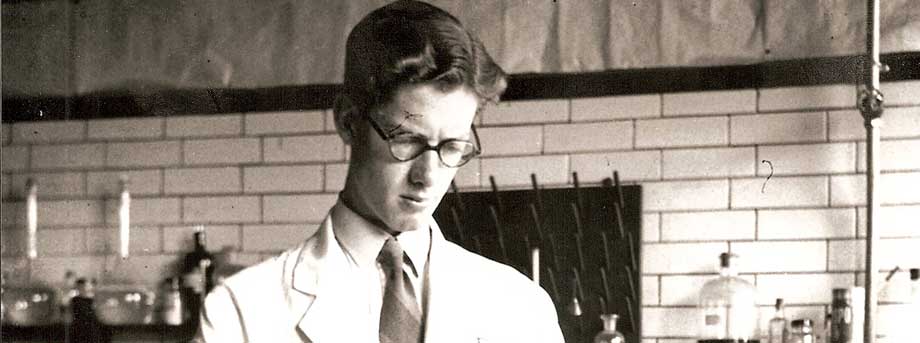
The work of the man who helped to pave the way to the discovery of the structure of DNA has been remembered by the University.
Dr JM (Michael) Creeth graduated in chemistry from University College Nottingham in 1944. His work was celebrated at last month’s Analytical Ultracentrifugation Conference, which took place in the city. Dr Creeth played a key part in the race to identify the structure of the ‘code of life’ in his Nottingham lab — a little-known chapter in the story that ended with the discovery of the double helix structure of DNA, which earned James Watson and Francis Crick their Nobel Prize.
Dr Creeth died in January this year at the age of 85.
Following his degree, Dr Creeth embarked on his PhD in what was then the University’s Department of Chemistry, supervised by DO Jordan and JM Gulland. Using an excellent sample of DNA obtained by fellow student Cedric Threlfall, Dr Creeth eventually came to the important conclusion that the bases of DNA were linked by hydrogen bonds.
Research continued, but by 1947 the research team that Dr Creeth was a part of had begun to disperse. Dr Creeth himself followed his professor to Adelaide University, ending his academic interest in DNA structure.
But the papers on hydrogen bonds were later read by what Watson and Crick in Cambridge, giving them an essential clue to the structure of DNA — a discovery that still sits at the heart of modern medical research.
Though Dr Creeth accepted that the Nottingham team didn’t have the experience in crystallography that proved vital to the final discovery of the structure of DNA, he did admit to having the occasional ‘what if?’ moment.
“Of course I was impressed by Watson and Crick had done,” he said. “However, I must admit to a lingering thought of ‘why didn’t we think of that?’, although practically speaking there were many reasons why our research couldn’t have taken us to that conclusion.”
Steve Harding, Professor of Physical Biochemistry at the University, was a Research Fellow in Dr Creeth’s laboratory.
“The University is very proud of Mike’s achievements,” said Prof Harding. “Mike Creeth was a true gentlemen and meticulous towards his science, an approach which was passed down to all those privileged to have been trained by him.”
Tags: biochemistry, DNA, School of Chemistry, University College Nottingham
Posted in Features | Comments Off on DNA – the Nottingham strand
Tackling Toxin A
September 29th, 2010
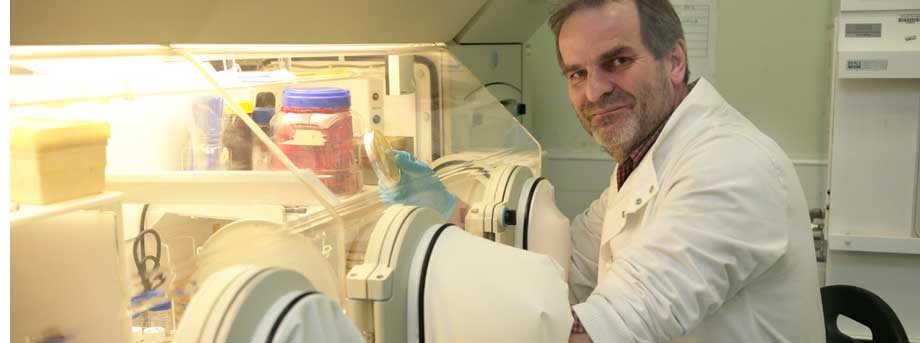
Scientists at the University have re-established the lethal role of a toxin in the leading healthcare associated infection Clostridium difficile.
In a paper published in the prestigious journal Nature, the Nottingham team has proven that Toxin A — one of two known disease-causing factors in Clostridium difficile — can kill on its own without working in tandem with the other associated virulence factor, Toxin B.
The results contradict those published last year in the same journal which suggested that only Toxin B was essential, and that Toxin A alone was not capable of causing the disease.
The new study has major implications for the development of new vaccines, drugs and diagnostic equipment for the prevention, treatment and detection of Clostridium difficile.
Prof Nigel Minton, head of the Clostridia Research Group in the School of Molecular Medical Sciences, said: “For many years it has been assumed by the scientific community that Toxin A and Toxin B worked hand-in-hand to cause fatalities by Clostridium difficile, although historically Toxin A was believed to be the most deadly factor.
“Last year a study was published that turned this on its head and appeared to prove that
Clostridium difficile strains producing Toxin A alone were innocuous, and that only Toxin B was essential for disease.
“This had significant implications — already we have seen a move within the diagnostics industry to develop new methods of diagnosing Clostridium difficile that rely entirely on targeting Toxin B.
“Our research, which has recreated that original experiment, resulted in a different outcome — we were able to show in the laboratory that the mutated Clostridium difficile strain, which produced only Toxin A, was deadly.”
Clostridium difficile infection is the most significant cause of hospital-acquired diarrhoea and is seven times more deadly than MRSA. The bacterium is present in the gut of up to three per cent of healthy adults and 66 per cent of infants.
Usually it is kept in check by the healthy balance of bacteria in the gut, but when this is disturbed by certain antibiotics Clostridium difficile can multiply rapidly and produce toxins that cause illness and death. The disease is spread through spores, usually from poor hygiene.
Tags: Clostridia Research Group, Clostridium difficile, hospital-acquired infection, MRSA, Prof Nigel Minton, School of Molecular and Medical Sciences, superbugs
Posted in Research | Comments Off on Tackling Toxin A
Cockroach brains… Future antibiotics?
September 29th, 2010

Cockroaches could be more of a health benefit than a health hazard, according to scientists at the University.
Experts from the School of Veterinary Medicine and Science have discovered powerful antibiotic properties in the brains of cockroaches and locusts which could lead to novel treatments for multi-drug resistant bacterial infections. They found that the tissues of the brain and nervous system of the insects were able to kill more than 90 per cent of MRSA and pathogenic Escherichia coli, without harming human cells.
The research has identified up to nine different molecules in the insect tissues that were toxic to bacteria.
Postgraduate researcher Simon Lee said: “We hope that these molecules could eventually be developed into treatments for E. coli and MRSA infections that are increasingly resistant to current drugs. These new antibiotics could potentially provide alternatives to currently available drugs that may be effective but have serious and unwanted side effects.”
Dr Naveed Khan, Associate Professor of Molecular Microbiology and Simon’s supervisor, first came up with the idea of investigating the properties of bug brains.
He said: “Superbugs such as MRSA have developed resistance against the chemotherapeutic artillery that we throw at them.
“They have shown the ability to cause untreatable infections, and have become a major threat in our fight against bacterial diseases. Thus, there is a continuous need to find additional sources of novel antimicrobials to confront this menace.”
Using state-of-the-art analytical tools, Dr Khan and his team are studying the specific properties of the antibacterial molecules. Research is currently underway to test the potency of these molecules against a variety of emerging superbugs such as Acinetobacter, Pseudomonas and Burkholderia.
Simon explained why it is unsurprising that insects secrete their own antimicrobials.
“Insects often live in unsanitary and unhygienic environments where they encounter many different types of bacteria,” he said. “It is therefore logical that they have developed ways of protecting themselves against micro-organisms.”
Tags: antimicrobials, cockroach, E coli, MRSA, School of Veterinary Medicine and Science, superbugs
Posted in Research | 2 Comments »
Chemistry’s Indian road trip
September 29th, 2010
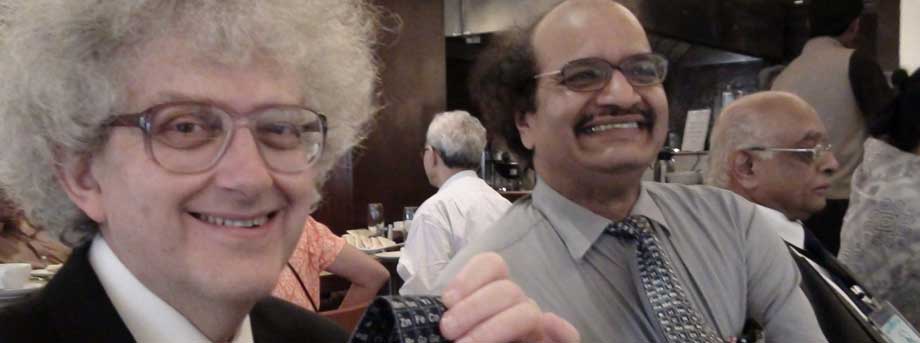
The international appeal of the School of Chemistry’s award-winning Periodic Table of Videos project was highlighted when one of its stars — Prof Martyn Poliakoff – visited India this summer.
Prof Poliakoff travelled to India to speak at the Asian Science Camp 2010, which brought together young scientists from across the continent. They attend lectures and meet some of the top scholars in their field — including Nobel Prize winners.
Video journalist Brady Haran accompanied Prof Poliakoff — known as ‘The Professor’ on the chemistry videos that have been watched more than 13 million times via the project’s website and its YouTube channel.
The result is a series of videos tracking their journey and introducing the characters they met along the way.
“I’ve come here because I like talking to young people and it seemed a really good opportunity to meet some of the brightest students in chemistry from across the world,” Prof Poliakoff, a lecturer in green chemistry at the University, told his viewers. “But it’s also an opportunity to meet fellow scientists, to set up new partnerships and collaborations.”
The visit schedule was jam-packed. As well as lecturing and meeting students and scientists, Prof Poliakoff also visited Mumbai’s Nuclear Magnetic Resonance research facility and met with Nobel Prize-winning chemist Prof Richard Ernst. Watch the video to discover what an expert in green chemistry and a world leader in nuclear magnetic resonance spectroscopy talk about when they get together…
The Professor also found himself a popular subject for photographs at the event — and gave away one of his trademark periodic table ties.
“Everyone wanted my photograph. Even one of the chefs from the restaurant wanted his photograph taken with me,” he said. “I think it’s because I look so silly.”
Watch the videos from The Professor’s visit to India at www.periodicvideos.com or www.youtube.com/periodicvideos
Tags: Asian Science Camp 2010, Brady Haran, nuclear magnetic resonance, Periodic Table of Videos, Prof Martyn Poliakoff, School of Chemistry
Posted in Features | Comments Off on Chemistry’s Indian road trip