

Campus News
The Corpse of Emiliano Zapata: The Story of a Photograph
January 14th, 2011
Andrea Noble
Date: Wednesday 2 February
Time: 6.30pm
Venue: Djanogly Gallery Lecture Theatre,
Lakeside Arts Centre, University Park
Admission: Free
Posted in Public Lectures, What's On | Comments Off on The Corpse of Emiliano Zapata: The Story of a Photograph
The Mystery and Paradox of Scientific Medicine
January 14th, 2011
Professor Raymond Tallis
Date: Tuesday 8 February
Time: 9.30am to 12.30pm
Venue: Room C18, Pope Building,
Main Campus
Admission: Free
Places are limited. Please email roger.
kerry@nottingham.ac.u.k to reserve a place.
Posted in Public Lectures, What's On | Comments Off on The Mystery and Paradox of Scientific Medicine
The Warren Cup: A Reflection of Roman Society?
January 14th, 2011
Dr Paul Roberts
Date: Friday 11 February
Time: 1pm to 2pm
Venue: Performing Arts Workshop Space,
Lakeside Arts Centre, University Park
Admission: Free
Posted in Public Lectures, What's On | Comments Off on The Warren Cup: A Reflection of Roman Society?
Teaching and research is entering a new dimension
January 14th, 2011

Colourful 3D reconstructions of ancient monuments, virtual galleries and a multi-screen ‘intelligent’ classroom will transform teaching and research in the Humanities, thanks to a new Digital Centre at The University of Nottingham.
The Centre will give students and staff instant access to a variety of digitised images, multimedia and 3D models of ancient artefacts, making the use of traditional slides and 2D screen presentations like Powerpoint a thing of the past.
Work in the Departments of Art History, Classics, and Archaeology, as well as Music, Philosophy and Theology, has previously relied on lantern slides and printed versions of thousands of images, objects and texts. Now the latest visualisation technologies and equipment will be available, setting new standards for the study and teaching of the Humanities in the digital age.
And it will be cross-disciplinary, with colleagues in the Faculties of Engineering and Biomedical Sciences also using the equipment and exchanging expertise with Arts and Humanities. The technology will be installed in several locations in the existing Humanities premises but the Centre will eventually have its own bespoke space in the new Humanities building, which is due to open at University Park in September 2011.
Resources available to staff and students include an equipment pool including photo and video kit, design and editing software and a 3D scanner. New digitisation equipment will be used to create a vast digital archive of thousands of slides and photographs, and objects. Art History alone has more than 80,000 slides in its image library.
Dr Katharina Lorenz, from the Department of Classics, said: “Digital technologies are dramatically changing the appearance and delivery of our teaching and research. The Humanities are ideal disciplines to engage with these new visualisation methods because most of the sources we deal with are highly fragmented – to bring them to life, sophisticated technologies and methodological rigour are required.”
Art History’s Dr Mark Rawlinson added: “New digital technologies are capable of producing high-quality scans of individual artworks which help preserve originals whilst simultaneously offering access to students, researchers and members of the public from anywhere in the world. 3D modelling also enables the recreation of art exhibitions from the past, creating a new kind of visual archive and offering the opportunity to take virtual tours of historical art shows.”
Dr Will Bowden, from Archaeology, said: “The 3D modelling of objects will have a direct benefit for our research projects and will also stimulate new developments in teaching, for example, allowing students to undertake detailed examination of objects that would be otherwise unavailable to them, or allowing multiple students to simultaneously examine and discuss a single object.”
In collaboration with the University’s Centre for Advanced Study and the Digital Humanities Network, the Centre will also provide a meeting hub to exchange ideas and develop projects.
Further details can be found on the Centre’s website at www.nottingham.ac.uk/ digitalhumanities.
Posted in Features | Comments Off on Teaching and research is entering a new dimension
Spotlight
January 14th, 2011
Major collaboration unveiled
A major new industrial collaboration will drive forward the research and manufacturing of cutting-edge electronics at the University. A partnership in the area of microwave semiconductor devices has been unveiled by e2v — a leading global provider of specialised solutions, subsystems and components — and academics. Funding of £1m from e2v — and significant match-funding from the University — will see a purpose-built cleanroom built at the School of Physics and Astronomy on University Park, housing the e2v semiconductor fabrication facility. e2v engineers will also have access to existing nano-fabrication facilities within the school, as well as advanced materials characterisation instruments available on campus. Physicists at Nottingham will also have access to the e2v fabrication tools. The collaboration further strengthens the University’s portfolio of successful technology transfer partnerships, which includes industry leaders such as Rolls Royce plc, Siemens and BAE Systems.
Medieval treasure trove
The largest surviving family-owned library of medieval manuscripts in Britain can be enjoyed by everyone thanks to the publication of a new book. The Wollaton Medieval Manuscripts: Texts, Owners and Readers is the culmination of a major research project at the University. The hardback volume tells the story of Notts’ landowning Willoughby family, and the extensive library of rare medieval manuscripts they collected during the 15th and 16th centuries. The manuscripts were housed in the family library at Wollaton in Nottingham, and transferred to Wollaton Hall, built by Sir Francis Willoughby in the 1580s. The book focuses on 10 manuscripts in the Wollaton Library Collection, which are now in the care of the University’s Department of Manuscripts and Special Collections. Essays by academic and curatorial experts explore various aspects including the library’s history and the Willoughbys’ motivation for collecting such a wide range of medieval books and papers.
New ‘salt’ wins award
A healthy food product created in Nottingham has earned an innovation award. Soda-Lo, which has huge market potential as a healthier natural alternative to standard salt, was recognised as an outstanding product at the Food and Drink iNet Innovation Awards. The company that developed it, eminate Ltd, won the CenFRA Award for Most Innovative Research Project. eminate Ltd, a wholly-owned subsidiary of The University of Nottingham based at BioCity, was recognised for the successful manipulation of salt crystals that resulted in the development of Soda-Lo. Soda-Lo enables a reduction in salt use of between 25 and 50 per cent in food products, by altering the size, form and structure of salt particles to increase their saltiness, so reducing the amount of salt needed.
Debt advice could soar says report
A report, produced by Dr John Gathergood, an economist at the University, warns that if independent forecasts are right and unemployment continues to rise, the demand for debt advice by the middle of next year will exceed that seen at the peak of the financial crisis. Between 2008 and 2009, more than 1.5m people sought help for debt problems. Dr Gathergood — an expert on credit, debt and borrowing in the Centre for Policy Evaluation in the School of Economics — produced Demand, Capacity and Need for Debt Advice in the UK on behalf of the Money Advice Trust. He said: “Despite demand for debt advice currently being at near all-time high levels in the UK, the scale of potential need for debt advice among households remains much greater than the level of advice currently sought.”
Posted in media | Comments Off on Spotlight
Juan Martin Flamenco Dance Ensemble
January 14th, 2011
Juan Martin — a celebrated virtuoso of the flamenco guitar — has been voted one of the top three guitarists in the world by US magazine Guitar Player. He tours extensively, appearing at major international festivals and on TV in Britain, Spain, Germany and America. Martin brings his trademark seductive, fiery and passionate performance to Lakeside, mixing the traditional with the modern. The show features Martin on guitar, Carlos Brias on vocals and dancers Raquel de Luna and Miguel Infante. It takes place at Djanogly Theatre, Lakeside Arts Centre, on Friday 14 January at 8pm. Admission is £20, £18 concessions and £15 restricted view.
Posted in events | Comments Off on Juan Martin Flamenco Dance Ensemble
Poet in the City and Apples and Snakes present Spoken Word All Stars
January 14th, 2011
Spoken Word All Stars presents an all-star cast, with five poets performing an original live show in partnership with the globally-acclaimed saxophone player Jason Yarde. The international award-winning and critically acclaimed performers include Kat Francois, OneNess and El Crisis. And for this show only, you can catch a guest performance from Midlands poet Lydia Towsey. Spoken Word All Stars’ journey began at Latitude Festival 2010, and featured in a Sky Arts TV documentary. The show promises comedy, tragedy, romance and philosophy; words interwoven with live and improvised loops, beats and melodies. Takes place on Tuesday 1 February at 8pm at Djanogly Theatre. Admission £12, £9 concessions, £6 restricted view.
Tags: Djanogly Theatre, Lakeside Arts Centre, Spoken Word All Star
Posted in events | Comments Off on Poet in the City and Apples and Snakes present Spoken Word All Stars
Cup winner
January 14th, 2011
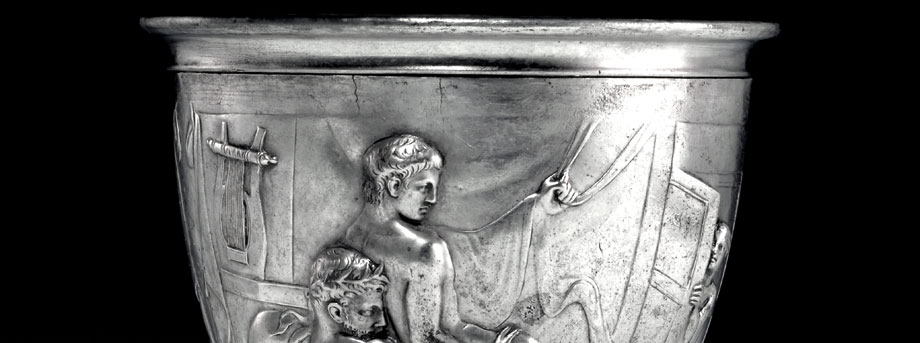
A new exhibition, Roman Sexuality: Images, Myths and Meanings, has opened at the University’s Weston Gallery to run until April.
The exhibition brings together a variety of sexual images from Roman art and archaeology and investigates what they meant to those who made and used them.
The exhibition is co-curated by Clare Pickersgill, University of Nottingham Museum, and Dr Paul Roberts, Department of Greece and Rome, British Museum, in collaboration with Manuscripts and Special Collections, University of Nottingham.
It starts by looking at how Victorian attitudes have affected the way we have collected, displayed and studied such objects including the exhibition’s centrepiece, The Warren Cup. This silver cup — as featured in the popular British Museum and BBC Radio 4 series, A History of the World in 100 Objects — is one of the highlights of the British Museum and is central to a wider discussion on sex and sexuality in the Roman world.
The exhibition looks at concepts of sacred and profane love, and the gods, goddesses and myths. Objects to modern eyes may appear to be sexual but to the Romans they weren’t, they were filled with meanings such as fertility, superstition and humour. It contains objects from the collections of the British Museum and University of Nottingham alongside pieces from Nottingham City Museums and Galleries and the Museum of Archaeology and Anthropology, University of Cambridge. It runs until Sunday 10 April, admission is free.
A series of free tours and talks will accompany the exhibition.
Tags: A History of the World in 100 Objects, British Museum, Clare Pickersgill, Dr Paul Roberts, manuscripts and special collections, Myths and Meanings, Roman Sexuality: Images, The Warren Cup, University of Nottingham Museum, Weston Gallery
Posted in News | Comments Off on Cup winner
Time to stand up and be counted
January 14th, 2011
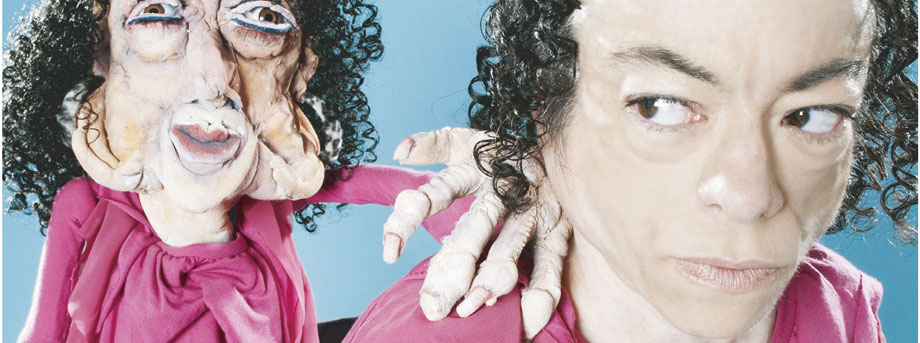
Nottingham law graduate Liz Carr dreamt of changing attitudes to disability.
Fast forward 20 years and she’s doing just that. It’s not in a court of law that Liz is making people sit up and take notice — but on the comedy circuit.
The stand-up star of It Hasn’t Happened Yet at Lakeside Arts Centre said: “Law sounded glamorous. It was the era of LA Law on TV.”
Wheelchair-using Liz chose Nottingham because at the time, there weren’t that many universities that had disabled access and personal care assistants.
Liz said: “it allowed me to have the same experience as everyone else. My time at uni was, like for so many teenagers but more so for me, about having a laugh, getting drunk for the first time, finding out who I was — life was full of expectations.”
She became involved in politics, disabled rights and activism “I wanted to change the world.” But after graduating in 1993 with a place at law school and articles at a prestigious legal firm, Liz turned her back on law.
“I had the dream ticket. But I thought, you know what, I don’t want to do this. It was very scary.”
Liz worked at Nottingham Law Centre, then as a disability equality trainer, and as an independent living adviser. Then in 2001 a course at Unity Theatre in Liverpool changed her life.
“I’d never done drama. In school, it was always like ‘well you can be the Queen because you’ve got your own throne’.”
It was at Unity that Liz met Anne Cunningham and they went on to form The Nasty Girls, a disabled/ deaf women’s sketch group that toured comedy festivals — including Edinburgh.
That changed in 2005 when a group called Abnormally Funny People was looking for disabled comedians, established and new, for a fly-on-thewall documentary for Sky TV. Someone dropped out and Liz — who’d since spent six months at London’s Graeae Theatre Co for disabled people — took the place.
Her premiere at Soho Theatre was a disaster.
“It was dreadful. The audience just sat there, looking at me and wondering ‘what has she just said’. In sketch shows, I’d always played characters but that night, doing stand-up without a character to hide behind, I felt naked. The audience was stunned. The theatre was silent. It was a terrible experience.”
Abandoning the project wasn’t an option. “It was like I’d got on a roller coaster and there was no emergency cord. It would have felt more humiliating not to carry on, but it was so painful. I survived a month, doing well and getting great reviews. I thought ‘this is a hobby. I’d never do it full time’. Before you know it, I’ve got 500 gigs under my belt.”
In 2007, there came another life-changing moment. A friend booked Wolverhampton Arena for her for and titled the event: It hasn’t Happened Yet. With the help of Huw Thomas, director in Abnormally Funny People, she created Alex Saunders and her puppet alter-ego, Little Al.
“I have a Quentin Blake-esque backdrop of 12 characters who are the voices in my head — the teachers at school, people in the street, etc. There are lots of barriers in life but some of the biggest are the internal ones. We all have these insecurities and that helps the audience to connect with me.”
The show has evolved in the three years that it’s toured the country, becoming darker.
“A lot of stuff in the play is true or based on the truth and my experiences. My act is fairly no-holds barred, but hopefully in a funny way. I’m not trying to be deliberately shocking — that’s just the way I am. I had a girl come up to me once after a gig. She said I shouldn’t headline a show because I’d made her and her boyfriend depressed.
“I’ve performed in lots of places that have poor access, something I thought I’d never do. But I can get my message across to more people by performing at these clubs and hope that by doing that, the clubs will rethink their access arrangements. Just being there is better than not being visible.”
Her parents come to every show and they love it. “They shouldn’t, there’s some foul language in it.” You’d expect nothing less from parents who used to video the TV news in case their daughter was filmed during a demo.
Liz — who produces articles and podcasts for the BBC’s Ouch! website and works at Hat- Trick Productions, the company behind Have I Got News for You — is in talks about It Hasn’t Happened Yet featuring on BBC Radio 4. But first there’s the show.
“It feels like a real journey for me. It was 20 years ago when I was at University and here I am back again. In the 80s, I was a student, the 90s was about activism and social justice, the 00s have been as a performance artist.
“And you know what, I’m 38 and I still don’t know what I want to be when I grow up.”
Tags: disabled rights, It Hasn’t Happened Yet, Lakeside Arts Centre, law, Liz Carr, Nottingham Law Centre
Posted in Features | 1 Comment »
Academy shares Royal spotlight
January 14th, 2011
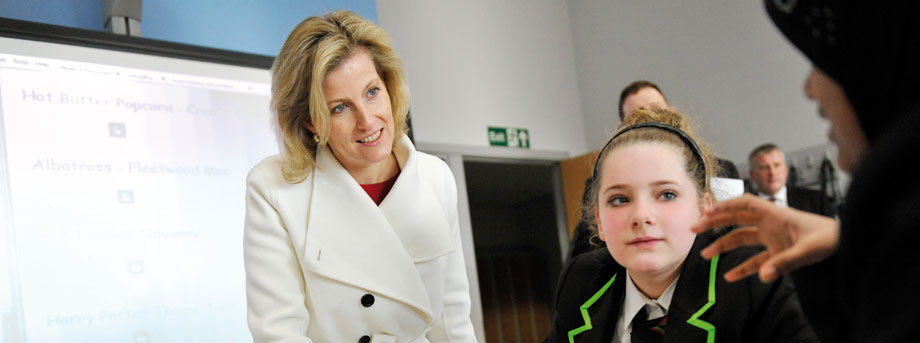
On the day the biggest Royal news story of the year was making headlines around the world, Nottingham University Samworth Academy (NUSA) was enjoying a little bit of Royal attention itself…
Her Royal Highness Sophie, the Countess of Wessex, arrived at the Bilborough school shortly after the announcement that Prince William is to marry his long-term girlfriend Kate Middleton.
She told the waiting media she was ‘delighted’ by the news and wished the couple all the ‘luck and love in the world’.
After being greeted by pupils and staff at the school, led by Principal David Harris, she was treated to a drama and dance performance and a look at one of the school’s art lessons.
The Countess also had the opportunity to take in the weird and the wonderful in the school’s Wonder Room — a modern-day ‘cabinet of curiosities’ which promotes learning through fascination.
Her visit came as part of a wider fact-finding mission to Nottingham to learn about the city’s Early Intervention Programme to tackle underachievement and deprivation, which includes 11-16 Life Skills lessons, which aim to develop pupils’ financial acumen by offering successful tips on managing money, avoiding overspending and debt.
At NUSA, the Countess took part in a Life Skills lesson. She also met young mothers and their babies who have been helped through the Family Nurse Partnership — another strand of the city’s Early Intervention Programme. NUSA — a £24m government-funded complex — is one of the first in the country to have direct sponsorship and academic links with a university and is also backed by local businessman and philanthropist Sir David Samworth.
Tags: Early Intervention Programme, Nottingham University Samworth Academy, NUSA, Principal David Harris, Sir David Samworth
Posted in News | Comments Off on Academy shares Royal spotlight