

Campus News
Blue Peter’s big green sleepover
April 6th, 2011
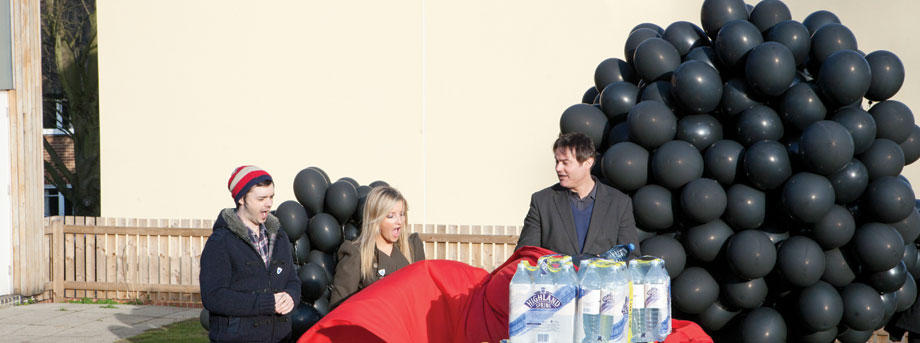
As part of their Climate Week coverage – during the week the University was running its Go Greener Week – BBC Blue Peter presenters Helen Skelton and Barney Harwood spent a night in an eco-home on campus.
Together with Barney the dog, the pair spent 24 hours in the E.ON 2016 research house, part of the Creative Energy Homes Project led by the Department of Architecture and Built Environment. The house – a re-creation of a 1930s’ semi – is being used to trial energy retrofit solutions aimed at reducing the carbon impact of the UK’s existing housing stock.
As part of a research project funded by the Engineering and Physical Sciences Research Council (EPSRC) and E.ON, the house is equipped with a hi-tech real-time location energy and occupancy monitoring system. It found out exactly how much energy Helen, Barney and Barney used and how much they wasted.
Helen said: “The point of all this is to show kids how much energy we use and to make them think about what they can do to off-set that. Before I did this I thought I was so carbon neutral. But having to stop and think about what I was doing has made me really think about how good I am at conserving energy.”
Dr Mark Gillott, co-director of the University’s Institute of Sustainable Energy Technology, told the presenters to live as normally as they could. During their stay, the monitoring systems registered where they were, how much energy they were using and how they were using it. It also monitored how warm they kept the house and the amount of water they used and wasted.
A breakdown of the results would tell them what their energy consumption was for lighting, heating, cooking and appliances, right down to the TV and games console they were using. Armed with this information, experts at the University were able to calculate the pair’s total energy carbon footprint for the 24-hour period. Their CO2 production for an hour was illustrated with black party balloons. The quantity of CO2 they produced from poor energy use, such as leaving the lights on or over-filling the kettle was also shown.
Dr Gillott said: “The unique energy and occupancy monitoring system we have in the house can see where people are at any time of the day or night and what their energy consumption is. It gives a real feel for who is using the energy and how and where they are using it. In everyday life it’s hard for people to quantify their energy use and visualise CO2 emissions so to reach out to a younger audience we had to find a way of representing the CO2 emissions from our living lab during the monitoring period.
“Over one year, a typical home in the UK is responsible for the production of enough CO2 to fill a much larger hot-air balloon, and when you consider there are 26 million homes in the UK, then that’s a staggering 26 million hot-air balloons worth of CO2 produced from housing alone!”
The aim of the Blue Peter visit was to also give young viewers an idea of where savings can be made and how important it is that everyone should do their bit to conserve energy.
The results were shown on Blue Peter on Monday March 21. You can find out by watching the video online at www.nottingham.ac.uk/exchange.
And check out May’s edition of Exchange for a round-up of the University’s Go Greener Week and environmental improvements over the
past 12 months.
Tags: BBC Blue Peter, carbon footprint, Climate Week, Co2, Creative Energy Homes Project, Department of Architecture and Built Environment, Dr Mark Gillott, E.ON 2016 research house, eco-home, Engineering and Physical Sciences Research Council (EPSRC), Go Greener Week, Institute of Sustainable Energy Technology
Posted in Features | Comments Off on Blue Peter’s big green sleepover
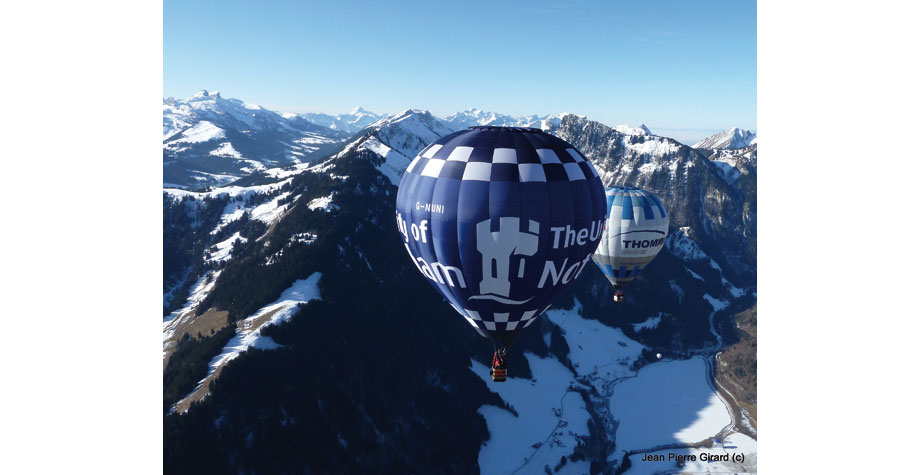
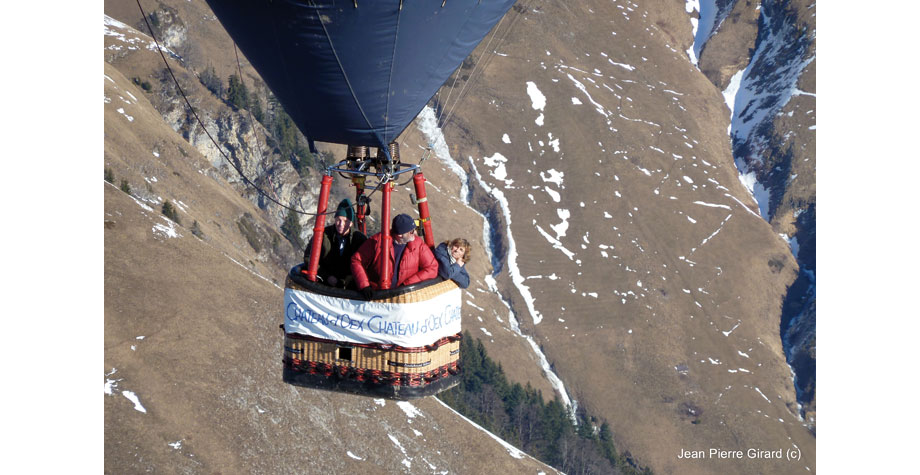
University flying high
March 15th, 2011
-

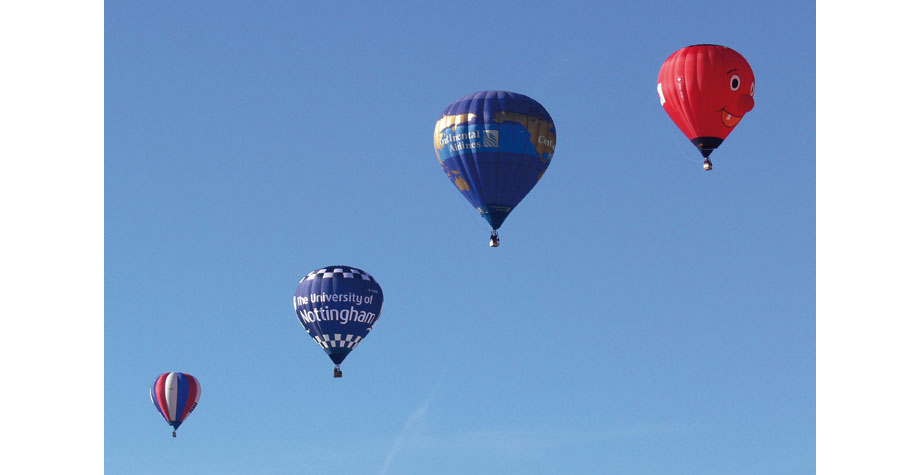
- Up, up and away
-
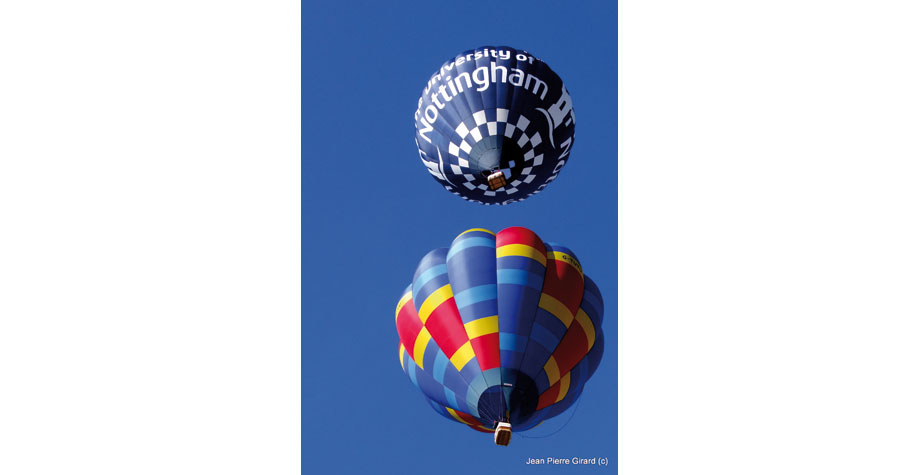
- All pictures by Jean Pierre Girard
-

- Chateau d’Oex provides a stunning backdrop for the 33rd Festival of Balloons
-
- Dr Janet Folkes, University of Nottingham engineer
Posted in slideshow | Comments Off on University flying high
On the threshold of a world of opportunities
March 9th, 2011
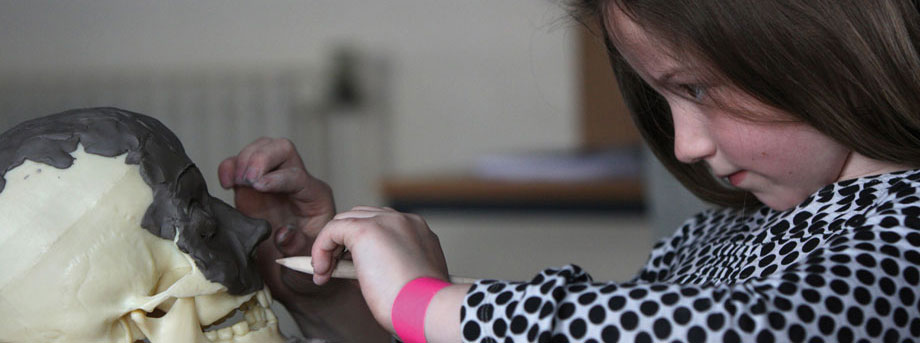
Thousands of people discovered things they never knew they didn’t know at last year’s community open day at The University of Nottingham!
The fun, interactive annual event draws visitors from across the county all with one thing in common — an enquiring mind. And the good thing is, it’s all free.
This year, May Fest 2011 seeks to draw in people from the local community while welcoming back former staff and students.
Gunpowder experiments, a thunder and lightning show and the chance to have a go at archery were just a few of the things on offer at last year’s community event.
This year’s event promises more science experiments, sociological debates, sporting activities and community projects. Visitors can explore science labs and chat with academics about the world-leading research being carried out on their doorstep.
Experts will explain the part engineering plays in your everyday life with activities for the whole family, while Community Health Sciences will run Steps to Active Kids — getting youngsters involved in interactive street dance sessions.
Other attractions include Eco House tours, tours of the University’s extensive gardens and brain games with the School of Psychology. The Archaeology Museum and the Vet School will both be putting on activities, as will Modern Languages, who will be running their popular one-stop language shop again.
The University is a major employer in the region and visitors will be able to find out about job and study opportunities through jobs and adult learning stalls.
The community open day runs from 11am to 5.30pm on Saturday 7 May at University Park campus.
Most activities are in or around the Portland Building, with a campus hopper bus available to transport visitors to events across campus.
May Fest 2011 also aims to encourage former students and staff to return to the University to recognise the part they’ve played in its past — and can continue to play in its future.
These alumni visitors have the option — at some extra cost — of being able to take a look around their old Schools, Departments and Halls or Residences, enjoy a Golden Reunion lunch and a gala dinner with Alumni Laureate Awards, and take a campus coach tour. They can meet current staff and students and help celebrate the University’s ongoing success.
May Fest 2011 is organised by the University’s Corporate Events team, in conjunction with the Community Partnerships (CP) team. CP, who were behind the launch of the community open day, develop relationships with the local community, from schools and businesses to civic bodies and the public.
Alumni visitors are also invited to attend an optional brunch on Sunday 8 May. For more details, visit www.nottingham.ac.uk/mayfest/index.aspx
Tags: Alumni Laureate Awards, community open day, Community Partnerships, Golden Reunion, May Fest 2011, Modern Languages, School of Psychology, The Archaeology Museum, Vet School
Posted in Features | Comments Off on On the threshold of a world of opportunities
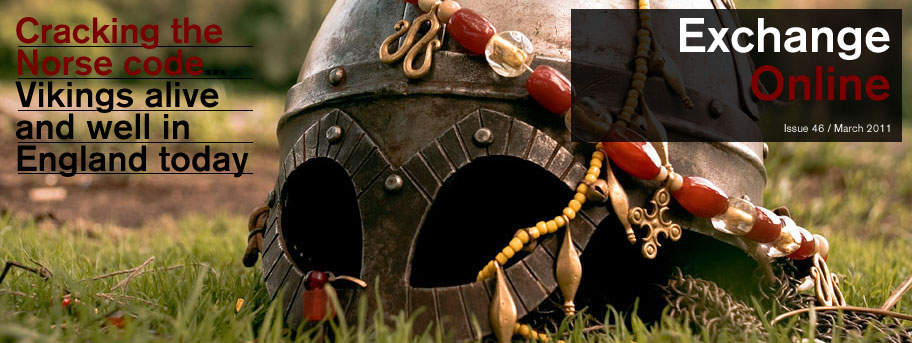
Cracking the Norse code
March 8th, 2011
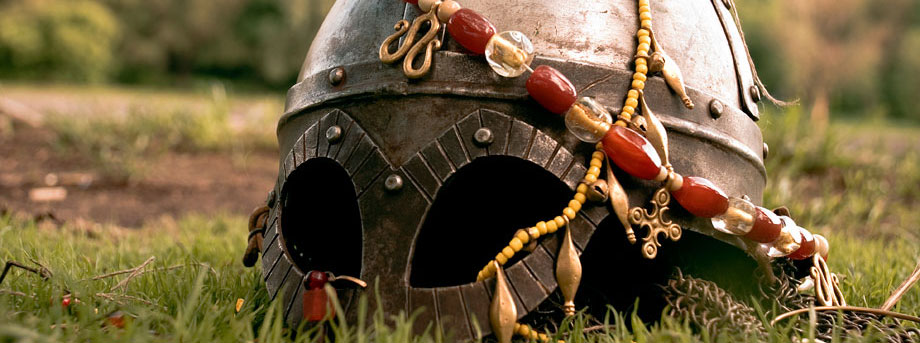
The Vikings are alive and well and living in the North West of England! That’s the revelation in a new book on an epic research project into the genetic footprint of the Scandinavian invaders.
Viking DNA: The Wirral and West Lancashire Project is the culmination of several years of research by Wirral-raised Professor Steve Harding from The University of Nottingham, Professor Mark Jobling and Dr Turi King from the University of Leicester, and many other collaborators. It showcases the power of modern DNA methods for probing ancestry using the North West of England as an example.
The North West has long been known to have special links with the Vikings going back over a thousand years. Evidence for this has been archaeological, in ancient manuscripts, local surnames and placenames such as Thingwall, from the Old Norse ‘ping-vollr’ meaning ‘meeting place’. It’s believed many Vikings, of mainly Norwegian origin, ended up in the region after being expelled from Ireland in AD902.
The book tells the story of how 21st-century genetic methods have been used in conjunction with historical and linguistic evidence to investigate the Viking ancestry of Wirral and neighbouring West Lancashire. Rigorous DNA analysis of samples of the local population has scientifically proved that the Vikings settled heavily in the area and left a huge genetic legacy which survives and continues today.
The researchers’ new ‘Norse saga’ unfolded as they carried out cheek swab DNA tests on around 100 men from the area who had local surnames dating back hundreds of years. Some names were sourced from a tax register from the time of King Henry VIII, others from lists of alehouse and criminal records, and a list of people who contributed to the stipend of a priest. Only men were swabbed as they carry the Y-chromosome, the DNA on which, like their surname, is passed down the paternal line from father to son with little or no change.
The results found that up to 50 per cent of the DNA from the men of both Old Wirral and Old West Lancashire ancestry was Viking in origin. The full scientific study appeared in the leading journal Molecular Biology and Evolution but has now been put into context for a wider audience in this new book, which pulls together all the evidence, both scientific and historical.
Prof Harding said: “The results forming the basis of this book were very exciting because they tie in with the other evidence from the area. We have tried to explain the background and the DNA method in a way that everyone can understand, and it should be of interest to anyone who is curious about the Vikings and ancestry.
“It also provides a great example of community involvement in science. One youngster from Irby on the Wirral was so impressed with the results for her father that she wrote a school project, My Viking Dad and his Viking Dog.”
Famous TV historian Michael Wood pays tribute to the book in his Foreword: “As the best history always should, the tale involves identity, local feeling, the life lived; it suggests how in a mysterious way even the deep past still lives on in us. It also shows how gripping and informative local history can be, but how it also can vividly illuminate the big picture. It is a model applicable to every community in the UK; a perfect example of what one hopes will become the new history. Not one delivered from on high but developed at grass roots in conjunction with the people themselves, using their archaeology, history and landscape, their family histories, documents, memories and even their DNA.”
The Wirral and West Lancashire Viking DNA survey has now been extended to North Lancashire, Cumbria and over the Pennines to North Yorkshire to see how far the Norse settlers from the Irish Sea penetrated into medieval northern England. The researchers are also collaborating with experts in Scandinavia focusing again on people who can show that their ancestry goes back many generations in particular parts of Scandinavia. In this way they will be able to get a much better idea of what the genetic profile of Scandinavia was like in the Viking age.
Viking DNA: The Wirral and West Lancashire Project (ISBN 978-1907284946) is published by Nottingham University Press in association with Countyvise and is available from Amazon and all good booksellers.
More details on the full Wirral genetic survey and the book are available at www.nottingham.ac.uk/-sczsteve.
Tags: DNA, Dr Turi King, Molecular Biology and Evolution, Professor Mark Jobling, Professor Steve Harding, University of Leicester, Viking DNA: The Wirral and West Lancashire Project
Posted in Features | Comments Off on Cracking the Norse code
Out of Africa
March 8th, 2011
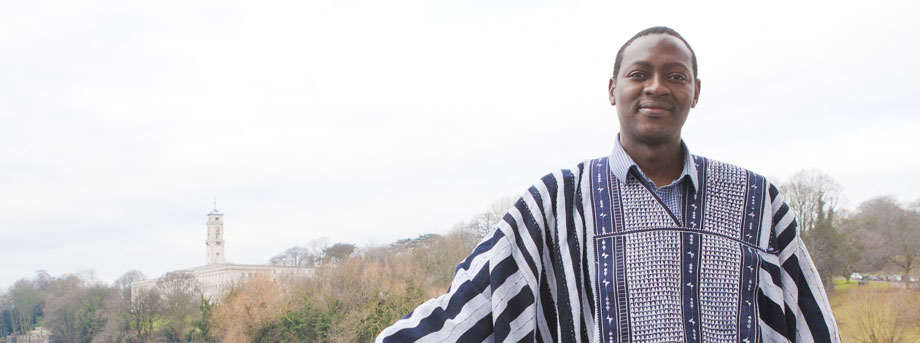
Student Emmanuel Amissah models a stunning Ghanian robe which is on display at Lakeside Arts Centre.
The robe was presented to Chairman of the Alumni Laureate Awards Panel, Mike McNamara, by Chris Skilton on behalf of the people of Northern Ghana.
Mike was made an Honorary Chieftain in recognition of the financial support given by the University’s alumni to CEDIS, a micro-financing project, which was founded by Chris, a 2008 finance, accounting and management graduate.
The project is helping to alleviate poverty in the rural region of Ghana and earned Chris a 2010 Alumni Laureate Award.
The robe will be on display in the Crafts Cabinet at Lakeside Arts Centre, University Park, until Thursday 31 March.
Tags: Alumni Laureate Award, CEDIS, Chris Skilton, Ghana, Lakeside Arts Centre, Mike McNamara
Posted in News | Comments Off on Out of Africa
Andrew Motion: The Cinder Path
March 8th, 2011
Date: Thursday 17 March
Time: 8pm
Venue: Djanogly Theatre, Lakeside Arts Centre, University Park
Admission: £12.50, £9.50 concessions, £6.50 restricted view
Posted in Theatre and Dance, What's On | Comments Off on Andrew Motion: The Cinder Path
Miles Jupp: Fibber in the Heat (A Cricket Tale)
March 8th, 2011
Date: Friday 18 March
Time: 8pm
Venue: Djanogly Theatre, Lakeside Arts Centre, University Park
Admission: £12, £9 concessions, £6 restricted view
Posted in Theatre and Dance, What's On | Comments Off on Miles Jupp: Fibber in the Heat (A Cricket Tale)
Box
March 8th, 2011
suitable for 2-5 years
Date: Sunday 20 March
Time: 1.30pm & 3.30pm
Venue: Djanogly Theatre, Lakeside Arts Centre, University Park
Admission: £6
Posted in Theatre and Dance, What's On | Comments Off on Box