

Campus News
Aiming to bridge the rural and urban divide
May 6th, 2011
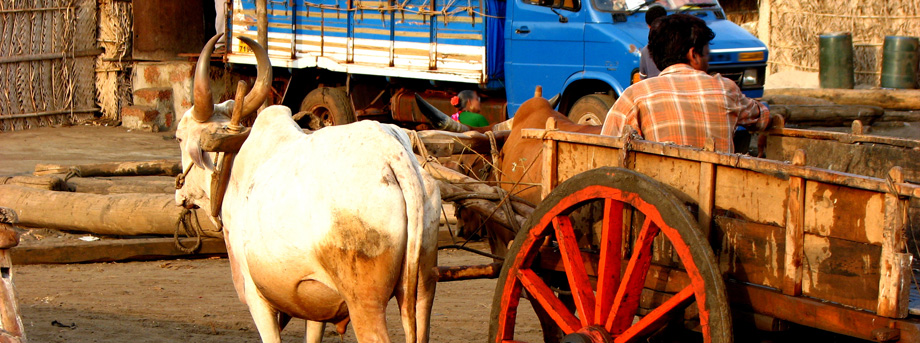
Academics at the University are to receive more than £5 million in UK funding for research that will aim to make rural living in both the UK and India more sustainable.
The money will be used for projects investigating opportunities for small scale energy generation through renewable sources, developing a new autonomous green power system and promoting greater use of mobile technologies to grow wealth in rural communities.
The projects are being supported by the Bridging the Urban and Rural Divide (BURD) initiative with more than £7 million from Research Councils UK (RCUK). Researchers at the University will also receive significant matched resources from the Indian Government’s Department of Science and Technology (DST) and will work closely on the projects with their peers in India.
A £2.6 million project, led by Michèle Clarke, Professor of Environmental Change, at Nottingham and involving the universities of Birmingham, Loughborough, Leicester, Manchester Metropolitan University and Liverpool Hope, will aim to address the dependence of rural communities on fossil fuels.
The project will involve using technological innovations in small-scale energy generation coupled with tailored rural enterprise business models to create Rural Hybrid Energy Enterprise Systems, which can be adapted to address the similar challenges experienced by those living in rural communities in both the UK and India.
The research will focus on three communities in the UK — the Peak District, Lincolnshire and north Scotland (Caithness, Sutherland, Easter Ross and Orkney) — and three communities in India — Karnataka, Jharkhand and the NE (Assam).
New technologies developed during the project will be piloted at villages in Karnataka, south India, Assam, North East India and the University’s dairy farm at its Sutton Bonington Campus in Leicestershire.
The project will have three main themes:
• Rural Energy and Renewable Resources — Assessing access to energy services, surveying supply and demand and mapping potential of existing biomass and renewable energy resources while engaging with local communities.
• Community and Business Enterprise — investigating rural community attitudes to the need and potential of proposed energy technologies and developing new business strategies for sustaining energy generation at a community level.
• Hybrid Energy Systems — Developing innovative, low-carbon, sustainable biomass-fuelled hybrid energy systems at a scale suitable for community use. The new technologies will use small scale anaerobic digestion — the microbiological breakdown of organic matter such as agricultural waste to produce methane (biogas) — in conjunction with biomass gasification coupled with fuel cell technologies to produce and store energy for cooking, heat or transport. The systems will also produce other useful by-products including nutrient-rich organic waste which can be sold as an organic fertiliser and soil improver.
Professor Clarke said: “About 20 per cent of the UK population and 72 per cent of the Indian population live in rural communities, where access to resources, amenities and services are inherently different to those of urban dwellers. Rural communities in both countries share similar challenges, including poor rural transport links and limited access to healthcare and affordable energy. Universal access to clean and efficient energy sources has long been viewed as critical to global needs and expanding access to good quality, stable, energy options in rural areas is therefore essential.
“In this exciting interdisciplinary project we aim to develop community-scale hybrid renewable energy systems coupled with appropriately tailored rural enterprise/business models which can be adapted for local needs in the UK and India.”
In another project, funded with £1.4 million, Nottingham researchers will work with experts from Heriot-Watt and Leeds universities in the UK to develop a new renewable energy system which combines solar power and bioenergy to bring electricity to homes in a remote Indian village.
This project will aim to develop a new class of concentrated photovoltaic technology to integrate with biomass and waste gas production and to develop high-efficiency hydrogen generation and storage for the back-up power.
The integrated system will be installed at Uttar Sehalai Tribal Hamlet, which is located 200km west of Calcutta and has 80 homes and a population of around 400 people. The prototype system will be the first of its kind ever to be installed in India.
Gavin Walker, Professor in Sustainable Energy, will be working to investigate the hydrogen system that uses waste heat and electricity from the solar powered cells and the hydrogen and methane generated from renewable energy sources such as waste biomass.
Professor Walker said: “Due to the lack of electricity in the village, the major fuels currently used are kerosene, firewood and wood-based raw coal. Most of the nearby villages are also without any grid connections and, as a result, children from the poorer families do not have the motivation and necessary resources to take advantage of basic education and health.
“Availability of energy is a critical driving factor in economic development, while limited fossil fuel resources and environmental hazards drive the need for sustainable and environmentally-friendly solutions based on renewable energy.”
In a £1.26 million project, researchers from Horizon Digital Economy Research at Nottingham and the Centre for Technology and Development in New Delhi will lead an international team including, the Future Interaction Technology lab at Swansea University, IIT Bombay, NISTADS in New Delhi, alongside industrial partners including Microsoft Research India, and IBM Research Laboratory in India.
Although a world apart, organic food producers in Ceredigion in west Wales and non-edible oil producers in Uttarakhand in the foothills of the Himalayas both increasingly struggle to get a decent price for their goods. One reason for this is that these communities both lack the scale to maximise their position in an increasingly global market place.
The sustainability of small communities is a huge issue in rural areas. Rural enterprises in both the UK and India struggle without the communication and distribution infrastructures found in urban-industrial areas.
Dr Catherine Mulligan said: “We will develop new technologies to allow communities to shape the next generation of rural enterprises. This will allow rural enterprises to achieve the economies of scale and retain control of the supply chain dynamics that currently work against them.
“Mobile technologies have already allowed rural communities across the world greater access to information and expertise, leading to the creation of new local enterprises. The next challenge is helping these communities exploit these technologies to coordinate their activities in order to scale up the levels of production and compete on a level playing field with urban enterprises.”
Tags: Dr Catherine Mulligan, Gavin Walker, Michèle Clarke, Professor in Sustainable Energy, Professor of Environmental Change, ridging the Urban and Rural Divide (BURD), Rural Hybrid Energy Enterprise Systems
Posted in Research | 1 Comment »
Plans to set fees at £9,000
May 6th, 2011
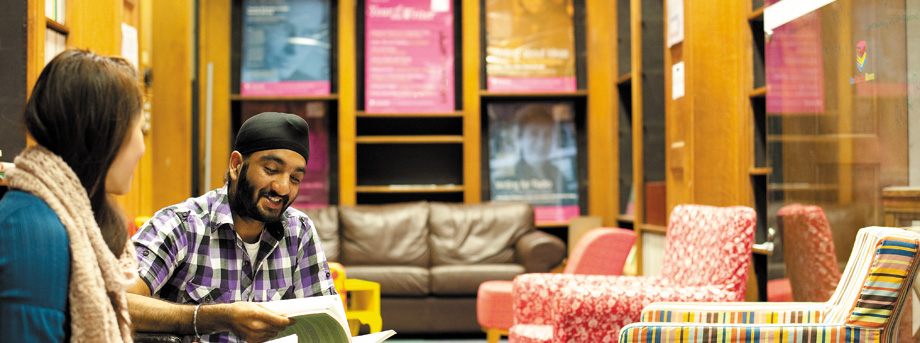
The University has announced plans to set undergraduate fees at £9,000 from 2012, subject to agreement by the Office for Fair Access (OFFA).
The fees will apply to full-time UK and EU students on all undergraduate degree courses. They will replace funding being withdrawn by the Higher Education Funding Council for England (HEFCE) and allow the University to invest further in a world-class student experience that has made Nottingham one of the most popular universities in the UK.
New funding proposals follow the recommendations set out in the Browne Review, and reflect the Government’s decision to make significant cuts in annual teaching grants and capital grants. The University faces a £12m cut in Government funding in 2011/12, following a loss of £4m in 2010/11.
A substantial package of financial aid will be available to students, to ensure that the University continues to attract the best and the brightest, whatever their background. The University will be offering a further £4m to support entrants in 2012, with students from lower-income families benefitting from bursaries and, in some cases, fee waivers. This boosts the £6m the University already invests in these initiatives.
This package will include support for students with their living costs, and extra provision will be targeted towards foundation year students, local students, those with disabilities, those with responsibilities as carers and students formerly in care.
The University will also increase in its work with schools, colleges and the community. The new Nottingham Potential programme will increase outreach significantly, providing academic support, curriculum enrichment, student-pupil mentoring and focused work. This represents a long-term commitment to widening participation and provides a major opportunity for transformational work in the local area.
Professor David Greenaway, Vice-Chancellor, said: “We are currently investing £90m in teaching and learning, to ensure that our students continue to enjoy the very best facilities during their studies. The new fee levels we are proposing will allow us to replace the cuts in Government expenditure and build on this investment, and build on what we can offer to students who aspire to a world-class education, while maintaining the financial sustainability of the University.
“For our students, a degree from The University of Nottingham represents an investment in their future. This is reflected in the fact that when they graduate, they are among the most sought-after in the country.
“At the same time we have a long tradition of raising aspiration, widening access and supporting achievement, both locally and nationally. With the comprehensive package of financial support we are proposing, together with a step-change in our widening participation activity, we will ensure that Nottingham continues to attract students of the highest calibre – regardless of their financial circumstances.”
More information is available at: www.nottingham.ac.uk/fees/frequentlyaskedquestions.aspx.
The University has seen a surge in enquiries from prospective students. The number of people booking onto undergraduate open days — held in June and September
— is up by 48% on this time last year. The University has also seen a 26% increase in calls to its undergraduate enquiry centre, and a 22% increase in prospectus requests.
Dr Paul Greatrix, Registrar, said: “It is clear that interest in a Nottingham degree has not diminished in light of the proposed new fee arrangements — in fact, we have seen greater interest than in previous years.”
Tags: Browne Review, Dr Paul Greatrix, fees, Higher Education Funding Council for England (HEFCE), Nottingham Potential, Office for Fair Access (OFFA), Registrar, undergraduate open days, Vice-Chancellor Professor David Greenaway
Posted in News | Comments Off on Plans to set fees at £9,000
Curiouser and curiouser…
May 6th, 2011

The inner ear of a whale, a costume from the 1980s’ hit film Flash Gordon and a Voodoo Lily which attracts pollinating insects by giving off the smell of rotting meat…
Dr Matthew McFall – Agent of Wonder at the Nottingham University Samworth Academy (NUSA) – is on a mission to fire the imagination of young learners.
And with his Wonder Room – a first for a UK school – Dr McFall throws open a modern-day cabinet of curiosities for children to explore.
Every shelf is laden with assorted unidentified ephemera – a mere glimpse of the wonders of the world – and uses the natural inquisitiveness of children to inspire a thirst for knowledge.
From the retro to the mysterious and the downright weird, the room has a section on puzzles and secret codes, alien-looking plant pods and a rib bone of a woolly mammoth.
The Wonder Room stems from Dr McFall’s research at the University’s Learning Sciences Research Institute (LSRI) for his doctorate examining whether wonder can be used in the classroom as a tool for learning. It also taps in to Dr McFall’s other lifelong passion, stage magic. A specialist in illusion design, his interest dates back to when he received his first magic set from his parents at the age of four.
Dr McFall said: “Magic is brilliant for building confidence and dexterity and some forms of magic such as illusions and effects may also have a mathematical or scientific element. Magic also teaches us that it’s OK if we don’t know everything, can’t see how something is done, but also fascinates us enough that we want to find out.
“Magic has stayed with me throughout my life and I want to use that same sense of wonder to empower the children rather than have them feel they are stupid because they don’t yet understand everything they encounter in life. There’s an element of thinking involved but I want the journey they take by exploring the objects in this room to affect their head, heart and hands.”
Dr McFall’s passion seems to border on the obsessive – he admits that most of the exhibits in the room have come from his own home. However, donations have started trickling in from colleagues and curious visitors.
The Wonder Room is also playing an increasingly supportive role in lessons — Dr McFall has begun supplying colleagues with a themed pack of objects to enhance teaching in a particular area.
NUSA’s principal Dave Harris believes that this is crucial in reaching pupils who may not always engage with traditional classroom methods, particularly those pupils with behavioural problems or special educational needs.
He said: “I have seen so many of our pupils talk so enthusiastically about The Wonder Room: they are interested, they ask questions and that can only be beneficial. The objects from The Wonder Room gives them a context that they don’t get elsewhere. For some kids certain topics are mystifying but by looking at and holding an artefact it allows them to more easily relate to that topic — it’s another piece of the puzzle.”
Pupils can visit The Wonder Room during break times, lunchtime or as a reward for achievement. Many have asked to bring family or friends in, while others have been inspired to take up a hobby or start collecting.
Jordan Elsgood, 13, said: “I come in here quite regularly and I have found I am really good at metal key puzzles. They’re a real brain strain but when I actually do it I feel like I’ve really achieved something.”
Aiden Whitehead, 11, agreed: “This room is cool — strange but cool. It feels quite calm. I really like all the different kinds of puzzles here too and I can spend ages working on trying to do them.”
Visitors can leave feedback on pieces of card. Every single one is a ringing endorsement. But one enthusiastically scrawled comment sums it up perfectly. It simply says: “I want to live here!”
Tags: Agent of Wonder, Dr Matthew McFall, Learning Sciences Research Institute (LSRI), Nottingham University Samworth Academy (NUSA)
Posted in Features | 3 Comments »
Inside the mind of a psychology student…
May 6th, 2011
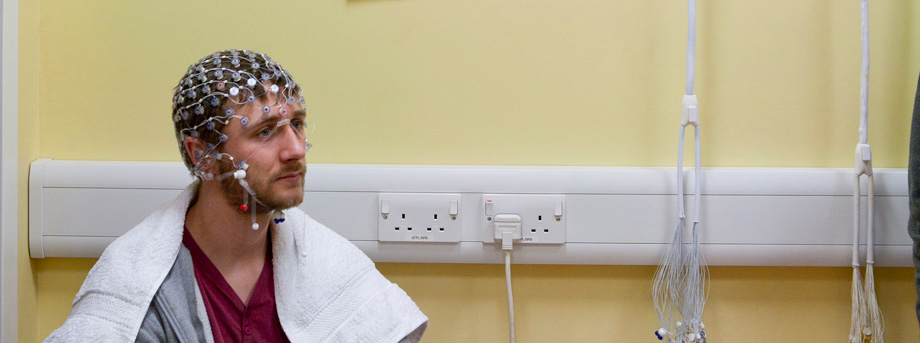
Around 50 A-level students have had a taste of university life with two mini ‘seminars’ at The University.
Academics gave lectures on autism, aggression and schizophrenia, while postgraduate students organised lab tours and hands-on experiments.
Lucy Cragg, RCUK academic fellow in translational neuroscience and outreach officer at the University’s School of Psychology, said the workshops had been designed to complement the A-level curriculum while extending into new areas.
In Visual Neuroscience, students were asked to wear prism goggles, which shift everything horizontally, and throw balls into a basket, sparking hilarity. Within a minute, their eyes adjusted and the balls landed in the basket. But immediately after the goggles were removed, the students’ aim failed as their eyes then had to readjust.
And in Cognition and Language (electrical brain cells and subliminal messages), postgraduates Emily Coderre and Kate Bailey demonstrated how an EEG (electroencephalograph) measures the pattern of a brain’s electric activity.
Other workshops were Behavioural Neuroscience: is your memory as good as a rat’s?, NITES (Nottingham Integrated Transport and Environment Stimulation): tracking drivers’ eye movements, Personality, Social Psychology and Health: social problem-solving & are you a morning person?, Human Development and Learning: the use of eye-tracking technology, and Cognition and Language: subliminal priming.
Students came were from George Spencer Academy, Stapleford, Rushcliffe School, The Nottingham Emmanuel School, Bramcote Hills College and Christ the King School, Arnold. The Brain Awareness Week event allowed the postgraduates to experience training in outreach activities.
The School’s Summer Scientist Week runs from August 8-12. For more information, visit www.summerscientist.org or visit exchange.nottingham.ac.uk/research-is-childs-play/ for a round-up and a video of last year’s event.
Tags: Brain Awareness Week, Lucy Cragg, School of Psychology, Summer Scientist Week
Posted in Features | Comments Off on Inside the mind of a psychology student…
Irish Sea ‘the M6 of the Viking age’
May 6th, 2011

Experts at the University have reached across ‘the M6 of the Viking age’ to spread the latest research on the history and culture of the Norsemen.
The 7th Midlands Viking Symposium brought together some of the foremost Viking researchers in Dublin.
The Vikings left a strong imprint on Ireland that is still apparent in place-names, archaeological finds and in the DNA of the modern population.
Archaeological finds have provided new evidence of the widespread impact the invaders had on Ireland when they arrived on its shores over 1,000 years ago. The recently-discovered site of Annagassan promises to rival Viking Dublin in the richness and variety of relics.
There is strong evidence to suggest that all modern Irish cities had their foundations in the Viking age. Limerick, for example, can trace its heritage back to the Norsemen’s settlement of Hlymrekr.
The Symposium is a collaboration between the universities of Nottingham, Birmingham and Leicester, and brings together academics and non-academics. This year’s event, from April 29-30, was co-organised and hosted by Dublin City Council, and supported by the National Museum of Ireland.
Professor Judith Jesch, of The University of Nottingham, presented a session on ‘Depictions of the Irish in Norse literature’. She said: “In the Viking age, the Irish Sea was the M6 of its day – an extremely busy highway for trade and travel. Both England and Ireland were thus plugged into the wider Viking world that extended north to Scotland and Iceland. The literature of medieval Iceland is one of the best ways of finding out what people thought of their neighbours in this busy multicultural world.”
In the past, Vikings have been seen as ‘Gaill/foreigner’ in Britain and Ireland, but focus has shifted to settlement and integration into existing cultures. The Vikings are a shared experience for the two nations, linked by the Irish Sea and characterised by varied adaptation to circumstances of language, economy and politics.
The opening keynote lecture was given by Dr Christina Lee, of The University of Nottingham, and Dr John Sheehan, of University College Cork, who talked about the importance of Vikings in their respective research areas – literature/language and archaeology. Other sessions included: ‘A nest of pirates? Weapons, warriors and early Viking Dublin’ – Dr Stephen Harrison, University College Dublin, ‘and What’s in a name? The genetic legacy of the Vikings in the north of England’ – Dr Turi King, University of Leicester.
The University of Nottingham is at the forefront of Viking research, through the Centre for the Study of the Viking Age in the School of English Studies (www.nottingham.ac.uk/csva/index.aspx), which was founded in 1995 by Professors Christine Fell OBE and Judith Jesch.
A web resource, with a list of Viking finds in Ireland, is at: www.vikingage.mic.ul.ie/. The resource will be showcased at May Fest 2011, the University’s community open day, on Saturday 7 May. Visit www.nottingham.ac.uk/mayfest/index.aspx.
Posted in News | Comments Off on Irish Sea ‘the M6 of the Viking age’
Sam’s driving ambition…
May 6th, 2011
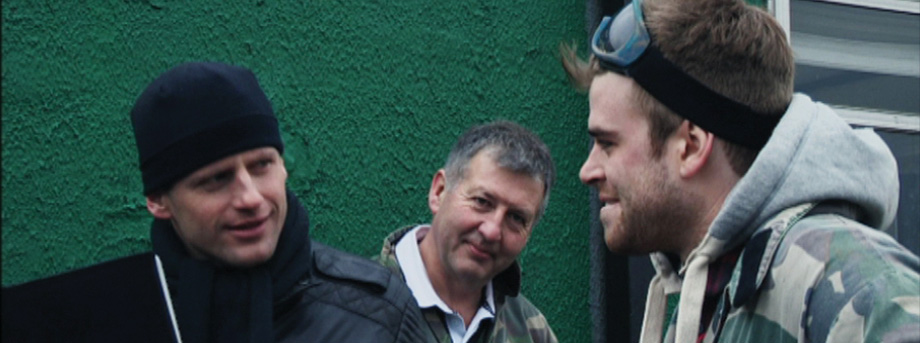
A nursing student has notched his determination to succeed up a gear after a global TV show pushed him to the limit.
Sam Nutter, a third year trainee nurse, is a “phenomenal student who always puts others first”, say his lecturers. But a lack of confidence held Sam back until he appeared on MTV MADE — a self-improvement reality TV show which pairs young people with experts in their field to help them achieve their goals.
Sam entered the challenge with trepidation — he had no idea what he was going to be asked to do. And being hurled down a hill inside a giant plastic ball — zorbing — was just a taste of things to come. He was about to be put through a series of extreme sporting challenges designed to test his courage and boost his confidence.
Step one: learning a skill. Sam spent three days driving a Formula One simulator and a go-kart in Weston-super-Mare.
Step two: practice, practice, practice. Sam, who had a reputation for being a bit of a Sunday driver, soon got a taste for speed. But the stakes were raised when he was flown to Spain to “play with four new Volkswagen Sciroccos” on an empty race track.
Step three: pedal to the metal. Sam flew to Sweden to meet Ronny Wechselberger, a star of Formula 3 and the man behind the wheel in the Bourne film trilogy. Sam also learnt how to race on ice and had a go at dog sledging.
“The experience has been amazing and completely blew me away!” said Sam. “This was a once in a lifetime chance and I am so lucky they picked me. I am now less reserved, have more self-confidence and try to tackle any challenges head on. It has also inspired me to travel and I hope to do this after university.
“I had no idea what I would be doing ahead of the filming and the few clues I was given just added to my nerves as I like to know what is happening at all times,” he continued.
“I just had to learn to go with whatever was happening and try to enjoy it. I knew it was to do with driving but your mind always suggests the worst, I even imagined at one point that I would be asked to drive a car off a cliff, attached to a bungee rope. This only added to my anxiety, although in the end it was fantastic.”
Helen Laverty, lecturer in the School of Nursing at the University and Sam’s personal tutor, says the experience has given Sam the confidence to achieve his full potential.
She said: “Sam has always gone the extra mile, seen the best in people and has a can do perspective, skills which will all help him when he does qualify. But since the show he has grown in stature, with this new-found self belief, the sky’s the limit for Sam.
Helen added: “Having watched some of the clips from the show, it is a good job that he made it back OK. If he hadn’t I think the Nursing and Midwifery Council would have struck me off for letting him take part!”
MADE with Sam Nutter was broadcast on MTV on 25 April.
Posted in News | Comments Off on Sam’s driving ambition…
The quiet revolutionary
May 6th, 2011

For a man who hasn’t had a holiday in nearly two years, Dlawer (Del) Ala’Aldeen looks remarkably relaxed. Even more remarkable when you consider that as well as his role as Professor of Clinical Microbiology and Head of the Molecular Bacteriology and Immunology Group (Division of Microbiology & Infectious Diseases) at The University of Nottingham, he is Minister for Higher Education and Scientific Research in Kurdistan.
Prof Ala’Aldeen was invited to join the newly elected coalition government in Kurdistan in 2009 by Dr Barham Salih.
“We go back a long way,” explains Prof Ala’Aldeen. The pair had both been in London in the late 80s when Saddam Hussein massacred 180,000 Kurds in a systematic campaign of mass summary executions and disappearances, widespread use of chemical weapons and the destruction of thousands of villages.
Prof Ala’Aldeen had fled Saddam’s brutal regime for the UK in 1984 but campaigned vigorously for those left behind.
After the Gulf War ceasefire in 1991, a Kurdish uprising was crushed by Iraqi and tens of thousands of people fled to the mountains, sparking a humanitarian crisis. Prof Ala’Aldeen, who by now had founded the British-based Kurdish Scientific and Medical Association (KSMA), went over to Kurdistan to work with refugee charities.
Throughout this time, Prof Ala’Aldeen lobbied Parliament and persuaded then Prime Minister Margaret Thatcher to support the Kurds – and to persuade the US and French governments to do the same. This led to the formation of the Kurdistan region. Saddam withdrew his administration and in 1992, the Kurdistan Regional Government (KRG) was formed. At about the same time, Prof Ala’Aldeen came to Nottingham, taking up his Clinical Leadership position two years later.
He began supporting Higher Education in Kurdistan, persuading the then Vice-Chancellor Sir Colin Campbell to organise for more than 80 university leaders to come here to learn how to run a university. A fee-paying course later evolved and the University continues to build on its relationship with Kurdistan.
Prof Ala’Aldeen continued to follow events in Kurdistan, writing newspaper articles and being appointed to the British Government’s working party on chemical and biological weapons.
“I was a critic, but a constructive critic,” he says, “which is why the parties and the Prime Minister liked my comments because there were criticisms, but always solutions. I became known as this outspoken academic who supported the system but remained critical as to how things could be improved.”
And then came the invitation from Dr Salih, the newly elected Prime Minister in Kurdistan’s coalition government, to head up the reform of the region’s desperately outdated and bureaucratic Higher Education system.
“I asked him to accept radical reform rather than a partial approach,” says Prof Ala’Aldeen, who wrote A Vision to the Future of Higher Education in Kurdistan (A Road Map to Quality). “I got the backing of the government and the opposition. That was a unique situation as our reform was based on a model that everyone agreed on.”
He then asked the VC for a secondment. “He very kindly agreed and supported me with enthusiasm and I’m grateful for that.”
Prof Ala’Aldeen quickly realised the enormity of his task. “A country that is emerging from the ashes of Saddam Hussein and a completely closed system that was designed to keep a closed community suddenly became democratic and forward looking and wanted to catch up with the rest of the world. At first it was almost overwhelming and like a one-man band. But luckily there is plenty of talent around that has the understanding necessary and is willing to help.
“Each day, each month, there was a milestone. Each time we introduced something it created the expectation of something else.
“Occasionally, it’s like flying an aeroplane while you are mending the wings. It was a steep learning curve, learning how everything there worked before we could start to change it. We were taking on, head on, the long-entrenched interests of people who made money out of the system and knew how to exploit it. For the first time in the history of Iraq, all appointments would have to be made on talent and merit, and each university would have its own elected body which would be central to all its functions.”
There were protests at first. Prof Ala’Aldeen explains: “There was extreme intolerance of change but the time for introducing change was right – there was a palpable hunger. Trying to reform a system that’s bureaucratic, enclosed, nationalist, socialist, run by a dictator – first you need to understand the mentality and the culture while at the same time you’ve worked all your professional life in a country like Britain. It’s like going back, maybe by a century. There’s a gap between your aspirations and what you can achieve in reality.”
The coalition government in Kurdistan aims to swap Prime Minister every two years, creating cabinet reshuffles. “I decided to just do as much as I could in the first two years. Indeed the first milestone was changing the legislation which will make the reform more permanent,” says Prof Ala’Aldeen.
“This is a long evolving system – a process that may take decades and generations to complete. But what we have done in the first two years is lay the foundations.”
So how does life in Kurdistan compare to Nottingham, where Prof Ala’Aldeen has a wife and three children?
“In Kurdistan, when I wake up in the morning and go to work I don’t know what is waiting and how my day will go. This is greatly different to my academic life, where you can plan a year ahead. There I have bodyguards and have to be driven. It’s a joy when I come back to Nottingham and I’m able to lead a normal family life.
In Nottingham, Prof Ala’Aldeen heads a group of 20-odd scientists and students. Maintaining a relationship is vital and he is in regular contact via Skype.
“It’s amazing how much you can do – it’s not that different to being here and in another room! I’m lucky to have a very good group of scientists who are mature and independent. I also have a very good deputy, who’s been a very safe pair of hands over the years. I make sure my work here is not affected in any way by this secondment.
“All my life I worked in academia. It what gives me job satisfaction and it’s where my priorities are. But when I was invited to join a historic opportunity to contribute to system reform in the country where I was born I could not say no. I don’t want to retire and look back and think I had a lifetime of opportunity to do something big for the people of Kurdistan but I chose an easier life.
“I feel very lucky to be in Britain and think my family are very lucky to be in a society where things are so organised.
“I came here as a refugee looking for freedom but I found life. My attachment to Britain is eternal.”
Posted in Features | Comments Off on The quiet revolutionary
Psst! Want to know how to make Barbie look like your mum?
May 6th, 2011
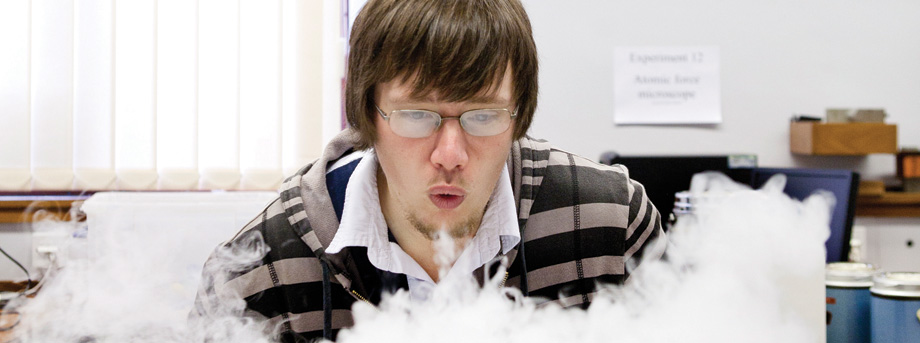
What happens if you stick a sharp stick into a balloon? It pops, right? Well, not necessarily, as The University of Nottingham’s Physics Buskers are keen to demonstrate…
The Physics Buskers — whose last appearance was at Nottingham’s Light Night — are busy brushing up their skills ready for May Fest 2011, the University’s free community open day for family, friends and alumni on Saturday 7 May.
Barbie dolls, balloons, fluorescent pens and liquid nitrogen all play a part in helping to shake off the bearded-old-man-in–white-coats image and making people realise that science is fun.
“The aim is to raise interest in science and to let people know that it’s relevant to everyone,” explains Professor Penny Gowland, of the School of Physics and Astronomy. “People from age six to 60 — they’re all interested.”
“This is fun for us too,” agrees lab technician Paul Munday, as he dips a balloon into liquid nitrogen. The balloon deflates completely. He removes the wrinkled balloon and blows on it gently. Within seconds it reinflates.
“The liquid nitrogen is so cold — about minus 196 degrees — that it liquefies the air inside the balloon, making it about 700 times smaller. But the air is still there, it hasn’t gone away. When it warms back up it expands again and so the balloon reinflates,” he explains.
Then he pours the liquid nitrogen into a miniature steam engine; the gas that it gives off sets the engine in motion.
Other ‘tricks’ include dropping peanuts into fizzy water, writing on the audience with ‘invisible’ ink and making table-top rockets.
Paula Croal, first year PhD Physics student, demonstrates the balloon trick with a kebab stick. “This is a fab idea! I’m going to recreate this with my nephew — he’ll be amazed!”
Paula, along with Julian Sterling, has just spent several weeks working with city schoolchildren for a module on communicating science — part of the School’s outreach work.
Julian and Paula worked with year 9 students at Nottingham Academy, helping them to design and build rockets and rocket launchers.
The aim of the project was to spark an interest in the students and to make them think about studying at university. And, again, to challenge the stereotype about scientists.
“The kids were a little surprised when I turned up,” says Paula. “They assumed I’d be a man!”
After two weeks working with Paula and Julian, the students created an activity for 70 year 5 pupils from Jesse Boote Primary School to do as part of a ‘trickle down’ approach.
“I was quite impressed when I heard the year 9s explaining how the physics worked to the younger kids because we hadn’t drummed it in to them, they had just taken it in during the work we were doing,” says Paula.
“They really enjoyed it and by the end they all said they would definitely recommend it to another year as a worthwhile thing to do.”
It’s the introduction of physics busking to The University of Nottingham that earned its creator — PhD student Claire Sweetenham — a Vice-Chancellor’s Achievement Award last year. One busking event at Nottingham’s Broadmarsh Centre attracted more than 600 people.
By now the lab has come alive with spinning lights, noises, bubbles and smoke — and lots of discussion and laughter.
Finally, one of the students practises his Barbie spiel: “Why doesn’t Barbie look like your mum?”
“Because her legs are too long.”
He then plunges Barbie into a glass of water and: “Voila! Now she looks like your mum!”
May Fest 2011: Saturday 7 May, 11am to 5.30pm at University Park. Visit www.nottingham.ac.uk/mayfest/index.aspx to find out details of May Fest 2011 and to download a programme.
Posted in Features | Comments Off on Psst! Want to know how to make Barbie look like your mum?
The magic finger…
May 6th, 2011
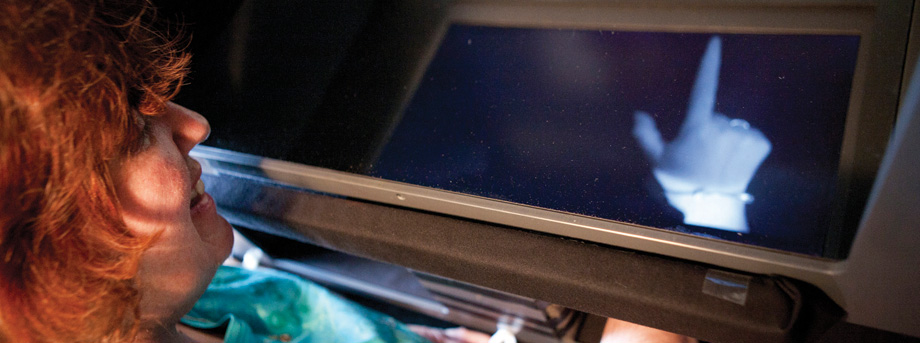
An accidental discovery by academics at the University has shown that a simple illusion can significantly reduce — and in some cases temporarily eradicate — arthritic pain in the hand.
By tricking the brain into believing that the painful part of the hand is being stretched or shrunk, researchers were able to halve the pain felt by 85% of sufferers they tested.
The research could point to new technologies which could help patients to improve mobility in their hand by reducing the pain they experience during physiotherapy.
The Nottingham team stumbled on its finding by chance at last year’s community open day. People had been invited to experience body distortion illusions used for every day research with Nottingham’s unique MIRAGE technology. This takes a real-time video image of a hand and uses computer manipulations combined with physically pulling or pushing to fool the brain into believing the hand is stretching or shrinking.
The technology has been used for research into body representation — the way in which our brain puts together what we see and what we feel.
Dr Roger Newport, who is leading the research in the School of Psychology, said: “The majority of people who come to these fun events are kids — the illusions really capture their imagination and they think it’s a cool trick and can become a bit obsessed with working out how we do it.”
Dr Catherine Preston, who is now at Nottingham Trent University and collaborated on the study, added: “The grandmother of one of the children wanted to have a go, but warned us to be gentle because of the arthritis in her fingers. We were giving her a practical demonstration of illusory finger stretching when she announced: “My finger doesn’t hurt any more!” and asked whether she could take the machine home with her! We were just stunned — I don’t know who was more surprised, her or us!”
The team contacted an osteoarthritis support group and asked them to take part in tests to confirm the effectiveness of MIRAGE for pain relief.
The study attracted 20 volunteers with an average age of 70, all clinically-diagnosed with arthritic pain in the hands and/or fingers and none medically managing their pain on the day by anything stronger than paracetamol. Before the test they were asked to rate their pain on a 21-point scale, with 0 indicating no pain and 20 representing unbearable pain.
The team then compared the MIRAGE body illusion to just physically pushing and pulling on the painful parts of the volunteers’ hands to test the effect on their pain. Other control tests were conducted by stretching or shrinking a non-painful part of the hand and visually enlarging or reducing the hand.
The results showed a marked reduction in pain — on average halving the discomfort for 85% of volunteers. Stretching or shrinking the painful part – combined with physical manipulation – temporarily eliminated pain in a third of volunteers. Anecdotally, many volunteers also reported an increased range of movement.
The work is at an early stage and further studies are needed. The researchers have secured a £23,000 Serendipity Grant from the Dunhill Medical Trust. There is also potential for collaboration with colleagues at the Arthritis UK Pain Centre at the University to study the brain’s role in mediating pain.
“This is an excellent example of how fundamental research can often produce unexpected and significant results,” said Dr Newport. “In my early career I was lucky enough to receive internal funding to develop the MIRAGE technology which is unique to the University. Without that support we never would have unearthed this surprising and exciting result, which potentially could be extremely important to the millions of people who suffer from this painful and debilitating illness.”
Posted in News | Comments Off on The magic finger…
Visitor
April 6th, 2011
Date: Saturday 12 March to Monday 2 May
Venue: Djanogly Art Gallery, Lakeside Arts Centre, University Park
Admission: Free
Posted in Exhibitions, What's On | Comments Off on Visitor