

Campus News
Life on Mars
December 22nd, 2011
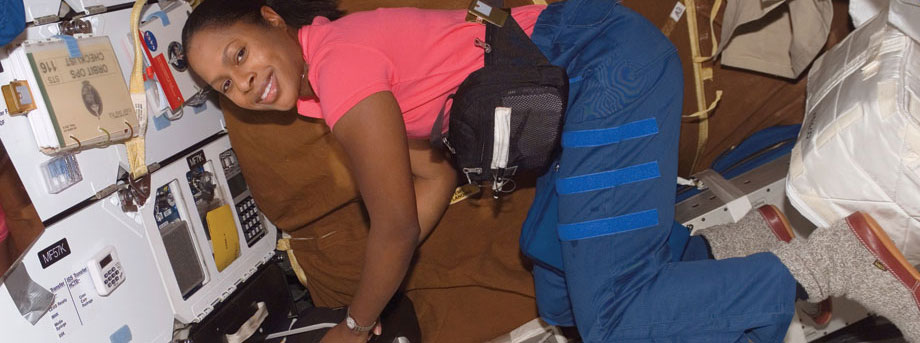
The astrophysicist Stephen Hawking believes that if humanity is to survive we will have to up sticks and colonise space. But is the human body up to the challenge?
Scientists at The University of Nottingham believe that Caenorhabditis elegans (C. elegans), a microscopic worm which is biologically very similar to the human being, could help us understand how humans might cope with long-duration space exploration.
Their research, published in Interface, a journal of The Royal Society, last month has shown that in space the C. elegans develops from egg to adulthood and produces progeny just as it does on earth. This makes it an ideal and cost-effective experimental system to investigate the effects of long duration and distance space exploration.
In December 2006 a team of scientists led by Dr Nathaniel Szewczyk, from the Division of Clinical Physiology in the School of Graduate Entry Medicine, blasted 4,000 C. elegans into space onboard the Space Shuttle Discovery. The researchers were able to successfully monitor the effect of low Earth orbit (LEO) on 12 generations of C. elegans during the first three months of their six-month voyage onboard the International Space Station. These are the first observations of C. elegans behaviour in LEO.
Dr Szewczyk said: “A fair number of scientists agree that we could colonise other planets. While this sounds like science fiction it is a fact that if mankind wants to avoid the natural order of extinction then we need to find ways to live on other planets. Thankfully, most of the world’s space agencies are committed to this common goal.
“Many of the biological changes that happen during spaceflight affect astronauts and worms and in the same way. We have been able to show that worms can grow and reproduce in space for long enough to reach another planet and that we can remotely monitor their health. As a result, C. elegans is a cost-effective option for discovering and studying the biological effects of deep-space missions. Ultimately, we are now in a position to be able to remotely grow and study an animal on another planet.”
Many experts believe the ultimate survival of humanity is dependent upon colonisation of other planetary bodies. But we face key challenges associated with long-term space exploration. Radiation exposure and musculoskeletal deterioration are thought to be two of the key obstacles to successful habitation beyond LEO.
The C. elegans has been used on Earth to help us understand human biology — now it could help us investigate living on Mars. C. elegans was the first multi-cellular organism to have its genetic structure completely mapped and many of its 20,000 genes perform the same functions as those in humans. Two thousand of these genes have a role in promoting muscle function and 50-60% of these have very obvious human counterparts.
This was Dr Szewczyk’s third space-worm mission. He and his team at Nottingham collaborated with experts at the University of Pittsburgh, the University of Colorado and the Simon Fraser University in Canada, to develop a compact automated C. elegans culturing system which can be monitored remotely to observe the effect of environmental toxins and in-flight radiation.
Dr Szewczyk said: “Worms allow us to detect changes in growth, development, reproduction and behaviour in response to environmental conditions such as toxins or in response to deep-space missions. Given the high failure rate of Mars missions, use of worms allows us to safely and relatively cheaply test spacecraft systems prior to manned missions.”
The 2006 space mission, which led to this latest research, was followed up with a fourth mission in November 2009. Some of the results of the 2009 mission were published earlier this year in the journal PLoS ONE: http://tiny.cc/plosonespacemission.
These two missions have established that the team are not only in a position to send worms to other planets but also to experiment on them on the way there and/or once there. More results, including a mechanism by which muscles can repair themselves are due to be published shortly.
The origins of Dr Szewczyk’s worms can be traced back to a rubbish dump in Bristol. C. elegans often feed on bacteria that develop on decaying vegetable matter.
Tags: Division of Clinical Physiology in the School of Graduate Entry Medicine, Dr Nathaniel Szewczyk
Posted in Research | Comments Off on Life on Mars
Who’s afraid of the Big Bad Wolf?
December 22nd, 2011
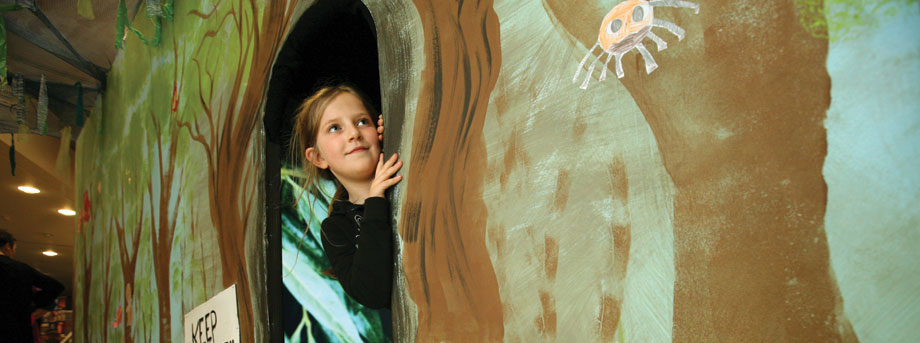
Children from Haydn Primary School in Nottingham have worked with Lakeside Arts Centre to create an interactive exhibition to accompany the centre’s festive production, Red Riding Hood. They went along to an opening ceremony.
Posted in Features | Comments Off on Who’s afraid of the Big Bad Wolf?
A new delivery
December 22nd, 2011
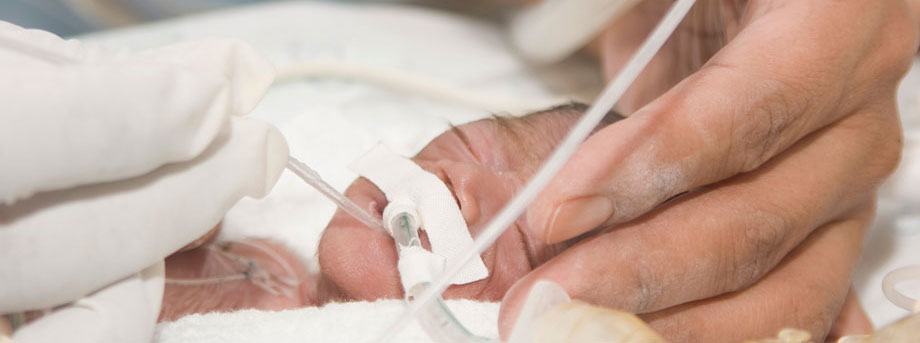
The QMC’s Neonatal Unit has welcomed an unusual but very welcome delivery: a new, state-of-the-art MR incubator.
The University’s highly specialised incubator — worth more than £200,000 — will be used to transport babies from the Neonatal Unit to the MRI scanner at the hospital.
The Neonatal Incubator has an integral 3T infant Head Coil for MR imaging, which is the first in the world, and is designed using MRI compatible parts. The whole unit can be wheeled into the MR scanner without having to move the baby. Premature babies can now have detailed MR imaging supported by other treatments. The benefits to the baby, parents and medical staff are immense. Diagnosing potential problems in neonatal babies is crucial, not only for their immediate health, but also for longer term development.
Dr Stephen Wardle, Consultant Neonatologist at the QMC, part of Nottingham University Hospitals NHS Trust, said: “During the process we want the baby to be settled and quiet so that we can get a detailed scan, without the baby moving and without interference and, obviously, we want the baby to be as comfortable as possible as well. The incubator allows for this and for the baby’s breathing to be supported if needed, while maintaining the right level of humidity, essential for babies born prematurely.”
The incubator was made possible by donations from a range of supporters, including the James Tudor Foundation.
Dr Helen Budge, Clinical Associate Professor and Reader in Neonatology at the University, said: “Our partnership with The James Tudor Foundation in our work on the brain development of extremely premature infants is integral to improving care for these vulnerable patients and informing clinical practice. We are most grateful to our donors for all their support which has made the purchase of this equipment possible.”
Impact: The Nottingham Campaign is a five-year campaign to raise funds for a series of high-impact projects which aim to change lives, tackle global issues and shape the future. To find out more about how you can support us visit: www.nottingham.ac.uk/impactcampaign.
Tags: Clinical Associate Professor and Reader in Neonatology, Dr Helen Budge, Impact: The Nottingham Campaign, James Tudor Foundation
Posted in News | Comments Off on A new delivery
Lowry
December 21st, 2011
Wednesday 16 November to Sunday 5 February 2012 at Djanogly Art Gallery, Lakeside Arts Centre, University Park. The gallery is open 11am-5pm, Monday to Saturday, and 12pm-4pm, Sundays and bank holidays. Admission is free.
This exhibition focuses on Lowry’s work from the 1920s to the immediate post-war period, and celebrates 130 years of excellence at the University. Supported by Sir Harry and Lady Djanogly and organised in association with the Crane Kalman Gallery, London, it includes a substantial body of works generously loaned by The Lowry Collection, Salford. With special thanks to Carol Ann Lowry and the Estate of L S Lowry.
Posted in events | Comments Off on Lowry
Impact: The Nottingham Campaign
December 21st, 2011
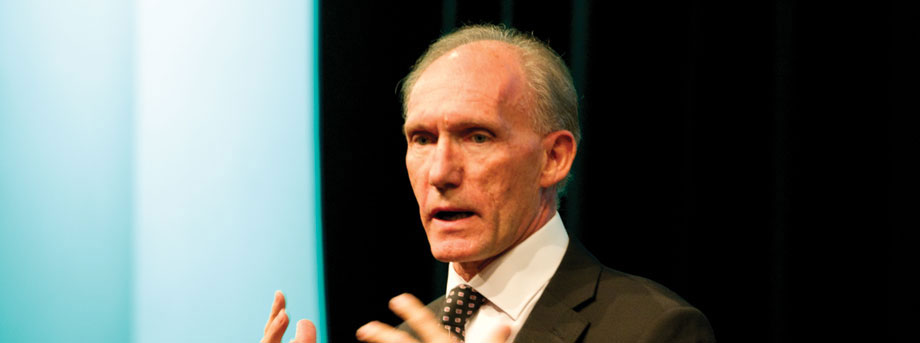
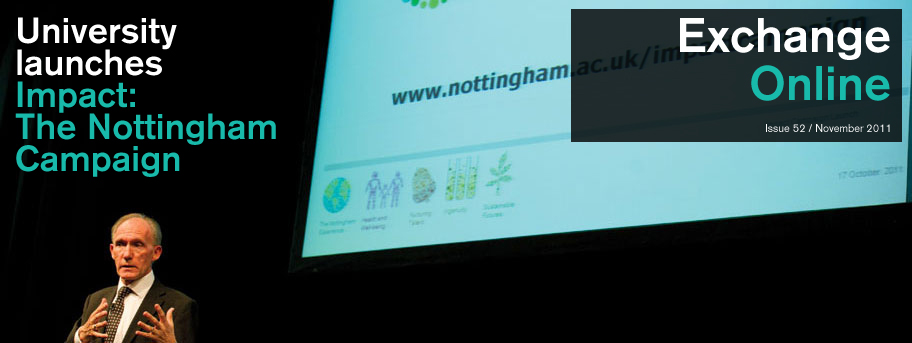
The University has launched the biggest fundraising campaign in its 130-year history. Impact: The Nottingham Campaign will raise £150m to transform research, enrich the student experience and enable the institution to make an even greater contribution to the global communities it serves.
A total of £50m has already been raised through generous donations, both large and small.
Vice-Chancellor Professor David Greenaway launched the Campaign on Monday 17 October and said: “Many of the world’s great universities have been able to flourish due to the visionary actions of philanthropists. Such investment has allowed independence of thought and action by scholars and students to tackle society’s most pressing issues.”
Two close friends and alumni of the University are the co-chairs of the five-year campaign — Jeff Randall, Sky News presenter and Daily Telegraph columnist and businessman and philanthropist David Ross, co-founder of The Carphone Warehouse and founder of the David Ross Foundation. Both have shown extraordinary levels of leadership and vision in support of the Campaign.
Jeff Randall said: “I graduated in 1979 but my enthusiasm and love affair for The University of Nottingham remains undimmed by time. That’s why I’m supporting the Impact Campaign to raise £150m. It’s a lot of money and seems like a tall order but it’s a privilege to be involved and to give back something to the University that gave so much to me.
“I’m very proud to be the co-chair of Impact: The Nottingham Campaign with David Ross. Our aim is to persuade you, all of you, that you really can help make a difference. With your involvement in this Campaign we can help lift this University to the next level of excellence. It’s about shaping the future and making a unique Impact.”
Posted in News | Comments Off on Impact: The Nottingham Campaign
’Tis the season…
December 20th, 2011

Manuscripts and Special Collections have been working with Communications and Marketing at the University to create an Advent calendar blog to be launched on Thursday 1 December at http://tiny.cc/uonadvent. Each day, a new post will reveal curiosities and extraordinary stories relating to items from the Collections, including videos, podcasts, interactive presentations, digitised books and photographs.
Highlights will include; the re-creation of recipes from as far back as 1728, the performance of poems by D H Lawrence and an 18th-century musical arrangement (pictured), interviews with academics about subjects ranging from the humble Robin red-breast to how Christmas was spent inside a German PoW camp, plus a crazy photo shoot with members of the New Theatre in Alice in Wonderland costume! All this and more…
The calendar blog aims to raise the profile of the Manuscripts and Special Collections archives and to promote the University of Nottingham’s blog system whilst showcasing the work (and play) of our staff and students.
The blog ties in with this year’s University Christmas card. Cards can be ordered from: www.alphagraphics.co.uk/uk007 (Other Printed Products section), in the same way as business cards, letterheads and campus maps. Department administrators should be able to place your order for you, or you can email: s.johnson@alphagraphics.co.uk for a username and password. Cards cost £7.50 for a pack of 25, including p&p, and you pay when you order.
An e-card will be available again this year, to match the printed card design. This will be available to download from the staff and student portals by the end of November.
Tags: e-Advent bo, manuscripts and special collections
Posted in News | Comments Off on ’Tis the season…
Episode
December 20th, 2011
Date: Tuesday 22 November
Time: 8pm
Venue: Djanogly Theatre,
Lakeside Arts Centre, University Park
Admission: £15, £12 concessions,
£9 restricted view
Posted in Theatre and Dance, What's On | Comments Off on Episode
Vampirates
December 20th, 2011
Date: Tuesday 15 November and Wednesday 16 November
Time: 7.30pm
Venue: Djanogly Theatre,
Lakeside Arts Centre, University Park
Admission: £7
Posted in Theatre and Dance, What's On | Comments Off on Vampirates
Hare and Tortoise
December 20th, 2011
Date: Sunday 13 November
Time: 1.30pm & 3.30pm
Venue: Djanogly Theatre,
Lakeside Arts Centre
Admission: £6
Posted in Theatre and Dance, What's On | Comments Off on Hare and Tortoise