

Campus News
Students’ Arctic role
February 3rd, 2011

Four Nottingham students have won a trip to the Arctic Circle in the npower Future Leaders’ Challenge.
Umesh Kumar (Geography and Chinese), Ben Blackburn (Geography and Business), Andrew James (Management Studies) and Eliot Booker (Sociology) came up with SheepMob, a project was designed to encourage students to be more environmentally friendly without the need for major changes to their normal behaviour.
It deliberately distanced itself from the traditional messages that often surround environmental issues, and the team organised an event at Minus One, a Nottingham bar, during which students were encouraged to pledge to reduce their carbon footprint. Judges were impressed with the pledge event and their social media campaign.
Andrew said: “We wanted to run a project that helped students become aware of environmental issues but avoided the typical hippy stereotype.
“We created the SheepMob brand and made it relevant to students by using social media and hosting a night out to inform them of ways they could reduce their impact on the environment.”
The team were one of two winners; a team from St Andrew’s University in Scotland submitted a project called We Care. The students will spend a week in Northern Norway in March, putting their team skills to the test as they sled 124 miles in temperatures as low as -30?C.
Andrew said: “I can’t think of anything better than flying as far north as possible, being let loose with six huskies and travelling across the Arctic. Seeing the Northern Lights whilst lazing in a hot-tub at the end of a hard day sledding really would be something to tell the grandchildren when I’m an old man.”
The competition — in its second year — challenges students to create, develop and deliver a project which will have a positive, lasting impact on sustainability within their community. As well as raising awareness, the challenge boosts entrants’ employability as they develop time-management and event-organisation skills.
Volker Beckers, RWE npower’s CEO, congratulated the team for their commitment and enthusiasm.
He said: “The Future Leaders’ Challenge has offered a platform to develop specific skills to help them in their future careers. I am positive that their projects will continue to develop and that they will have inspired others to consider how they too can make a difference.
“We developed the challenge to find undergraduates with passion and drive, and I believe we have unearthed that passion and also found real climate-change champions in this competition.”
Tags: Minus One, npower Future Leaders’ Challenge, SheepMob
Posted in News | Comments Off on Students’ Arctic role
World’s smallest periodic table… by a hair’s breadth?
February 3rd, 2011
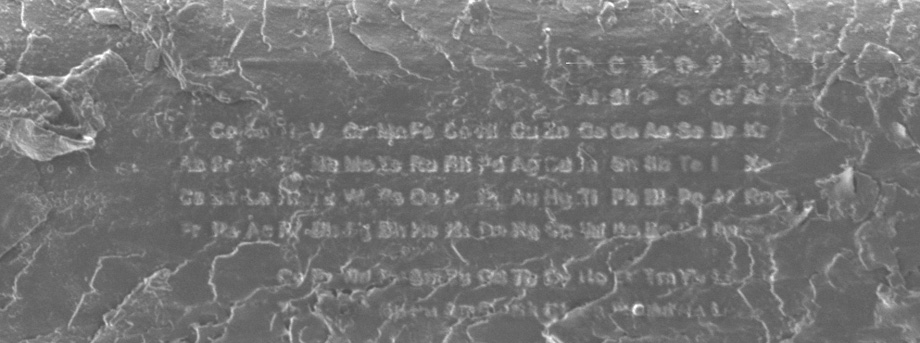
Scientists at The University of Nottingham have written what they believe is the world’s smallest periodic table — on the side of a human hair. The table is so small that a million of them could be replicated on a typical Post-it note.
Experts from the University’s Nottingham Nanotechnology and Nanoscience Centre used a sophisticated combination of ion beam writer and electron microscope to carve the symbol of all 118 elements into the strand of hair taken from the head of Professor Martyn Poliakoff, an expert in Green Chemistry. You can see how it was done by going to: http://tiny.cc/7mytk
Prof Poliakoff said: “Although the application was lighthearted I felt that it enabled us to show people how such nano writing is done.
“Our microscopist, Dr Mike Fay, made the whole operation seem so simple and really demystified it in
a most appealing way.”
Prof Poliakoff has become one of the stars of the Periodic Table of Videos (visit: tiny.cc/x830v).
What is thought to be the world’s tiniest Periodic Table was presented to him as a birthday present.
To demonstrate just what the very latest technology is capable of, nano technologists Dr Fay and Dr Chris Parmenter took advantage of the freezing weather to engrave the words Merry Christmas into a snowflake. You can see them in action at: tiny.cc/gd9o5.
The video showing the Christmas message being carved onto a shard of snow was made for the physics and astronomy project Sixty Symbols, which can be seen at tiny.cc/i07ag.
Philip Moriarty, Professor of Physics, said: “Although writing on a snowflake is on one hand a bit of seasonal fun, it’s also a neat demonstration of the powerful capabilities of the tools that scientists use in the lab on a day-to-day basis.
“It’s great that, via Sixty Symbols, we have the opportunity to show a wide audience just how exciting academic research can be.”
Working at the most unimaginable scale, the team features in the latest videos made by the University’s film-maker in residence, Brady Haran. Presented by experts from the University, his short films take a behind-the-scenes look at science with the aim of making science fun and unravelling some of the mysteries surrounding the technology and symbols.
Brady said: “Making videos like this shows that scientists are like everyone else — they do things for fun at Christmas. But light-hearted videos like these have real educational value.
“They’ve already been watched tens of thousands of times and a wide audience has gained a better understanding of how electron microscopes work and what they can do.
“It is just another example of how learning can be quite good fun.”
Tags: Brady Haran, Dr Chris Parmenter, Dr Mike Fay, Green Chemistry, nano technology, Nanotechnology and Nanoscience Centre, Physics, Professor Martyn Poliakoff, Professor Philip Moriarty, Sixty Symbols, world’s smallest periodic table
Posted in Features | Comments Off on World’s smallest periodic table… by a hair’s breadth?
Cancer breakthrough
February 3rd, 2011
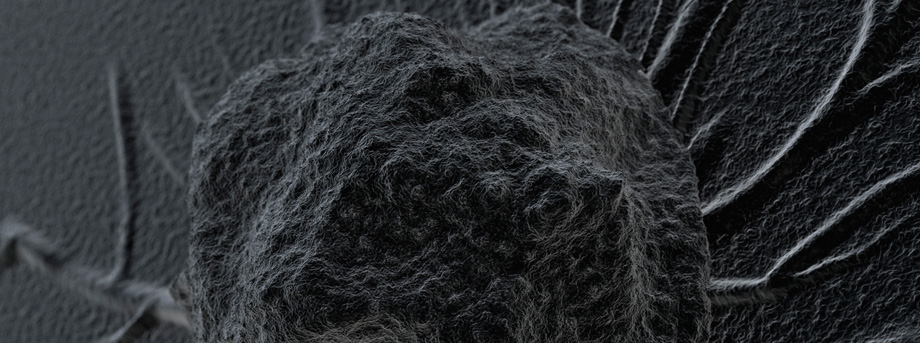 Scientists at The University of Nottingham have brought cancer cells back under normal control — by reactivating their cancer suppressor genes. The discovery could form a powerful new technology platform for the treatment of cancer of the breast and other cancers.
Breast cancer is diagnosed in about 1.4 million women throughout the world every year, with half a million dying from the disease. A common cause of cancer is when cells are altered or mutated and the body’s tumour suppressor genes are switched off.
Dr Cinzia Allegrucci, from the School of Veterinary Science and Medicine, and Dr Andrew Johnson, in the Centre for Genetics and Genomics, reactivated tumour suppressor genes and stopped cancer from growing by treating them with axolotl oocyte extract. After 60 days there was still no evidence of cancerous growth.
Cancers occur when the mechanisms that control normal cell division are mutated. The process of cell division is controlled by specific genes and these are turned on or off depending on their function. Among the most important of these genes are tumour suppressor genes. These genes repress the development of cancers and act as a control point in the cell division cycle. Therefore, the switching off of tumour suppressor genes is a common cause of cancers.
Dr Allegrucci, a lecturer in molecular genetics and cell biology, said: “The on/off switch in genes is controlled by the modification of proteins that are bound to the DNA in a cell — so called epigenetic modifications. Tumour suppressor genes in many breast cancers are switched off by epigenetic marks, which is the underlying cause of tumours. We sought to reverse this process, activating the tumour suppressor genes, in hope of stopping cancerous cell divisions.”
Dr Johnson said: “To do this we used novel technology that makes use of the eggs of the axolotl salamander.” Over the years Dr Johnson’s lab has shown that humans evolved from animals that closely resemble axolotls, and because of this the proteins in axolotls are very similar to those in humans. Axolotl oocytes — which are the eggs prior to ovulation — are packed with molecules that have very powerful epigenetic modifying activity. Previously Dr Johnson’s lab showed that extracts prepared from these oocytes have powerful capacity to change epigenetic marks on the DNA of human cells.
“And,” Dr Johnson added “in a breakthrough, they showed it is important to use oocytes from the ovary, because if the oocytes are ovulated these activities are lost. We thought that by treating cancer cells with extracts made from axolotl oocytes we could reverse the epigenetic marks on tumour suppressor genes, causing these genes to reactivate, and thereby stopping the cancerous cell growth.”
The identification of the proteins responsible for this tumour reversing activity in axolotl oocytes is a major goal of future research which could form a powerful new technology platform for the treatment of cancers from the breast, and other tissues.
Tags: Cancer, Centre for Genetics and Genomics, Dr Andrew Johnson School of Veterinary Science and Medicine, Dr Cinzia Allegrucci, molecular genetics and cell biology
Posted in Research | Comments Off on Cancer breakthrough
Issue 44/ January 2011
January 14th, 2011

Posted in Cover Story | Comments Off on Issue 44/ January 2011
Terry Alderton
January 14th, 2011
(age 16+)
Date: Thursday 20 January
Time: 8pm
Venue: Djanogly Theatre, Lakeside Arts
Centre, University Park
Admission: £12, £9 concessions,
£6 restricted view
Posted in Theatre and Dance, What's On | Comments Off on Terry Alderton
The Rape of Lucrece
January 14th, 2011
Directed by Gareth Armstrong
Date: Friday 21 January
Time: 8pm
Venue: Djanogly Theatre, Lakeside Arts
Centre, University Park
Admission: £12, £9 concessions
Posted in Theatre and Dance, What's On | Comments Off on The Rape of Lucrece
It Hasn’t Happened Yet
January 14th, 2011
(age 14+)
Date: Saturday 29 January
Time: 8pm
Venue: Djanogly Theatre,
Lakeside Arts Centre, University Park
Admission: £12, £9 concessions,
£6 restricted view
Posted in Theatre and Dance, What's On | Comments Off on It Hasn’t Happened Yet
Storm in a Teacup
January 14th, 2011
(age 4+)
Date: Sunday 30 January
Time: 3pm
Venue: Djanogly Theatre,
Lakeside Arts Centre, University Park
Admission: £6
Posted in Theatre and Dance, What's On | Comments Off on Storm in a Teacup
Poet in the City and Apples and Snakes present Spoken Word All Stars
January 14th, 2011
(age 16+)
Date: Tuesday 1 February
Time: 8pm
Venue: Djanogly Theatre,
Lakeside Arts Centre, University Park
Admission: £12, £9 concessions,
£6 restricted view
Posted in Theatre and Dance, What's On | Comments Off on Poet in the City and Apples and Snakes present Spoken Word All Stars
John Shuttleworth in A Man With No More Rolls
January 14th, 2011
Date: Thursday 3 February
Time: 8pm
Venue: Djanogly Theatre,
Lakeside Arts Centre, University Park
Admission: £18, £15 concessions,
£12 restricted view
Posted in Theatre and Dance, What's On | Comments Off on John Shuttleworth in A Man With No More Rolls