

Campus News
Best birthday surprise ever
November 8th, 2012
A 10-year-old boy came face to face with his heroes — the team behind the University’s YouTube hit, Periodic Table of Videos.
Edoardo Bandieri had already exchanged emails with Professor Martyn Poliakoff before his mother Paola arranged the birthday surprise.
Paola, who lives in Modena in Italy, wrote to Professor Poliakoff:
“My name is Paola Pavarotti and I am the mother of a little 9-year-boy, Edoardo Bandieri, with whom you kindly exchanged a few e-mails.
“Edoardo is very fond of chemistry, and in the last year has become a real fan of yours and of your team. At home we have to limit his accesses on the Internet as he would tend to spend all his free time on your periodic videos!
“On 12 September he will be turning ten and my husband and I have thought of surprising him by trying to organise a short visit to The University of Nottingham. We would like to know whether you and someone from your team would be available to spend a few hours with him, showing your labs and premises and explaining some experiments.
“Edoardo has been attending the English Primary School in Modena, where we live, and he is fluent in English, so you’d be able to communicate quite easily.
“If you think this could be somehow possible (not necessarily that week, due to this short notice), I could start planning a short stay in Nottingham and set a schedule with you.
“Despite your availability to meet Edo, let me thank you and your staff for the wonderful work you are doing. It is amazing how your videos have helped Edo to develop a real passion in chemistry.”
The Periodic Table of Videos, which are the brainchild of University of Nottingham film maker Brady Haran and a team of working chemists at the University, are designed to make chemistry as interesting as possible — and it looks like they’ve succeeded. From etching the Queen’s portrait onto a diamond to ozone insights on Bondi Beach, the series has covered every element in the Periodic Table and much more besides.
Professor Poliakoff said: “On the day, Edoardo attended the demonstration lecture for A-level students, sitting in the front row, and putting up his hand to answer questions.
“He brought biscuits as a present for the team, and cards for Pete, Sam, Debbie and me. After the lecture he visited my office and went to lab with Pete Licence.”
Edoardo’s favourite video is one where Pete demonstrates how to convert some white phosphorus into phosphorus pentoxide, using just a little bit of sand and a hot copper rod. Visit: http://youtu.be/U6_-EUcswSc.
“Edoardo has watched all the videos, quoting from them, and even reciting perfectly the limerick about DDT! His mother said that last year Edoardo chose Chemistry as the conversation topic for his English test at school,” said Professor Poliakoff.
The limerick is:
A mosquito was heard to complain,
that chemists had poisoned his brain.
The cause of his sorrow
Was para-dichlorodiphenyltrichloro-ethane.
Visit: http://youtu.be/L3QkJ9-Wnk4.
“It was really a moving experience,” said Professor Poliakoff. “It’s occasions like this that makes us feel that our YouTube project is really worthwhile.”
Visit: www.periodicvideos.com and periodicvideos.blogspot.co.uk.
Posted in Features | 2 Comments »
Spotlight
November 8th, 2012
Award-winning academic’s Ningbo role
An award-winning academic is to spearhead developments in teaching and learning at The University of Nottingham Ningbo China.
Professor Julie Sanders, Head of the School of English in the UK, will take up the post of Vice-Provost (Teaching and Learning) in 2013. She takes over from Professor Andrew Marton who moved to the University of Victoria in Canada as Associate Academic Vice-President International.
Professor David Greenaway, Vice-Chancellor, said: “Professor Sanders is ideally placed to take on this key role. Alongside her Director of Teaching, Dr Jo Robinson, she already leads several ground-breaking initiatives within the School of English aimed at enhancing teaching and learning through the development and implementation of innovative approaches. That, together with her experience as a head of school and her standing as a scholar of international repute, make this an outstanding appointment.”
Students join in day of action in Lenton
Students joined residents and businesses during a day of action in Lenton Boulevard last month.
Teams cleared rubbish and tidied gardens as well as calling door-to-door to spread crime prevention messages.
Melanie Futer, Off Campus Student Affairs Manager at the University, said: “Students are very much a part of the community residing and using the facilities of Lenton Boulevard. It is their community and as such they should and do take a pride in the area. Students being part of this initiative will help ensure that the area becomes more vibrant.”
CTU recognised as a centre of excellence
A centre which brings together specialist experts to support ‘bench to bedside’ research projects has been recognised as a centre of excellence.
The Nottingham Clinical Trials Unit has maintained its registration by the UK Clinical Research Collaboration (UKCRC), recognition of its excellence in coordinating randomised trials, which test the effectiveness of drugs and other healthcare interventions, and opening the door to potential research funding.
The Nottingham CTU offers a ‘one stop shop’ to support academics and clinicians from universities, hospitals and NHS Trusts to plan and run large-scale randomised clinical trials.
It receives CTU Support Funding from the National Institute for Health Research (NIHR) to support applications to NIHR research programmes and funded projects and has a current estimated annual turnover of £2m for all its research projects.
NUBs climbs in MBA rankings
Nottingham University Business School (NUBS) is celebrating after jumping up this year’s Economist MBA rankings.
NUBS improved its position from 94 in 2011 to 86 this year. The top 100 includes institutes from around the world and places the University’s business school as 13th in the country.
The Economist MBA rankings are ‘student-centric’ — focusing on the way business schools meet the demands that students have of an MBA programme.
Dr John Colley, Director of MBA Programmes at the Business School, said: “We believe that creativity and entrepreneurial thinking can be taught. Our students benefit from both our worldwide reputation for research in this area and our close links with entrepreneurs who contribute extensively to our teaching.”
The ranking considers a range of factors including the opening of career opportunities, personal development, increasing salary and the potential to network.
Posted in media | Comments Off on Spotlight
Seaton’s city
November 8th, 2012
“I’m a bloody billygoat trying to screw the world, and no wonder I am, because it’s trying to do the same to me.”
So said the hard-drinking, hard-fighting, hard-loving Arthur Seaton, the Raleigh factory worker in Alan Sillitoe’s 1958 groundbreaking novel Saturday Night and Sunday Morning.
The 1960 film — directed by Karel Reisz — saw Albert Finney bring Sillitoe’s anti-hero to life and was hailed a turning point in British cinema. It is also widely credited with putting Nottingham on the map.
The novel helped frame a cultural moment, set at a time when the working class had a collective identity thanks to trades unions and working men’s clubs. But Seaton has rejected this and was out for himself. If he isn’t “pursuing his rebellion against the rules of love, or distilling them with the rules of war, there was still the vast crushing power of government against which to lean his white-skinned bony shoulder, a thousand of its laws to be ignored and therefore broken”.
It was also the time when youth culture was emerging. Young people realised that they could have an identity and lifestyle that was different from that of their parents. And, in stark contrast to the austerity of the post-war years, they had a spending power like never before.
Saturday Night and Sunday Morning: The ‘Authentic Moment’ in British Photography is inspired by the novel and the film. Shirley Anne Field — who played Doreen, Seaton’s naïve young girlfriend — will open the exhibition at Djanogly Art Gallery on 17 November.
The exhibition aims to capture the essence of the world Sillitoe portrayed. As Sillitoe was writing the novel in Majorca, Nottingham was undergoing a radical social upheaval. Whole areas of the city were razed as new housing developments such as the Clifton Estate changed the face of the city. The Raleigh factory where Seaton worked and his home — the film featured Sillitoe’s family home at 5 Beaconsfield Terrace — are long gone; the University’s Jubilee Campus stands in their place, the Aspire statue symbolic of the hopes and aspirations of the city and its people.
Taking seminal moments from the book and the film, the exhibition explores the depiction of the social changes in contemporary photography, focusing on working class culture in the 50s and 60s. It highlights the work of a generation of photographers drawn to the regions in a bid to capture the authenticity of ordinary lives.
The exhibition is curated by Neil Walker and Anna Douglas. Neil says: “Whereas previous photographic surveys have tended to focus on the ‘swinging’ capital, we wanted to examine a cultural phenomenon which was more regional in spirit and more closely aligned to the spate of accounts of urban working-class life by academics, playwrights, novelists and documentary filmmakers that were making such an impact at the time. We were also interested in those photographers — often working in journalism — who seemed to us to be pursuing a similar realist agenda to the filmmakers of new wave cinema.”
The discovery at the British Film Institute of an archive of photographic stills from the shooting of Reisz’s film was a breakthrough for the organisers, suggesting how Sillitoe’s world could be portrayed.
Neil says: “We have taken liberties with his narrative to interpret the Sunday Morning section of the exhibition in terms of the dawn of this new world … at the end of the book Seaton himself hints at a more settled future life with Doreen in one of the new estates he despises.”
“Our excuse for extending the chronology of the exhibition to the late 60s was to be able to encompass the photography produced for the books by Ken Coates and Bill Silburn at the University on the effects of poor housing in St Ann’s.”
The exhibition features the work of John Bulmer, Graham Finlayson, Roger Mayne, Shirley Baker and Maurice Broomfield, alongside national photographers and more than 33 local amateurs. Including the work of local amateurs was Anna’s idea.
“The introduction of this less-privileged imagery expands the gamut of uses to which photography was put and confounds further our readings of reality and artifice,” says Neil. “We hope that the results will appeal on many levels in capturing the essence of the novel’s time and place as well as providing a snapshot of the country at the point of profound cultural change.”
Image: Saturday Night and Sunday Morning 1960 ©Woodfall/BFI.
Tags: Saturday Night and Sunday Morning
Posted in Features | Comments Off on Seaton’s city
Tributes paid to Dolly the Sheep pioneer
November 8th, 2012
Tributes have been paid to internationally renowned scientist Professor Keith Campbell, who has died at the age of 58.
Professor Campbell was instrumental in the creation of Dolly the Sheep, the first cloned mammal, which paved the way for the successful cloning of other species. He was a cell biologist/embryologist with a research career spanning more than 30 years, the majority of which was in the field of cell growth and differentiation. He joined the University in 1999 as Professor of Animal Development in the School of Biosciences.
Professor David Greenaway, Vice-Chancellor, said: “Keith was a brilliant scientist. His work was genuinely transformational and inspirational. His pioneering research was revolutionary. That, together with his passion for science, will ensure he is justifiably remembered for all he accomplished. Keith was also an outstanding colleague whose absence leaves a huge gap. He will be greatly missed. I offer my deepest respect and sympathy to his family.”
Prof Neil Crout, Head of the School of Biosciences, said: “Keith was a valued and respected colleague who will be sadly missed. His work and scientific achievements speak for themselves and his death is a great loss for developmental biology. Inevitably most people will remember him for Dolly the Sheep although his recent work was focused on fundamental and applied stem cell research as a tool for the study of human disease.”
Prof Jus St John, Director, Centre for Reproduction & Development at Monash University, Australia, said: “Keith was an outstanding and inventive scientist whose foresight and work led to major changes in how we now ask scientific questions and make significant advances.
“Very few scientists of Keith’s calibre exist and when they are successful, their impact is immense. The generation of Dolly, which he was the intellectual leader of, was an advance that triggered a revolution in scientific investigation. Without Keith’s input, the field of cellular reprogramming would not have made the significant advances that it has. I will sorely miss Keith as a great friend and collaborator.”
Prof Jose Cibelli, of Michigan State University, USA, said: “I knew Dr Campbell for almost two decades, first as a competitor, then as a colleague and then as a dear friend. While he is known worldwide by the public because of his role in the generation of Dolly the Sheep, his contributions to science are enormous and will be forever lasting. He developed new techniques to produce therapeutic proteins in domestic animals and was the first person to clone pigs, now being used for the generation of organs to potentially treat patients in need of organ transplantation.
“Thanks to his dedication and brilliant intellect the field of regenerative medicine is today closer to the clinics. We anticipate that within the next five years, patients suffering from degenerative diseases will be treated, if not cured, using technology introduced by Dr Campbell. All these scientific breakthroughs Prof Campbell gave us did not happen by chance; they are the product of years of study, hands-on experimentation and above all, a deep love for science.”
Prof Campbell is survived by his wife, Kathy Campbell and his daughters, Claire and Lauren Mills. An online book of condolence has been set up on the University website. An extended version of this article is available at: www.exchange.nottingham.ac.uk.
Posted in News | Comments Off on Tributes paid to Dolly the Sheep pioneer
How you can help to make an Impact
November 8th, 2012
Happy Christmas to all our readers, lots of love, from seven-year-old Jessica, four-year-old Tim, five-year-old Kallum and Jacob, aged eight (and a half).
The children who designed these superb Christmas cards are all patients at the Queen’s Medical Centre and created the cards under the guidance of students from the University’s Open Art Surgery Society. A pack of eight cards (two of each design) costs £4 and every penny will go directly to support the work of the Children’s Brain Tumour Research Centre (CBTRC) at Nottingham, helping to improve survival rates of children with brain tumours.
Order your cards online at: store.nottingham.ac.uk (click on Product Catalogue). To purchase on behalf of your school/department, please call the Campaign and Alumni Relations team on +44 (0)115 951 3036 with your project code and order details. Cards will also be available from The Alumni Hub, B floor, Portland Building, University Park.
The CBTRC is a key project within Impact: The Nottingham Campaign, a five-year campaign to raise money across five strategic themes. The Campaign — the biggest fundraising campaign in the University’s 130-year history — aims to change lives, tackle global issues and shape the future.
In just over a year since its launch, Impact has already raised more than £80m towards its £150m target.
And you can play your part. This year’s corporate card features the Campaign logo with a festive twist. Cards are available in packs of 25 for £7.50 plus VAT with a donation from every pack going to Impact: The Nottingham Campaign. Order your corporate card at: www.alphagraphics.co.uk/uk007, click on AG online, log in and order. (Email Richard Eldridge: r.eldridge@alphagraphics.co.uk to request an account if you don’t have one). The card will be available to order from 5 November.
Ecards of both the CBTRC and corporate cards will also be available to download from: www.nottingham.ac.uk/christmas-e-cards in the run-up to the festive season.
Posted in News | Comments Off on How you can help to make an Impact
In the market for a national award
November 8th, 2012
A farmers’ market founded and run by students at Sutton Bonington Campus has made it into the finals of BBC Radio Four’s Food Awards — just over a year after its launch.
The monthly market is one of three finalists in the Best Food Market category of the national awards scheme.
“I found out we’d been nominated by hearing us mentioned on the Food Programme,” said founder Emily Boothroyd.
“It came as a real surprise as I hadn’t thought we’d have even been in the running being such a new market and not that well known.”
The market has more than doubled in size since it was launched in May 2011, with around 35 local food producers at each event.
“Both past and present organising committees are really delighted that we’ve been shortlisted. They are all full-time students and as you can imagine, a lot of time and effort goes into the planning and execution of every market, so this is well-deserved recognition for all that hard work.”
Judges TV chef Valentine Warner and Kath Dalmeny, from Sustain — the alliance for better food and farming — were impressed when they dropped in last month.
“I was incredibly impressed by the market,” said Valentine. “It was well thought out and offered an impressive variety of produce to the students, some of which I was surprised but delighted to know they were buying.
“Stall-owners were giving student discounts too, it was still worth it for them as the market was supported by so many people. It was very encouraging to see everyone selling out.”
Valentine praised the student organisers as “very organised, very friendly, very forward thinking” and said the market had been chosen as a finalist, not just for its standards, but for the benefits it brings to the local area.
“Markets champion ingredients particular to various region of the country and support local commerce. They often take things hard to find in the city to the city. They are a fun day out as well as a good place to learn more about ingredients.
“We also like the idea of students being given an opportunity to have things that normally they couldn’t afford, while also having an alternative to the supermarket and bad eating which they are commonly associated with.”
Posted in Features | Comments Off on In the market for a national award
Campbell leaves an amazing legacy
November 8th, 2012
Campbell Burns, the baby son of University research secretary Bekki Burns, has sadly lost his fight against the rare metabolic disorder Leigh’s Disease.
Campbell, whose story we featured in Exchange in September, was diagnosed with the condition at just nine weeks old and his parents Bekki and Mark were told it was unlikely he would live until his first birthday.
Despite continuing to defy the doctors by making remarkable progress, Campbell was taken ill suddenly on the afternoon of Friday 28 September and died in hospital later that evening.
Bekki, who works in the School of Electrical and Electronic Engineering, said: “Campbell was only in our lives for eight months, but had a huge impact — we were lucky to have been his parents, and will hold our little boy in our hearts forever.”
Bekki and Mark have two other children, five-year-old Daniel and three-year-old Holly, who are not affected by the condition.
Bekki added: “The support of family and friends in recent months has been invaluable, and we are grateful to everyone who contacted us to ask how we were doing, and to send their condolences.
“What is certain is that Campbell has left an incredible legacy in his charity. We can’t wait to start helping other families in his name.
“The Campbell Burns Metabolic Trust will grow from strength to strength and will be there to support families like ours.”
Friends and family gathered to say goodbye to the eight-month-old on Friday 5 October at Loughborough Crematorium.
Shortly after learning of Campbell’s diagnosis his family established the Campbell Burns Metabolic Trust, which aims to raise money to support other families affected by these devastating conditions.
More information about the Campbell Burns Metabolic Trust is available at: www.campbellstrust.co.uk. Donations can be made via: www.justgiving.com/thecampbellburnsmetabolictrust. Applications for help from the Trust will
Alternatively text CBMT01 £1 (or whatever figure you would like to donate) to 70070. And you can follow the charity on Twitter: @CampbellsTrust and on Facebook at: www.facebook.com/TheCampbellBurnsMetabolicTrust.
Posted in News | Comments Off on Campbell leaves an amazing legacy
Riders raise a massive £250k
October 15th, 2012
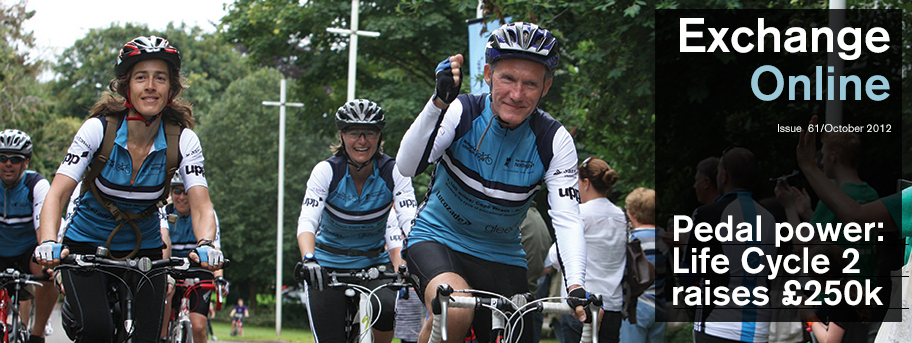
Life Cycle 2 — the second charity challenge by a team of cyclists from the University — has raised £250,000 for Nottingham Potential.
The 12-strong team cycled 1,100 from Cape Wrath in Scotland to Dover in the South East in just 14 days.
It followed on from the success of last year’s Life Cycle, when the team rode from John o’Groats to Land’s End and raised over £230,000 for the University’s Sue Ryder Care Centre for research on Supportive, Palliative and End of Life Care.
Nottingham Potential is part of Impact: The Nottingham Campaign under the Nurturing Talent theme and aims to help those from the most disadvantaged backgrounds to access higher education.
Members of the public also got involved as the team reached Nottingham on Day 10, with more than 300 people taking part in a Community Day featuring two cycling challenges and a sponsored walk around University Park.
The £250,000 raised so far is in addition to the University’s £8m annual commitment to widening participation.
After growing up in an area of serious social deprivation in the east end of Glasgow, Professor Greenaway knows first-hand the potential difference the money raised could make to people’s lives.
He said: “Nottingham Potential is all about widening participation, raising aspirations and supporting achievement so that even more capable young people from under-represented backgrounds in Nottingham, across the East Midlands and more widely can reach their academic potential. We want to ensure that financial concerns do not limit the ambition of those with the ability to achieve academic excellence.
“Nottingham Life Cycle 2 will make a huge impact on increasing awareness and funds for educationally disadvantaged young people but is only one part of our ongoing pledge to widen participation and raise aspirations across the region.”
The Vice-Chancellor thanked all of the people who had supported the ride, including Lucozade, Gleeds, Santander Universities and UPP. Special praise was also given to those who had joined the team on the ride, including Chief Executive of Malaysian Airways Ahmad Jauhari Yahya and fellow alumni Doug Thomson and Jack Swannell from Into University and everyone who took part in the Community Day.
Professor Greenaway said: “To have ridden almost 1,100 miles is a remarkable achievement. What is even more remarkable is that we have already raised more to help young people from disadvantaged backgrounds than Life Cycle 1 — John o’Groats to Land’s End.
“For me personally, it has been a privilege to spend two weeks on the road with such a special group of people. I have taken enormous pride in that the riders and support team take this on for no other reason than trying to have an impact on educational disadvantage.”
For more information, visit the Life Cycle website at: www.nottingham.ac.uk/lifecycle or hear more about the fundraising journey on the Life Cycle Blog at: blogs.nottingham.ac.uk/lifecycle
Tags: Impact: The Nottingham Campaign, Into University, Life Cycle, Nottingham Potential, Nurturing Talent, Widening Participation
Posted in Features | Comments Off on Riders raise a massive £250k