

Diamond Jubilee
June 28th, 2012
It’s Her Majesty Queen Elizabeth II’s Diamond Jubilee this year, but after 60 years on the throne, what special gift do you give the monarch to mark this special event?
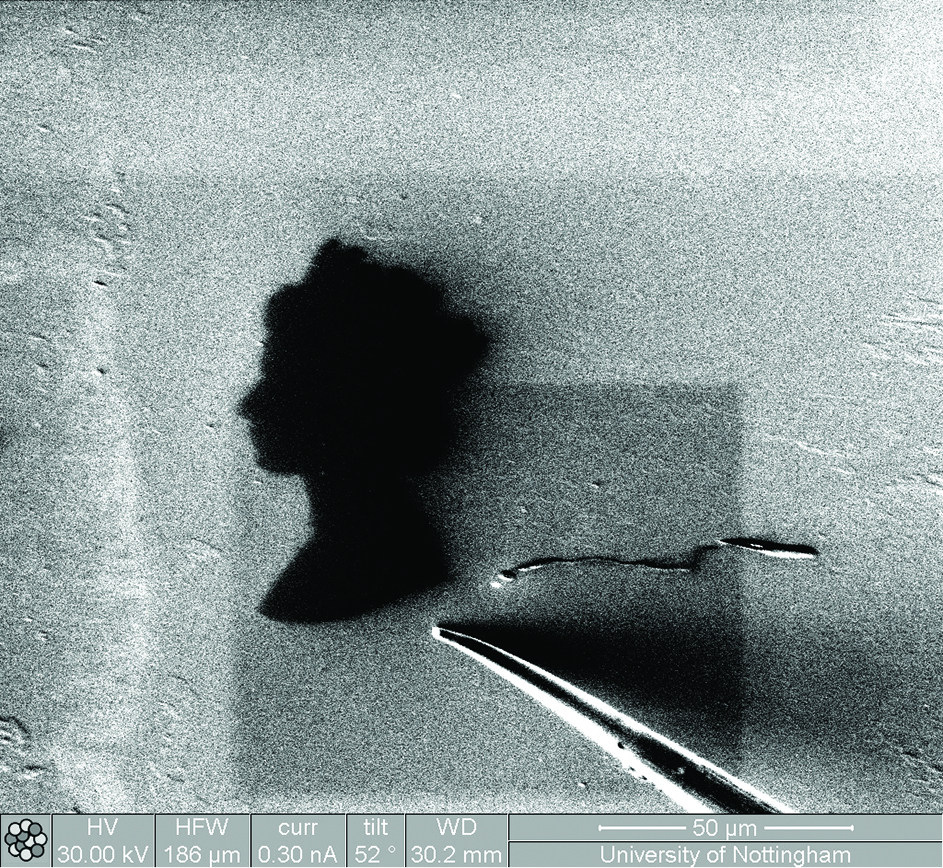
Award-winning chemistry channel The Periodic Table of Videos knows — a microscopic etching of her profile on a diamond just 46 microns high and 32 microns wide, and invisible to the naked eye. And they made a video charting their progress.
Prof Martyn Poliakoff, of The University of Nottingham’s School of Chemistry, called on his colleagues in the Nottingham Nanotechnology and Nanoscience Centre (NNNC) on University Park to help him achieve his royal aim. It might seem an odd tribute to some, but as The Prof himself says: “Diamonds are chemicals after all.”
The Periodic Table team used a discarded diamond that had been intended for use in infrared spectroscopy. The diamond had been damaged and was unsuitable for experimental use.
“The next question was what to do with the diamond,” said Prof Poliakoff. “And the obvious thing to do was to put a picture of Her Majesty on it.”
They took the diamond to the NNNC, where the engraving machinery necessary for the attempt was available during the Easter holiday. Dr Chris Parmenter and Dr Mike Fay helped to address the main issues presented by the plan — the diamond is just millimetres across, and diamond is an incredibly difficult material to engrave on.
The NNC had the answer — a machine that uses accelerated gallium ions to work in fields as varied as pharmaceuticals and energy storage, and on materials including food and graphene.
“The gallium ions go like bullets at incredibly high speeds and will chip off material from any surface,” said Prof Poliakoff.
But it wasn’t all plain sailing from here. Diamond has no electrical charge, while the gallium ions are positively charged. After a while, the engraving creates a positive charge on the surface of the diamond. This electric field deflects the ions away from the surface — resulting in a ‘foggy’ image on the first attempt.
“You could say that’s really good, because the year Her Majesty became Queen there was some of the worst fog in London that anyone could ever remember,” offers Prof Poliakoff. “You could hardly see more than a few feet in front of you. The problem is, it doesn’t make for a very good picture…”
However, a solution to the fog problem was found. A layer of carbon — thin enough that it didn’t affect the engraving process, but thick enough to create an electrical charge — was applied to the diamond. The gallium ions did their job unhindered, and an image was successfully created.
“I think the result is pretty pleasing,” said Prof Poliakoff. “It looks very like the Queen. And from a scientific point of view, it looks very like the image that we used to make it. You can put one on top of the other and they match perfectly.”
Filmmaker Brady Haran thinks the diamond should be sent to the Queen as a gift, while Prof Poliakoff would prefer the image to go into an exhibition of objects connected to the Diamond Jubilee. What do you think? Contact periodicvideos@gmail.com with your ideas.
The video is available at http://youtu.be/wm2YtvNmPxQ.
Comments are closed.
Other News

Need news? See you on SharePoint
After 14 years of service, Campus News is being retired as the university’s staff news platform. […]

Roads and car parks closed for refurbishing work
As part of ongoing road improvements at the university, works will be taking place to resurface […]