

The quiet revolutionary
May 6th, 2011
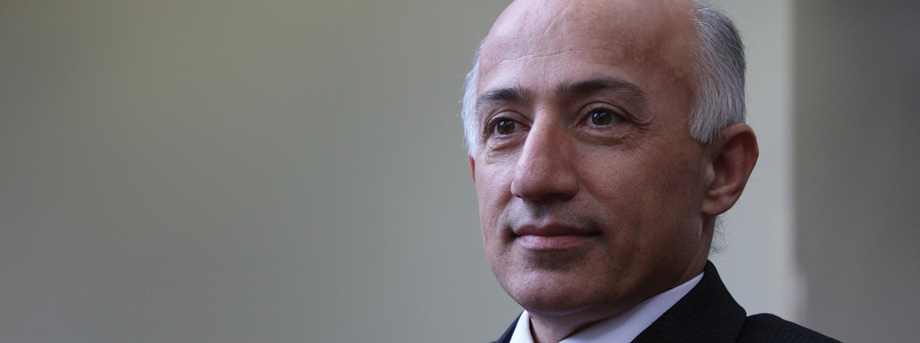
For a man who hasn’t had a holiday in nearly two years, Dlawer (Del) Ala’Aldeen looks remarkably relaxed. Even more remarkable when you consider that as well as his role as Professor of Clinical Microbiology and Head of the Molecular Bacteriology and Immunology Group (Division of Microbiology & Infectious Diseases) at The University of Nottingham, he is Minister for Higher Education and Scientific Research in Kurdistan.
Prof Ala’Aldeen was invited to join the newly elected coalition government in Kurdistan in 2009 by Dr Barham Salih.
“We go back a long way,” explains Prof Ala’Aldeen. The pair had both been in London in the late 80s when Saddam Hussein massacred 180,000 Kurds in a systematic campaign of mass summary executions and disappearances, widespread use of chemical weapons and the destruction of thousands of villages.
Prof Ala’Aldeen had fled Saddam’s brutal regime for the UK in 1984 but campaigned vigorously for those left behind.
After the Gulf War ceasefire in 1991, a Kurdish uprising was crushed by Iraqi and tens of thousands of people fled to the mountains, sparking a humanitarian crisis. Prof Ala’Aldeen, who by now had founded the British-based Kurdish Scientific and Medical Association (KSMA), went over to Kurdistan to work with refugee charities.
Throughout this time, Prof Ala’Aldeen lobbied Parliament and persuaded then Prime Minister Margaret Thatcher to support the Kurds – and to persuade the US and French governments to do the same. This led to the formation of the Kurdistan region. Saddam withdrew his administration and in 1992, the Kurdistan Regional Government (KRG) was formed. At about the same time, Prof Ala’Aldeen came to Nottingham, taking up his Clinical Leadership position two years later.
He began supporting Higher Education in Kurdistan, persuading the then Vice-Chancellor Sir Colin Campbell to organise for more than 80 university leaders to come here to learn how to run a university. A fee-paying course later evolved and the University continues to build on its relationship with Kurdistan.
Prof Ala’Aldeen continued to follow events in Kurdistan, writing newspaper articles and being appointed to the British Government’s working party on chemical and biological weapons.
“I was a critic, but a constructive critic,” he says, “which is why the parties and the Prime Minister liked my comments because there were criticisms, but always solutions. I became known as this outspoken academic who supported the system but remained critical as to how things could be improved.”
And then came the invitation from Dr Salih, the newly elected Prime Minister in Kurdistan’s coalition government, to head up the reform of the region’s desperately outdated and bureaucratic Higher Education system.
“I asked him to accept radical reform rather than a partial approach,” says Prof Ala’Aldeen, who wrote A Vision to the Future of Higher Education in Kurdistan (A Road Map to Quality). “I got the backing of the government and the opposition. That was a unique situation as our reform was based on a model that everyone agreed on.”
He then asked the VC for a secondment. “He very kindly agreed and supported me with enthusiasm and I’m grateful for that.”
Prof Ala’Aldeen quickly realised the enormity of his task. “A country that is emerging from the ashes of Saddam Hussein and a completely closed system that was designed to keep a closed community suddenly became democratic and forward looking and wanted to catch up with the rest of the world. At first it was almost overwhelming and like a one-man band. But luckily there is plenty of talent around that has the understanding necessary and is willing to help.
“Each day, each month, there was a milestone. Each time we introduced something it created the expectation of something else.
“Occasionally, it’s like flying an aeroplane while you are mending the wings. It was a steep learning curve, learning how everything there worked before we could start to change it. We were taking on, head on, the long-entrenched interests of people who made money out of the system and knew how to exploit it. For the first time in the history of Iraq, all appointments would have to be made on talent and merit, and each university would have its own elected body which would be central to all its functions.”
There were protests at first. Prof Ala’Aldeen explains: “There was extreme intolerance of change but the time for introducing change was right – there was a palpable hunger. Trying to reform a system that’s bureaucratic, enclosed, nationalist, socialist, run by a dictator – first you need to understand the mentality and the culture while at the same time you’ve worked all your professional life in a country like Britain. It’s like going back, maybe by a century. There’s a gap between your aspirations and what you can achieve in reality.”
The coalition government in Kurdistan aims to swap Prime Minister every two years, creating cabinet reshuffles. “I decided to just do as much as I could in the first two years. Indeed the first milestone was changing the legislation which will make the reform more permanent,” says Prof Ala’Aldeen.
“This is a long evolving system – a process that may take decades and generations to complete. But what we have done in the first two years is lay the foundations.”
So how does life in Kurdistan compare to Nottingham, where Prof Ala’Aldeen has a wife and three children?
“In Kurdistan, when I wake up in the morning and go to work I don’t know what is waiting and how my day will go. This is greatly different to my academic life, where you can plan a year ahead. There I have bodyguards and have to be driven. It’s a joy when I come back to Nottingham and I’m able to lead a normal family life.
In Nottingham, Prof Ala’Aldeen heads a group of 20-odd scientists and students. Maintaining a relationship is vital and he is in regular contact via Skype.
“It’s amazing how much you can do – it’s not that different to being here and in another room! I’m lucky to have a very good group of scientists who are mature and independent. I also have a very good deputy, who’s been a very safe pair of hands over the years. I make sure my work here is not affected in any way by this secondment.
“All my life I worked in academia. It what gives me job satisfaction and it’s where my priorities are. But when I was invited to join a historic opportunity to contribute to system reform in the country where I was born I could not say no. I don’t want to retire and look back and think I had a lifetime of opportunity to do something big for the people of Kurdistan but I chose an easier life.
“I feel very lucky to be in Britain and think my family are very lucky to be in a society where things are so organised.
“I came here as a refugee looking for freedom but I found life. My attachment to Britain is eternal.”
Comments are closed.
Other News

Need news? See you on SharePoint
After 14 years of service, Campus News is being retired as the university’s staff news platform. […]

Roads and car parks closed for refurbishing work
As part of ongoing road improvements at the university, works will be taking place to resurface […]