

The long and winding road…
January 2nd, 2011
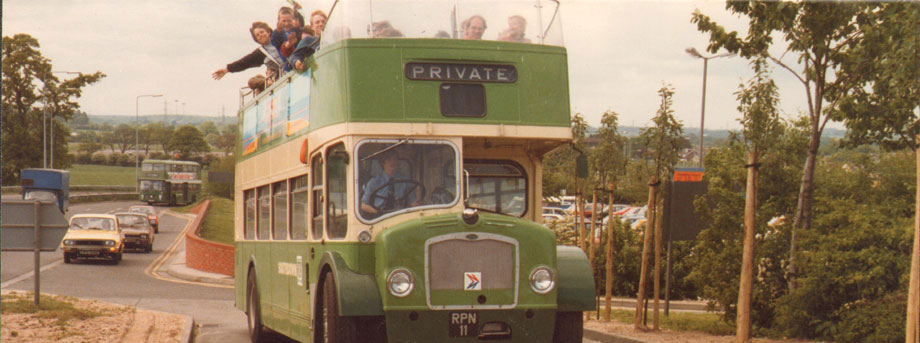
The road which has taken Dr Susan Townsend from a council estate to published academic may not have followed the most traditional route but it’s been an eventful journey.
Dr Townsend’s stops along the way have seen her career choices overcoming gender stereotypes during stints as a physical training instructor (PTI) for the Women’s Royal Navy Service and as one of the first female bus drivers in the south of England.
Now, her research at Nottingham has brought her full circle, marrying her interest in transport with her academic area of expertise for a study comparing the cultural and environmental impact of car ownership on the cities of Birmingham and of Nagoya in Japan.
“I’ve been obsessed with driving ever since I first passed my test at the age of 18,” said Sue. “The idea of the open road really appealed to me; being cooped up indoors all day was my worst nightmare.”
But her 20-year road trip from a Wolverhampton council estate to the leafy University Park campus almost stalled before it started. After failing her 11-plus, Sue went to the local secondary modern. She left in 1972 with three A-levels (a C and two Es) and settled for a safe but dull office job in local government. Her career could have taken a different path. “I stuck it out for two years, but I was bored out of my skull!” she said.
When the opportunity arose to join the Wrens — Women’s Royal Navy Service (WRNS) — as an education assistant, she seized it. It coincided with a time of huge transformation for the service. Radical developments led to the formation of the Physical Training Branch in 1977. Sue was among the first cohort of women to train to become a Physical Training Instructor. She specialised in the martial arts — judo, aikido and okinawan karate, a very traditional form of the sport which jumpstarted an enduring passion for Japanese philosophy and culture.
After four happy years, it would have been easy for Sue to sign up for a further period of service; the top brass made no secret of the fact that they believed her officer material. But the open road still called and Sue set about working towards another longstanding ambition — to become a long-distance lorry driver. She was advised to start with buses and began training for a PSV licence at the wheel of a 1940s’ Leyland PD2 bus, with frog-eye lamps. Pre power-steering, controlling such a vehicle demanded peak physical fitness. And, as one of the first woman bus driver-conductors in the south of England, with Southdown Motor Services, Sue and her female colleagues didn’t always receive the warmest of welcomes.
Sue said: “It was one of the few jobs in the 1970s that offered equal pay for women — a man’s wage. But it was hard work. We would start anywhere between 4am and 4pm. Although most of the fleet had semi-automatic gears, only around half had power steering and some were still ‘leg and lever’ with heavy clutches and gearsticks.
“There was still a lot of resistance to female drivers. Some inspectors would give us the heaviest, coldest buses to drive but in those days you didn’t shout about discrimination. It became a point of pride and all of us girls had a secret pact that we would never complain because it was so important for us to prove ourselves.
“The passengers were generally supportive. I only had one occasion where a man told me that I was taking the bread out of the mouths of another man’s family. The female passengers on board soon put him in his place! It was a driving force because in those circumstances you have no choice but to do the job and do it well.
“We did turn heads I used to get people stopping on a zebra crossing stunned to see a woman behind the wheel, and one colleague actually saw a motorist drive into a bridge because they were so busy staring.”
The late 80s brought privatisation to the service and new horizons for Sue. She went back into education, achieving a first in BA (hons) History and Literature from Staffordshire Polytechnic before taking a diploma in Japanese language and spending a year in Kobe.
She returned to England to do a PhD in Japanese history at Sheffield University. After years of working in a man’s world, a prestigious post-doctoral fellowship from the British Academy took her to the women-only New Hall College (now Murray Edwards) in Cambridge. She came to Nottingham in 1999 as a lecturer, while continuing her studies into leading Japanese thinkers.
But it’s her latest project which has enabled her to reconnect with her roots; a three-year partnership with Prof Simon Gunn at Leicester University, funded with more than £150,000 from the Leverhulme Trust, to compare how the car has helped shape the modern ‘motor’ cities of Birmingham and Nagoya (in Japan).
Sue said: “Both are regional capitals: Nagoya is in the Chukyo area which literally translates as The Midlands and both were reconstructed after the Second World War around the car, with pedestrians being mostly sidelined. Birmingham became notorious for its Inner Ring Road including the Queensway and was home to Austin and British Leyland. Nagoya is unique in having two 100 metre-wide boulevards criss-crossing its centre, and is the home of Toyota.
“There has been a lot of study around Toyota, Honda and Nissan, all the great car manufacturers, but virtually nothing on the coming of the automobile and car ownership. It’s a huge consumer item which has changed our lives and the cities that we live in, both in terms of the physical aspects of the city such as suburbanisation and our leisure pursuits. We will also be looking at what it has done to us as people and the way in which the car has affected our view of the urban and natural environment.
“Essentially, the project is about something which really resonates with me on a personal as well as academic level: how does our view of the world change when seen through a car windscreen?”
Comments are closed.
Other Features
Baptism of fire for WW1 curator
Stories from the First World War are being revealed for the first time at a University […]

The University is tapping into our national appreciation of beer by introducing a new full-time Masters […]