

Spotlight
November 2nd, 2010
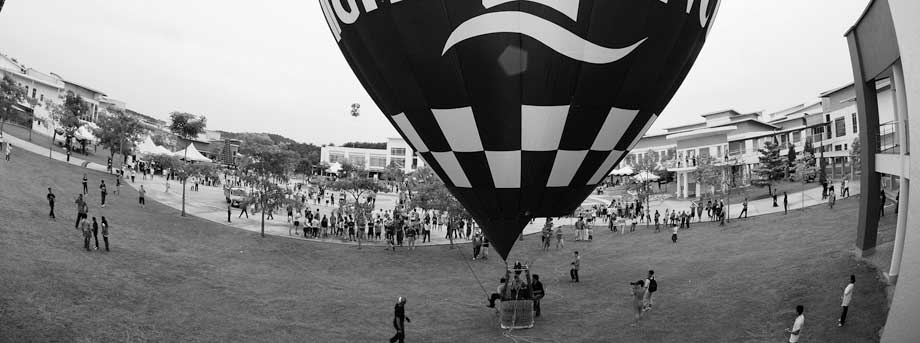
Balloon races, seminal research and company takeovers are among the highlights of University media coverage last month.
Sir Peter in British science top 100
The Times Eureka supplement has compiled the 100 most important people in British science — what they do, where they work and why they qualify. At number 28 is Sir Peter Mansfield. While studying for a physics degree he began the research that would lead to him being awarded the Nobel Prize in Physics in 2003 for the discovery of magnetic resonance imaging (MRI), now a standard body scanning technique. In the course of his work at The University of Nottingham, Sir Peter also developed an MRI scanning sequence capable of making images of the brain, opening a new window into the human mind.
Ballooning success
Two academics who had been hoping to break the world distance and duration records for female balloonists have come 13th in the Coupe Aéronautique Gordon Bennett race, the world’s oldest and most prestigious aeronautical contest. This year the race was held in the UK for the first time, the Times Higher Education reported. Janet Folkes, a mechanical engineer from The University of Nottingham, and her co-pilot Ann Webb, an atmospheric scientist from the University of Manchester, broke the duration record during last year’s race.
Pulmonary fibrosis on the increase
Five thousand people a year in Britain are diagnosed with pulmonary fibrosis, most of them over 60, The Daily Telegraph reported. “It’s becoming more common, and we have no idea why,” says Prof Richard Hubbard, who is leading a team researching the illness at The University of Nottingham. “When they get a diagnosis people often say, ‘Well, thank God it’s not lung cancer,’ but cancer can be treated. This can’t.”
Takeovers up
Takeovers of companies by private equity groups accounted for almost three-quarters of all UK mergers and acquisitions by value in the first half of the year, setting a record that shows the buy-out industry is bouncing back, The Financial Times reported. The story quoted research from the Centre for Management Buy-out Research at The University of Nottingham.
Influential physicist remembered
Prof Kenneth Stevens was a distinguished theoretical physicist who spent most of his career at The University of Nottingham. His work was highly influential in helping researchers to understand paramagnetic resonance, and his joint papers with Oxford collaborators, Sir Roger Elliott and the late Prof Brebis Bleaney are still regularly cited by researchers. Prof Stevens died on 16 July 2010, aged 87, The Independent reported.
Pre-eclampsia trigger identified
British scientists have found the cause of pregnancy killer preeclampsia, The Sun reported. The condition is triggered by a protein which makes blood vessels constrict. That leads to high blood pressure and kills 50,000 mums-to-be and half a million babies worldwide each year. Scientists realised pregnant women were at greater risk because they have more oxygen in their bodies for their unborn babies. And further research from The University of Nottingham proved high levels of oxidised angiotensinogen can be found in women with preeclampsia.
Comments are closed.
Other News

Need news? See you on SharePoint
After 14 years of service, Campus News is being retired as the university’s staff news platform. […]

Roads and car parks closed for refurbishing work
As part of ongoing road improvements at the university, works will be taking place to resurface […]