

On the road
September 2nd, 2010
Are more experienced motorcyclists safer on the roads than those who are newly-qualified? And do advanced motoring qualifications make you a better rider?
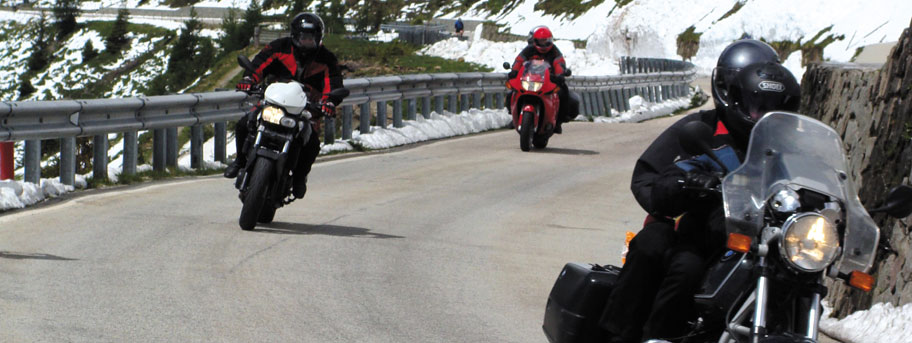
This summer Dr Alex Stedmon conducted a 10-day research ride to Italy following 13 riders (and two pillion passengers) over 2,500 miles.
New research at the University could help answer these questions using a unique motorcycle simulator — the first of its kind in the world.
Funded by the Institute for Advanced Motorists (IAM), the research project will investigate different rider behaviours, including forward planning, hazard perception and levels of risk taking.
The simulator uses a Daytona 675 motorcycle — generously donated by Triumph Motorcycles Ltd — mounted on a custom rig which was designed and built at the University.
Dr Alex Stedmon, a lecturer in the Centre for Motorcycle Ergonomics and Rider Human Factors, is leading the project. He is working alongside Dr David Crundall from the School of Psychology.
“We’re extremely excited about being invited onto this research as it links into previous work in Psychology, but takes it forward in an exciting new way with the use of dedicated simulation trials,” said Dr Crundall.
“With different motorcyclists experiencing exactly the same riding scenarios and recording their individual responses, researchers can begin to look at differences in individual riding styles and how rider differences translate into behaviour on the road,” Dr Stedmon added.
Dr Stedmon is coupling this research with other data captured ‘on the road’. This summer he conducted a 10-day research ride to Italy following 13 riders (and two pillion passengers) over 2,500-miles through France, Switzerland, Lichtenstein, Italy, Austria and Germany. The riders rode different styles of motorcycle — ranging from small road and sports bikes to large capacity tourers.
“The research ride was a unique opportunity to capture approximately 130 rider days-worth of data in a very short period of time,” Dr Stedmon said. “It also has the added benefit and insight of being able to interpret observations ‘in the field’ on real roads as riders actually experienced them.”
Experiencing a range of road conditions, from Alpine hairpin bends to German autobahns, the group featured male and female riders of varying ages and experience levels all riding the same roads around Europe. Each day the physical and mental impact of the ride was measured using a number of ergonomic tools and methods with specific attention on whether the riders were leading the group, responsible for navigation; at the back of the pack, responsible for making sure no rider was left behind; or in the centre of the group.
Results are currently being collated and should be available in the autumn. This project has also been part-funded by the IAM.
Comments are closed.
Other News

Need news? See you on SharePoint
After 14 years of service, Campus News is being retired as the university’s staff news platform. […]

Roads and car parks closed for refurbishing work
As part of ongoing road improvements at the university, works will be taking place to resurface […]