

Every second counts
July 26th, 2012
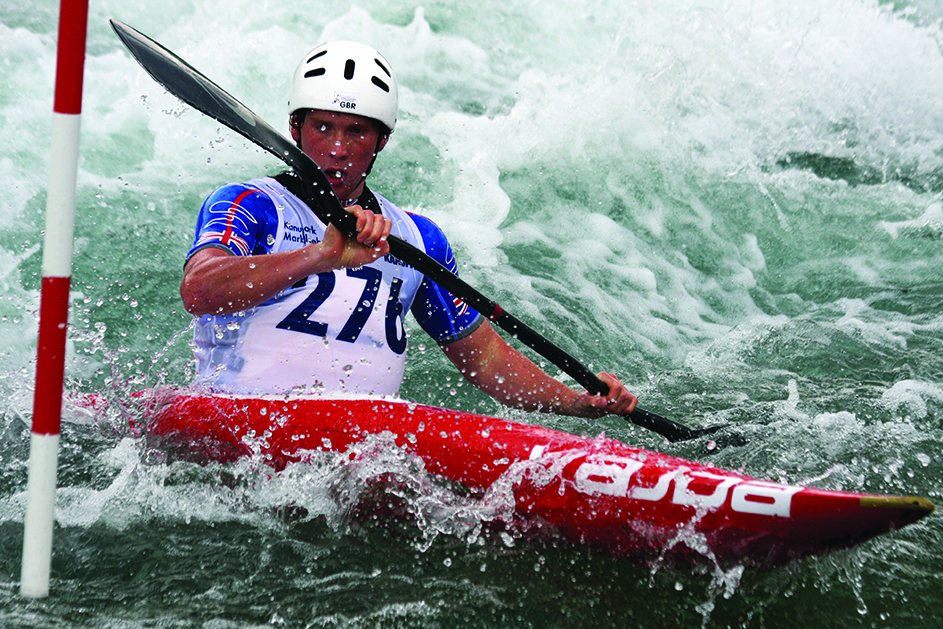
Pioneering research at The University of Nottingham’s Faculty of Engineering could give British athletes the edge as they paddle for gold in the canoe slalom at the Olympics.
The University’s Stuart Morris is boat designer for the GB Slalom team and his recently completed doctorate examines new ways of testing kayak design and performance.
A successful slalom kayak is a compromise between speed, manoeuvrability and stability.
“The difference between gold and silver medal positions in the 2011 Men’s Kayak World Cup race in Bratislava was a mere 0.15 seconds — that’s just 0.17% of the total run time,” said Stu. “Competitions are regularly won and lost by fractions of a second.”
Canoe Slalom takes place on a demanding, highly variable white water course. Athletes paddle against the clock and look to their equipment as a key area when seeking performance gains.
Previously, slalom kayaks evolved slowly through trial and error. There was no methodology for comparative testing or measuring performance as athletes tried different designs.
Stu — supported by UK Sport Research & Innovation and The British Canoe Union — instead developed methods to analyse kayak design against performance.
A series of identical kayaks were manufactured and a succession of changes made to certain areas of their form to highlight the effects on performance. Laser scanning and hydrostatic analysis with 3D computer-aided design was used to define each kayak’s shape.
In three field tests — a flat water sprint, a turning task (for manoeuvrability) and a white water task (for race performance) – athletes defined the boats’ performance. The tests timed and athletes’ perception of their performance was recorded. Boats were also towed to look at drag characteristics, and acceleration and angular velocity were captured using a six-degrees-of-freedom inertial measuring unit, which captures three-dimensional movements.
By analysing the relationship between kayak form and performance, Stu’s work will allow athletes and designers to make more advanced kayaks in less time. Kayaks can now be designed and tested in a scientific, empirical manner giving athletes a clear advantage as they strive for medal-winning performance.
Comments are closed.
Other Research

Welcome to Associate Pro-Vice-Chancellor for Researcher Academy and Research Culture Development
Professor Jeanette Woolard has been appointed as Associate Pro-Vice-Chancellor for the Researcher Academy and Research Culture Development. […]

Strong research funding performance is a fantastic achievement
Professor Tom Rodden’s research update I am delighted to report that the University of Nottingham is […]