

‘CSI’ trail
January 18th, 2013
Finding ways to stop corrosion will save the oil and gas industry billions of dollars every year and help protect the environment against spillages from eroded pipelines across the world.
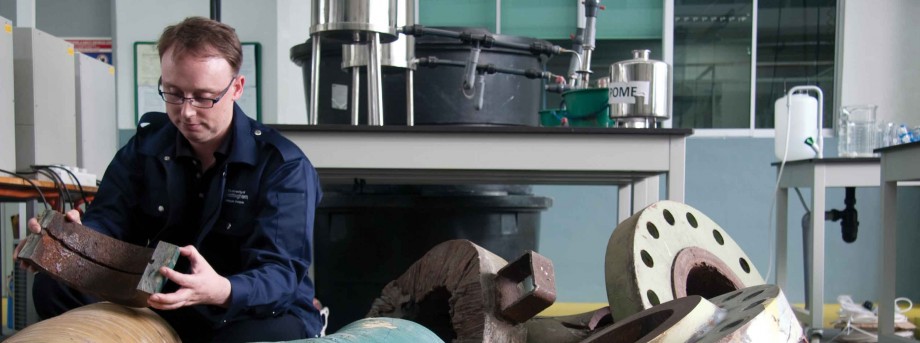
A detective-style research team based at The University of Nottingham Malaysia Campus is working with partners in the oil and gas sector by forensically examining the nature of corrosion.
Dr Andrew Spowage, Director of Studies in the Department of Mechanical, Materials and Manufacturing, said: “It is a little bit like CSI if you like but it isn’t quite as glamorous. We collect samples, put things in bags and bring them back to our labs for analysis.”
Corrosive fluids eat away iron. On pipelines across the world this constant assault can erode the surface of the pipe and its protective layers. The damage can lead to a failure in the mechanical strength and integrity of the pipe. This risks pipe failure and the spillage of oil and gas into the environment.
Dr Spowage and his team are often despatched to oil rigs off the Malaysian coastline to deal with such problems. The ‘CSI’ team collect evidence, establish a cause and make recommendations for remedial action.
Dr Spowage, an expert in characterisation and testing of materials, said: “The damage is not always easy to detect and access can be difficult but we prefer our customers to leave the pipe intact so we can see the real situation. We remove samples from the surface of the pipe, together with samples of the corrosive products. In our laboratories we use advance characterisation techniques to understand more about these samples. By relating this information back to the corrosion processes and production data we try to find out what has been going wrong.
“There is only so much you can do using these techniques so what we also do is try to replicate the conditions in the pipe. If we can replicate the conditions and produce the same type of corrosion products on the surface of the pipe we can offer better advice on how to mitigate the problem and prevent it from happening again.”
Conditions vary in oil and gas fields, but welding standards and materials, and the problems affecting the oil and gas industry, are the same worldwide. In search of a solution, Dr Spowage and his team are also sent samples from oil and gas fields, enabling them to conduct further research to help us understand more about the phenomenon of corrosion.
Tags: Director of Studies in the Department of Mechanical, Dr Andrew Spowage, Materials and Manufacturing
Comments are closed.
Other Research

Welcome to Associate Pro-Vice-Chancellor for Researcher Academy and Research Culture Development
Professor Jeanette Woolard has been appointed as Associate Pro-Vice-Chancellor for the Researcher Academy and Research Culture Development. […]

Strong research funding performance is a fantastic achievement
Professor Tom Rodden’s research update I am delighted to report that the University of Nottingham is […]